Z-Algorithm for Linear-Time String Matching
Master the Z-algorithm for pattern matching in O(n) time. Learn Z-array construction, the Z-box optimization, and applications like finding string periods and distinct substrings.
What you'll learn
- ✓What the Z-array is and how to read it
- ✓The Z-box optimization for linear time construction
- ✓How to use Z-algorithm for exact pattern matching
- ✓Finding the period of a string
- ✓Comparison with KMP and Rabin-Karp
- ✓Complete Python implementation with examples
Prerequisites
- •Basic understanding of strings and arrays
- •Familiar with Big-O Notation
- •Reading Rabin-Karp first gives helpful context
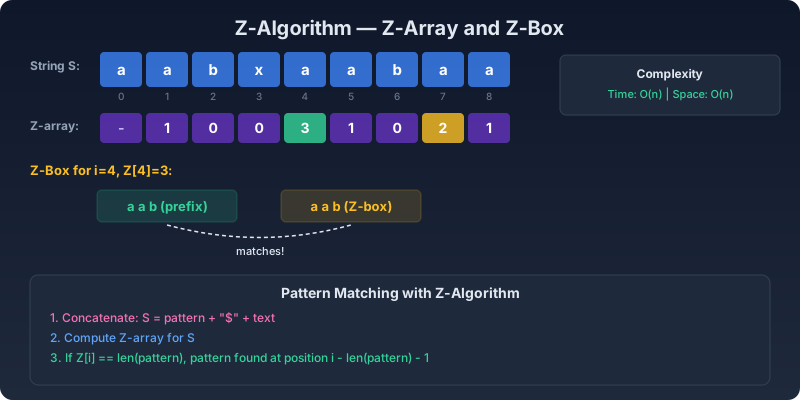
What is the Z-Array?
Given a string S of length n, the Z-array Z[0..n-1] is defined as:
Z[i]= the length of the longest substring starting at positionithat matches a prefix ofS.
By convention, Z[0] is undefined (or set to 0 or n, depending on the implementation) since the entire string trivially matches itself.
Example
For S = "aabxaab":
| i | 0 | 1 | 2 | 3 | 4 | 5 | 6 |
|---|---|---|---|---|---|---|---|
| S | a | a | b | x | a | a | b |
| Z | - | 1 | 0 | 0 | 3 | 1 | 0 |
Z[1] = 1: Starting at index 1, “a” matches the prefix “a” (but “ab” != “aa”).Z[4] = 3: Starting at index 4, “aab” matches the prefix “aab”.Z[2] = 0: Starting at index 2, “b” does not match “a” (the first character of the prefix).
Naive Z-Array Construction (O(n^2))
def z_array_naive(s):
    """Compute Z-array in O(n^2) -- for understanding only."""
    n = len(s)
    z = [0] * n

    for i in range(1, n):
        while i + z[i] < n and s[z[i]] == s[i + z[i]]:
            z[i] += 1

    return z


s = "aabxaab"
print(z_array_naive(s))  # [0, 1, 0, 0, 3, 1, 0]
This is O(n^2) in the worst case (e.g., “aaaaa”).
Linear-Time Z-Algorithm: The Z-Box
The Z-algorithm maintains a Z-box [l, r] which is the rightmost interval [l, l + Z[l] - 1] that has been computed so far and extends the farthest to the right.
The Algorithm
For each position i:
-
Case 1:
i {'>'} r—iis outside the Z-box. ComputeZ[i]from scratch by comparing characters. -
Case 2:
i {'<'}= r—iis inside the Z-box. We know thatS[i..r]matchesS[i-l..r-l]. Letk = i - l. We have two sub-cases:- 2a:
Z[k] {'<'} r - i + 1— The previous match at positionkdoes not reach the end of the Z-box. SoZ[i] = Z[k](we can reuse it directly). - 2b:
Z[k] {'>'}= r - i + 1— The match might extend beyond the Z-box. Start extending fromr + 1.
- 2a:
After computing Z[i], update the Z-box if i + Z[i] - 1 {'>'} r.
Implementation
def z_function(s):
    """Compute Z-array in O(n) using the Z-box optimization."""
    n = len(s)
    if n == 0:
        return []

    z = [0] * n
    z[0] = n  # By convention

    l, r = 0, 0  # Z-box [l, r]

    for i in range(1, n):
        if i < r:
            # Case 2: inside Z-box
            k = i - l
            if z[k] < r - i:
                # Case 2a: stays within Z-box
                z[i] = z[k]
                continue
            else:
                # Case 2b: might extend beyond
                z[i] = r - i

        # Extend from z[i] (either from 0 or from r-i)
        while i + z[i] < n and s[z[i]] == s[i + z[i]]:
            z[i] += 1

        # Update Z-box if this extends further right
        if i + z[i] > r:
            l = i
            r = i + z[i]

    return z


# Test cases
print(z_function("aabxaab"))       # [7, 1, 0, 0, 3, 1, 0]
print(z_function("aaaaa"))         # [5, 4, 3, 2, 1]
print(z_function("aabaab"))        # [6, 1, 0, 3, 1, 0]
print(z_function("abcabcabc"))     # [9, 0, 0, 6, 0, 0, 3, 0, 0]
Why is This O(n)?
Each character comparison either:
- Extends the Z-box to the right (this can happen at most
ntimes total sinceronly increases), or - Reuses a previously computed value without any character comparisons.
So the total number of character comparisons is O(n).
Pattern Matching Using Z-Algorithm
The Trick: Concatenation
To find pattern P in text T:
- Create
S = P + "$" + Twhere$is a character not in P or T. - Compute the Z-array of
S. - For any index
i {'>'} len(P), ifZ[i] == len(P), then the pattern starts at positioni - len(P) - 1inT.
def z_search(text, pattern):
    """Find all occurrences of pattern in text using Z-algorithm."""
    concat = pattern + "$" + text
    z = z_function(concat)

    m = len(pattern)
    results = []

    for i in range(m + 1, len(concat)):
        if z[i] == m:
            results.append(i - m - 1)  # Position in original text

    return results


# Examples
text = "abcabcabc"
pattern = "abc"
print(f"'{pattern}' found at: {z_search(text, pattern)}")
# 'abc' found at: [0, 3, 6]

text2 = "aaaaaaa"
pattern2 = "aaa"
print(f"'{pattern2}' found at: {z_search(text2, pattern2)}")
# 'aaa' found at: [0, 1, 2, 3, 4]

text3 = "hello world hello"
pattern3 = "hello"
print(f"'{pattern3}' found at: {z_search(text3, pattern3)}")
# 'hello' found at: [0, 12]
Application: Finding the Period of a String
A period of string S is the smallest length p such that S is a prefix of some repetition of S[0..p-1].
For example:
"abcabc"has period 3 (“abc” repeated)"aaaa"has period 1 (“a” repeated)"abcde"has period 5 (itself)
def find_period(s):
    """Find the smallest period of string s using Z-function."""
    z = z_function(s)
    n = len(s)

    for p in range(1, n + 1):
        # Check if p is a valid period
        # s is a period p if n % p == 0 (or n - z[n-p] <= p for partial)
        # and Z[p] == n - p
        if p + z[p] == n and n % p == 0:
            return p

    return n  # The whole string is the period


print(find_period("abcabc"))     # 3
print(find_period("aaaa"))       # 1
print(find_period("abcde"))      # 5
print(find_period("abababab"))   # 2
All Periods of a String
def find_all_periods(s):
    """Find all periods of string s."""
    z = z_function(s)
    n = len(s)
    periods = []

    for p in range(1, n):
        # p is a period if s[p..n-1] is a prefix of s
        # i.e., Z[p] >= n - p
        if z[p] == n - p:
            periods.append(p)

    periods.append(n)  # The string itself is always a period
    return periods


print(find_all_periods("abcabc"))    # [3, 6]
print(find_all_periods("aaaa"))      # [1, 2, 4]
print(find_all_periods("ababab"))    # [2, 4, 6]
Application: Number of Distinct Substrings
Count the number of distinct substrings of a string. We add characters one at a time and count new substrings introduced:
def count_distinct_substrings(s):
    """
    Count distinct substrings by adding characters one at a time.
    After adding s[0..i], the new substrings are those ending at i
    that haven't appeared before.
    """
    n = len(s)
    count = 0

    for i in range(n):
        # Consider the string t = s[0..i] reversed
        # The number of new distinct substrings = (i+1) - max(Z values of reversed t)
        t = s[:i + 1][::-1]
        z = z_function(t)

        max_z = 0
        for j in range(1, len(z)):
            max_z = max(max_z, z[j])

        count += (i + 1) - max_z

    return count


print(count_distinct_substrings("abc"))    # 6: a, b, c, ab, bc, abc
print(count_distinct_substrings("aab"))    # 5: a, b, aa, ab, aab
print(count_distinct_substrings("abab"))   # 7: a, b, ab, ba, aba, bab, abab
Application: String Compression
Find the shortest representation of a string as repeated copies:
def compress_string(s):
    """Find shortest repeating unit and count of repetitions."""
    z = z_function(s)
    n = len(s)

    for p in range(1, n + 1):
        if n % p == 0:
            # Check if s is p repeated n/p times
            valid = True
            for i in range(p, n, p):
                if z[i] < min(p, n - i):
                    valid = False
                    break
            if valid:
                return s[:p], n // p

    return s, 1


print(compress_string("abcabcabc"))  # ('abc', 3)
print(compress_string("aaaa"))       # ('a', 4)
print(compress_string("abcd"))       # ('abcd', 1)
print(compress_string("ababab"))     # ('ab', 3)
Z-Algorithm vs KMP
Both Z-algorithm and KMP solve pattern matching in O(n + m) time. Here is how they compare:
| Feature | Z-Algorithm | KMP |
|---|---|---|
| Array computed | Z-array (prefix match lengths) | Failure/pi array (longest proper prefix-suffix) |
| Conceptual clarity | More intuitive | More abstract |
| Pattern matching | Concatenate P$T, check Z[i]==m | Use failure function for transitions |
| Other applications | Periods, distinct substrings, compression | Automaton-based matching |
| Online matching | No (needs concatenation) | Yes (processes text character by character) |
| Implementation | Slightly simpler | Slightly more code |
Relationship Between Z and KMP
The Z-array and KMP failure function encode the same information in different ways. You can convert between them in O(n):
def z_to_kmp(z):
    """Convert Z-array to KMP failure function."""
    n = len(z)
    pi = [0] * n

    for i in range(1, n):
        if z[i] > 0:
            for j in range(z[i] - 1, -1, -1):
                if pi[i + j] > 0:
                    break
                pi[i + j] = j + 1

    return pi

def kmp_to_z(pi):
    """Convert KMP failure function to Z-array."""
    n = len(pi)
    z = [0] * n
    z[0] = n

    for i in range(1, n):
        if pi[i] > 0:
            z[i - pi[i] + 1] = max(z[i - pi[i] + 1], pi[i])

    # Extend Z values
    for i in range(1, n):
        if z[i] > 0:
            for j in range(1, z[i]):
                if i + j < n:
                    z[i + j] = max(z[i + j], z[i] - j)

    return z
Complexity Analysis
| Operation | Time | Space |
|---|---|---|
| Z-array construction | O(n) | O(n) |
| Pattern matching | O(n + m) | O(n + m) |
| Find period | O(n) | O(n) |
| All periods | O(n) | O(n) |
The Z-algorithm is optimal for single pattern matching — you cannot do better than O(n + m) since you must read both the text and pattern.
Implementation Tips
Handling the Sentinel Character
The $ separator must not appear in either the pattern or text. Common choices:
$for lowercase-only strings\x00(null byte) for general ASCII- Use the length check instead: during Z-array computation on
P$T, capZ[i]atlen(P).
def z_search_no_sentinel(text, pattern):
    """Pattern matching without using a sentinel character."""
    m = len(pattern)
    n = len(text)

    concat = pattern + text
    z = z_function(concat)

    results = []
    for i in range(m, len(concat)):
        # Z[i] might be > m because there's no separator,
        # but we only care if it's >= m
        if z[i] >= m:
            results.append(i - m)

    return results
Practice Problems
- Find Pattern (Basic) — Direct Z-algorithm pattern matching.
- Shortest Palindrome (LeetCode 214) — Reverse + concatenation + Z-algorithm.
- Repeated Substring Pattern (LeetCode 459) — Check if the string has a period < n.
- Longest Happy Prefix (LeetCode 1392) — Find the longest prefix that is also a suffix.
- Number of Distinct Substrings — Add characters one by one, use Z to count new substrings.
- String Period Queries — Precompute Z-array and answer period queries.
Key Takeaways
- The Z-array captures how much of each suffix matches the prefix of the string.
- The Z-box optimization ensures linear time by reusing previously computed information.
- Pattern matching works by concatenating
P$Tand checking whereZ[i] == len(P). - Z-algorithm is equivalent in power to KMP but often more intuitive to implement and understand.
- Beyond pattern matching, Z-arrays solve period detection, string compression, and substring counting problems.
Related articles
- DSA Minimum Remove to Make Valid Parentheses — Stack Solution
Solve LeetCode 1249 Minimum Remove to Make Valid Parentheses using a stack. Two-pass and one-pass approaches with Python code and traces.
- DSA Simplify Unix Path Using a Stack — LeetCode 71 Solution
Solve Simplify Path LeetCode 71 with a stack. Handle ., .., multiple slashes, and edge cases. Python solution with step-by-step trace.
- DSA Anagram Problems: Patterns and Solutions
Master anagram problems — valid anagram checks, grouping anagrams by sorted and frequency keys, finding all anagrams in a string with sliding windows, and the minimum window substring problem.
- DSA String Encoding and Decoding Patterns
Master string encoding and decoding — delimiter-based encode/decode, run-length encoding, decoding nested bracket strings with stacks, string compression, and serialization patterns.