Tag Validator — Stack-Based XML Parsing (LeetCode 591)
Tag Validator solved with stack-based HTML/XML tag matching and CDATA parsing. Python solution with edge cases, step-by-step trace, and complexity analysis.
What you'll learn
- ✓How to validate nested XML/HTML tags using a stack
- ✓Parsing CDATA sections correctly
- ✓Handling tag name rules (1-9 uppercase letters)
- ✓Complete Python solution with all edge cases
- ✓Why this pattern appears in compiler and parser design
Prerequisites
- •Stack basics — see Stacks Intro
- •String manipulation — see Strings Intro
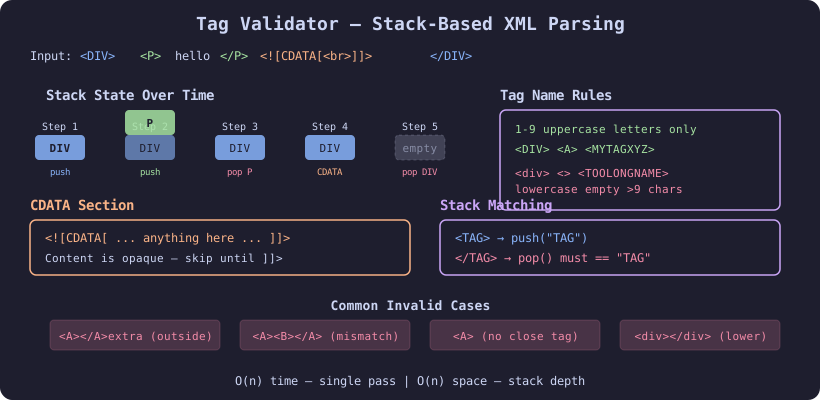
Tag Validator (LeetCode 591) asks you to validate whether a string represents valid XML-like code. This is a hard problem that tests your ability to carefully parse structured text using a stack — the same concept behind real XML parsers and compilers.
The Problem
A valid string must satisfy these rules:
- Closed tags: Every
<TAG_NAME>must have a matching</TAG_NAME> - Tag names: 1-9 uppercase English letters only
- Content: Everything between matching tags is valid content (including other tags)
- CDATA:
<![CDATA[content]]>sections can contain anything, including unmatched tags - Wrapping: The entire string must be wrapped in a single valid tag
Valid:   "<DIV>content</DIV>"
Valid:   "<DIV><P>text</P></DIV>"
Valid:   "<DIV><![CDATA[<br>]]></DIV>"
Invalid: "<DIV>"                    (no closing tag)
Invalid: "<div></div>"             (lowercase)
Invalid: "<TOOLONGTAGNAME></TOOLONGTAGNAME>"  (>9 chars)
Approach: Stack + Careful Parsing
We iterate through the string character by character, using a stack to track open tags:
- When we see
<![CDATA[, skip until we find]]> - When we see
</, extract the tag name and match against the stack top - When we see
<, extract the tag name and push onto the stack - Track whether we have ever had a valid wrapping tag
def isValid(code: str) -> bool:
    """
    Validate XML-like code using a stack.
    Time: O(n), Space: O(n) for the stack
    """
    stack = []
    i = 0
    n = len(code)

    # The entire code must be wrapped in a valid tag
    if not code.startswith("<"):
        return False

    while i < n:
        # We finished processing but stack had tags that closed
        # and there is remaining content outside
        if not stack and i > 0:
            return False

        # Check for CDATA
        if code[i:i+9] == "<![CDATA[":
            # CDATA only valid inside a tag
            if not stack:
                return False
            j = code.find("]]>", i + 9)
            if j == -1:
                return False
            i = j + 3

        # Check for closing tag
        elif code[i:i+2] == "</":
            j = code.find(">", i + 2)
            if j == -1:
                return False
            tag_name = code[i+2:j]
            if not is_valid_tag(tag_name):
                return False
            if not stack or stack[-1] != tag_name:
                return False
            stack.pop()
            i = j + 1

        # Check for opening tag
        elif code[i] == "<":
            j = code.find(">", i + 1)
            if j == -1:
                return False
            tag_name = code[i+1:j]
            if not is_valid_tag(tag_name):
                return False
            stack.append(tag_name)
            i = j + 1

        else:
            # Regular content character
            i += 1

    return len(stack) == 0


def is_valid_tag(tag: str) -> bool:
    """Check if tag name is 1-9 uppercase letters."""
    if not tag or len(tag) > 9:
        return False
    return all(c.isupper() for c in tag)
Step-by-Step Trace
Input: "<DIV><P>hello</P><![CDATA[<br>]]></DIV>"

i=0:  "<DIV>"  → open tag "DIV" → push → stack = ["DIV"]
i=5:  "<P>"    → open tag "P"   → push → stack = ["DIV", "P"]
i=8:  "hello"  → content, skip to next '<'
i=13: "</P>"   → close tag "P"  → matches stack top → pop → stack = ["DIV"]
i=17: "<![CDATA[<br>]]>" → CDATA section, skip to after "]]>"
i=33: "</DIV>" → close tag "DIV" → matches stack top → pop → stack = []
i=39: end of string, stack empty → VALID
Tricky Edge Cases
# Empty tag name
assert isValid("<></>") == False

# Tag name too long (>9 chars)
assert isValid("<ABCDEFGHIJ></ABCDEFGHIJ>") == False

# Lowercase tags
assert isValid("<div></div>") == False

# Content outside root tag
assert isValid("<A></A>extra") == False

# CDATA outside any tag
assert isValid("<![CDATA[content]]>") == False

# Nested CDATA-like text inside CDATA (only first ]]> matters)
assert isValid("<A><![CDATA[]]>]]></A>") == False
# Because ]]> at position 15 closes the CDATA, leaving "]]></A>"
# which means "]]>" is content, then </A> closes properly

# Multiple root tags
assert isValid("<A></A><B></B>") == False

# Properly nested
assert isValid("<A><B><C></C></B></A>") == True
Why the “Stack Empty But Not Done” Check Matters
# Without the check: "<A></A><B></B>" would be accepted
# The check "if not stack and i > 0: return False" ensures
# that once the root tag closes, no more content follows.
This is critical: XML requires a single root element. After the root closes, nothing else should remain.
The Parsing State Machine
The parser essentially has three modes:
| State | Trigger | Action |
|---|---|---|
| Normal | Regular character | Skip (content) |
| Open tag | < followed by uppercase | Push tag name |
| Close tag | </ | Pop and match |
| CDATA | <![CDATA[ | Skip until ]]> |
Complexity Analysis
| Metric | Value |
|---|---|
| Time | O(n) — single pass through the string |
| Space | O(n) — stack depth equals nesting depth |
The find() calls do not add extra complexity because they advance i to the found position, so each character is processed at most twice.
When to Use This Pattern
Use stack-based tag matching when:
- Parsing nested or balanced structures (HTML, XML, JSON brackets)
- The problem involves matching open/close delimiters with rules
- You need to handle escape sequences or special blocks (like CDATA)
- Building a tokenizer or parser for structured text
This exact pattern powers real-world XML validators, HTML sanitizers, and bracket-matching in IDEs.
Common Mistakes
- Not validating tag names — must be 1-9 uppercase letters only
- Allowing content outside root tag — the entire string must be inside one tag pair
- Not handling CDATA correctly — must find the matching
]]>, not parse inside - Off-by-one errors when extracting substrings between
<and> - Forgetting that CDATA must be inside a tag — cannot appear at the top level
Related Problems
| Problem | Key Difference |
|---|---|
| Valid Parentheses (LC 20) | Simpler — just brackets, no names |
| Exclusive Time of Functions (LC 636) | Stack for function call parsing |
| Basic Calculator (LC 224) | Stack for expression parsing |
| HTML Entity Parser (LC 1410) | String replacement, not validation |
| Decode String (LC 394) | Stack for nested encoded strings |
Key Takeaways
- Tag validation is a parsing problem perfectly suited for a stack
- The stack tracks open tags; closing tags must match in LIFO order
- CDATA sections are opaque blocks — skip everything inside them
- Always validate tag names and enforce single-root-element rules
- This pattern directly transfers to building real parsers and compilers
Related articles
- DSA 132 Pattern — Monotonic Stack with Reverse Traversal (LeetCode 456)
Solve the 132 Pattern problem using a monotonic stack scanning right to left. Python solution tracking s3 candidates and s2 maximum, with detailed trace.
- DSA Basic Calculator I, II, III — Complete Expression Evaluation Guide
Solve Basic Calculator problems LeetCode 224, 227, and 772. Master stack-based expression evaluation with +, -, *, /, and parentheses in Python.
- DSA Largest Rectangle in Histogram Using Stack
Find the largest rectangle in a histogram using a monotonic stack in O(n). Detailed walkthrough, Python code, visual trace, and common pitfalls.
- DSA Minimum Remove to Make Valid Parentheses — Stack Solution
Solve LeetCode 1249 Minimum Remove to Make Valid Parentheses using a stack. Two-pass and one-pass approaches with Python code and traces.