The Celebrity Problem Using Stack-Based Elimination
Solve the celebrity problem in O(n) time using a stack elimination technique. Includes proof of correctness, Python code, and matrix examples.
What you'll learn
- ✓What the celebrity problem is and its graph interpretation
- ✓Brute force O(n²) approach
- ✓Stack-based elimination in O(n) comparisons
- ✓Two-pointer alternative approach
Prerequisites
- •Stack basics — see Stacks & Queues Intro
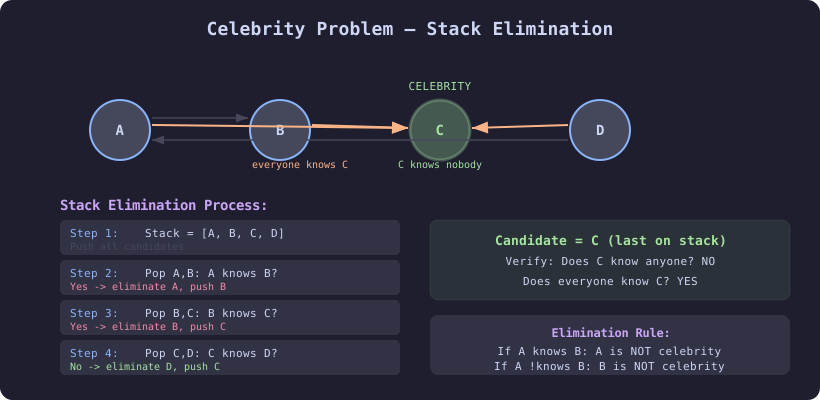
A celebrity is a person who is known by everyone but knows nobody. Given n people at a party, find the celebrity (if one exists) using the minimum number of questions.
Problem Definition
You have an n×n matrix knows[i][j] where knows[i][j] = 1 means person i knows person j. A celebrity:
- Is known by all other n-1 people
- Knows nobody
    0  1  2  3
0 [ 0, 0, 1, 0 ]
1 [ 0, 0, 1, 0 ]
2 [ 0, 0, 0, 0 ]  ← Celebrity (column all 1s except self, row all 0s)
3 [ 0, 0, 1, 0 ]
Brute Force — O(n²)
Check each person: verify their row is all 0s and their column is all 1s.
def find_celebrity_brute(knows, n):
    """Time: O(n²), Space: O(1)"""
    for candidate in range(n):
        is_celebrity = True
        for other in range(n):
            if candidate == other:
                continue
            if knows(candidate, other) or not knows(other, candidate):
                is_celebrity = False
                break
        if is_celebrity:
            return candidate
    return -1
Stack-Based Elimination — O(n)
The key insight: each knows(a, b) call eliminates one person.
- If
knows(a, b)is True → a is NOT the celebrity (celebrities know nobody) - If
knows(a, b)is False → b is NOT the celebrity (everyone knows the celebrity)
Algorithm
- Push all people onto a stack
- Pop two, ask if one knows the other, eliminate one, push survivor back
- After n-1 rounds, one candidate remains
- Verify the candidate
def find_celebrity(knows, n):
    """
    Find celebrity using stack elimination.
    Time: O(n), Space: O(n)
    """
    stack = list(range(n))

    # Elimination phase: n-1 comparisons
    while len(stack) > 1:
        a = stack.pop()
        b = stack.pop()

        if knows(a, b):
            stack.append(b)  # a knows b, so a is not celebrity
        else:
            stack.append(a)  # a doesn't know b, so b is not celebrity

    candidate = stack[0]

    # Verification phase: 2(n-1) checks
    for i in range(n):
        if i == candidate:
            continue
        if knows(candidate, i) or not knows(i, candidate):
            return -1

    return candidate
Trace
People: 0, 1, 2, 3. Person 2 is the celebrity.
Stack: [0, 1, 2, 3]

Round 1: pop 3, 2 → knows(3,2)=True → 3 eliminated → push 2
  Stack: [0, 1, 2]

Round 2: pop 2, 1 → knows(2,1)=False → 1 eliminated → push 2
  Stack: [0, 2]

Round 3: pop 2, 0 → knows(2,0)=False → 0 eliminated → push 2
  Stack: [2]

Candidate: 2
Verify: row 2 is all 0s ✓, column 2 is all 1s ✓
Answer: 2
Two-Pointer Alternative
The same elimination logic works with two pointers — no stack needed:
def find_celebrity_two_pointer(knows, n):
    """Time: O(n), Space: O(1)"""
    left, right = 0, n - 1

    while left < right:
        if knows(left, right):
            left += 1
        else:
            right -= 1

    candidate = left

    for i in range(n):
        if i == candidate:
            continue
        if knows(candidate, i) or not knows(i, candidate):
            return -1

    return candidate
Proof of Correctness
Claim: The celebrity (if it exists) is never eliminated.
Proof: Suppose person C is the celebrity. When C is compared with any person X:
knows(C, X)= False (C knows nobody), so X gets eliminated, C survivesknows(X, C)= True (everyone knows C), so X gets eliminated, C survives
In either case, C survives. After n-1 eliminations, C must be the last one standing.
Complexity
| Phase | Calls to knows() |
|---|---|
| Elimination | n - 1 |
| Verification | 2(n - 1) |
| Total | 3(n - 1) = O(n) |
Edge Cases
- No celebrity exists — verification phase catches this, returns -1
- n = 1 — the single person is trivially a celebrity
- Multiple people know nobody — at most one can be known by everyone
When to Use This Pattern
The elimination technique applies whenever you can discard one of two candidates per comparison. It appears in:
- Tournament-style algorithms
- Finding majority elements
- Voting algorithms (Boyer-Moore)
Related Problems
- Find the Town Judge (LeetCode 997) — graph degree version
- Majority Element (LeetCode 169) — Boyer-Moore voting
- Find the Winner of Circular Game (LeetCode 1823)
Related articles
- DSA Implement Stack Using Two Queues — Two Approaches Explained
Implement a stack using two queues with costly push and costly pop approaches. Complete Python solutions with complexity analysis.
- DSA Asteroid Collision Problem Using Stacks
Solve the asteroid collision problem (LeetCode 735) using a stack. Covers collision rules, Python implementation, and all edge cases.
- DSA Car Fleet Problem — Stack-Based Arrival Time Solution
Solve LeetCode 853 Car Fleet using a stack. Sort by position, compare arrival times, and count fleets. Python solution with visual trace.
- DSA Decode String (LeetCode 394) — Nested Bracket Decoding
Decode nested encoded strings like '3[a2[c]]' using a stack. Complete walkthrough with Python solution, traces, and edge cases.