Trapping Rain Water Using Stack — Step-by-Step Stack Approach Explained
Solve Trapping Rain Water (LeetCode 42) using a stack-based approach. Python code with detailed trace, comparison with two-pointer, and complexity analysis.
What you'll learn
- ✓How stacks solve Trapping Rain Water by finding bounded basins
- ✓Complete Python implementation with line-by-line trace
- ✓How the stack approach compares to two-pointer and prefix-max
- ✓When the stack approach is the right choice
Prerequisites
- •Stack basics — see Stacks Intro
- •Monotonic stacks — see Next Greater Element
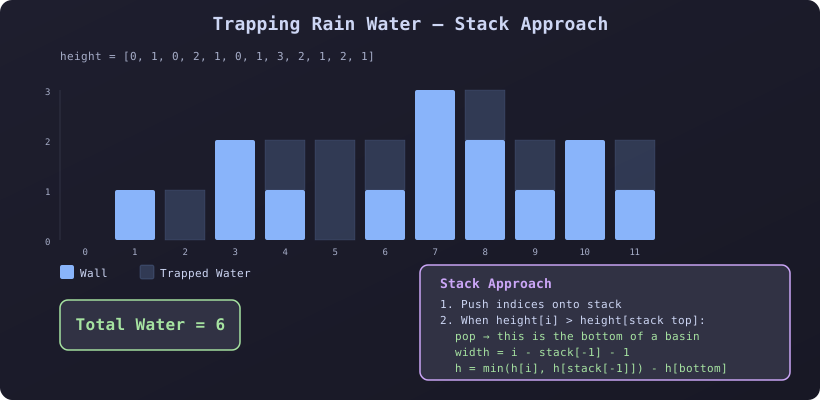
Trapping Rain Water (LeetCode 42) is a classic hard problem. Most tutorials teach the two-pointer or prefix-max solution. Here we focus on the stack-based approach, which processes water layer by layer instead of column by column.
The Problem
Given n non-negative integers representing an elevation map where each bar has width 1, compute how much water can be trapped after raining.
Input:  [0, 1, 0, 2, 1, 0, 1, 3, 2, 1, 2, 1]
Output: 6
Three Approaches Overview
| Approach | Time | Space | Style |
|---|---|---|---|
| Prefix max arrays | O(n) | O(n) | Column by column |
| Two pointers | O(n) | O(1) | Column by column |
| Stack | O(n) | O(n) | Layer by layer |
All three are O(n) time. The stack approach is unique because it calculates water in horizontal layers bounded by walls, not vertical columns.
The Stack Intuition
Imagine scanning left to right. Whenever you find a bar taller than the previous one, there might be a basin between the current bar and some earlier tall bar. The stack keeps track of bars that could form the left wall of a basin.
- Push bar indices onto a monotonic decreasing stack
- When the current bar is taller than the stack top, that top is the bottom of a basin
- The new stack top (after pop) is the left wall
- The current bar is the right wall
- Calculate the water trapped in that horizontal strip
Python Implementation
def trap(height):
    """
    Stack-based trapping rain water.
    Time: O(n) — each index pushed/popped at most once.
    Space: O(n) — for the stack.
    """
    stack = []  # monotonic decreasing stack of indices
    water = 0

    for i in range(len(height)):
        # While current bar is taller than stack top
        while stack and height[i] > height[stack[-1]]:
            bottom = stack.pop()

            if not stack:
                break  # no left wall

            left = stack[-1]
            # Width between left wall and current bar
            width = i - left - 1
            # Height is bounded by shorter wall minus the bottom
            h = min(height[i], height[left]) - height[bottom]
            water += width * h

        stack.append(i)

    return water
Detailed Trace
Let us trace through height = [0, 1, 0, 2, 1, 0, 1, 3, 2, 1, 2, 1]:
i=0, h=0: stack=[]       → push 0              stack=[0]
i=1, h=1: h[0]=0 < 1    → pop 0 (bottom=0)
           stack empty    → break
           push 1                               stack=[1]
i=2, h=0: h[1]=1 > 0    → no pop, push 2       stack=[1,2]
i=3, h=2: h[2]=0 < 2    → pop 2 (bottom=0)
           left=1, w=3-1-1=1, h=min(2,1)-0=1   → water += 1  (total=1)
           h[1]=1 < 2    → pop 1 (bottom=1)
           stack empty    → break
           push 3                               stack=[3]
i=4, h=1: h[3]=2 > 1    → no pop, push 4       stack=[3,4]
i=5, h=0: h[4]=1 > 0    → no pop, push 5       stack=[3,4,5]
i=6, h=1: h[5]=0 < 1    → pop 5 (bottom=0)
           left=4, w=6-4-1=1, h=min(1,1)-0=1   → water += 1  (total=2)
           h[4]=1 = 1    → no pop, push 6       stack=[3,4,6]
i=7, h=3: h[6]=1 < 3    → pop 6 (bottom=1)
           left=4, w=7-4-1=2, h=min(3,1)-1=0   → water += 0
           h[4]=1 < 3    → pop 4 (bottom=1)
           left=3, w=7-3-1=3, h=min(3,2)-1=1   → water += 3  (total=5)
           h[3]=2 < 3    → pop 3 (bottom=2)
           stack empty    → break
           push 7                               stack=[7]
i=8, h=2: h[7]=3 > 2    → no pop, push 8       stack=[7,8]
i=9, h=1: no pop, push 9                        stack=[7,8,9]
i=10,h=2: h[9]=1 < 2    → pop 9 (bottom=1)
           left=8, w=10-8-1=1, h=min(2,2)-1=1  → water += 1  (total=6)
           h[8]=2 = 2    → no pop, push 10      stack=[7,8,10]
i=11,h=1: no pop, push 11                       stack=[7,8,10,11]

Final answer: 6 ✓
Comparison with Two-Pointer
def trap_two_pointer(height):
    """Two-pointer approach for comparison. O(n) time, O(1) space."""
    left, right = 0, len(height) - 1
    left_max, right_max = 0, 0
    water = 0

    while left < right:
        if height[left] < height[right]:
            if height[left] >= left_max:
                left_max = height[left]
            else:
                water += left_max - height[left]
            left += 1
        else:
            if height[right] >= right_max:
                right_max = height[right]
            else:
                water += right_max - height[right]
            right -= 1

    return water
When to prefer the stack approach:
- You need to identify each bounded region (not just the total volume)
- The problem is a 2D variant where you process layers
- You are already using a stack for related work (e.g., largest rectangle)
When to prefer two-pointer:
- You only need the total volume
- You want O(1) space
Edge Cases
- Empty or single bar —
[]or[5]→ 0 - Flat surface —
[3, 3, 3]→ 0 (no basin) - Ascending —
[1, 2, 3]→ 0 (water runs off right) - Descending —
[3, 2, 1]→ 0 (water runs off left) - V shape —
[3, 0, 3]→ 3 - All zeros —
[0, 0, 0]→ 0
Complexity Analysis
| Metric | Value |
|---|---|
| Time | O(n) — each index pushed and popped at most once |
| Space | O(n) — stack can hold up to n indices |
When to Use This Pattern
The stack-based rain water approach is useful when:
- You are solving a bounded region problem on a 1D elevation map
- You want to decompose trapped water into horizontal strips
- You need to extend the solution to report where water is trapped
- Interview asks for “solve with a stack” specifically
Related Problems
| Problem | Difficulty | Key Idea |
|---|---|---|
| LeetCode 42 — Trapping Rain Water | Hard | This problem |
| LeetCode 84 — Largest Rectangle in Histogram | Hard | Similar stack pattern |
| LeetCode 407 — Trapping Rain Water II | Hard | 3D version with priority queue |
| LeetCode 11 — Container With Most Water | Medium | Two-pointer on walls |
Key Takeaway
The stack approach to Trapping Rain Water processes water horizontally — it finds basins formed between walls and computes water layer by layer. While the two-pointer approach is more space-efficient, the stack approach gives you deeper insight into bounded-region problems and is the foundation for harder variants.
Related articles
- DSA 132 Pattern — Monotonic Stack with Reverse Traversal (LeetCode 456)
Solve the 132 Pattern problem using a monotonic stack scanning right to left. Python solution tracking s3 candidates and s2 maximum, with detailed trace.
- DSA Basic Calculator I, II, III — Complete Expression Evaluation Guide
Solve Basic Calculator problems LeetCode 224, 227, and 772. Master stack-based expression evaluation with +, -, *, /, and parentheses in Python.
- DSA Largest Rectangle in Histogram Using Stack
Find the largest rectangle in a histogram using a monotonic stack in O(n). Detailed walkthrough, Python code, visual trace, and common pitfalls.
- DSA Maximal Rectangle in Binary Matrix
Find the maximal rectangle containing only 1s in a binary matrix. Builds on the largest rectangle in histogram technique with detailed explanation.