Word Ladder BFS Approach — Shortest Transformation Sequence
Word Ladder solved with BFS and pattern matching optimization. Step-by-step Python solution for LeetCode 127 with complexity analysis and interview tips.
What you'll learn
- ✓How to model word transformations as a graph problem
- ✓BFS approach for shortest transformation sequence
- ✓Wildcard pattern optimization to avoid O(n^2) neighbor checks
- ✓Bidirectional BFS for further optimization
- ✓Time and space complexity analysis
Prerequisites
- •BFS basics — see Queues Intro
- •Hash maps — see Hash Maps Intro
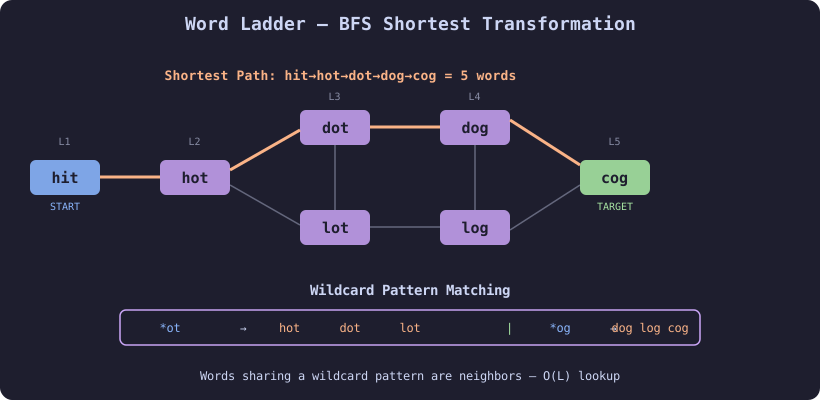
Word Ladder (LeetCode 127) is one of the most classic BFS problems. Given a start word, an end word, and a dictionary, find the length of the shortest transformation sequence where each step changes exactly one letter.
The Problem
Input:  beginWord = "hit", endWord = "cog"
        wordList = ["hot","dot","dog","lot","log","cog"]
Output: 5

Transformation: "hit" → "hot" → "dot" → "dog" → "cog"
Rules:
- Each transformation changes exactly one letter
- Every intermediate word must exist in
wordList - Return the number of words in the shortest sequence (including start and end)
Modeling as a Graph
Each word is a node. Two words are connected by an edge if they differ by exactly one letter. The problem becomes: find the shortest path from beginWord to endWord in this implicit graph.
Naive BFS: O(n x L) Neighbor Check
For each word, we could compare it against all other words in the list — but that is O(n^2 x L) total.
def are_neighbors(w1, w2):
    """Check if two words differ by exactly one letter. O(L)"""
    diff = 0
    for c1, c2 in zip(w1, w2):
        if c1 != c2:
            diff += 1
        if diff > 1:
            return False
    return diff == 1
Optimized BFS: Wildcard Pattern Matching
Instead of comparing every pair, we preprocess a map: for each word, generate its wildcard patterns by replacing one letter at a time with *.
"hot" → ["*ot", "h*t", "ho*"]
"dot" → ["*ot", "d*t", "do*"]
Words sharing a pattern (like "*ot") are neighbors. This lets us find neighbors in O(L) per word instead of O(n).
from collections import deque, defaultdict

def ladderLength(beginWord, endWord, wordList):
    """
    BFS with wildcard pattern optimization.
    Time: O(n * L^2) where n = word count, L = word length
    Space: O(n * L)
    """
    word_set = set(wordList)
    if endWord not in word_set:
        return 0

    # Build pattern → words map
    L = len(beginWord)
    pattern_map = defaultdict(list)

    for word in word_set:
        for i in range(L):
            pattern = word[:i] + "*" + word[i+1:]
            pattern_map[pattern].append(word)

    # BFS
    queue = deque([(beginWord, 1)])
    visited = {beginWord}

    while queue:
        word, length = queue.popleft()

        for i in range(L):
            pattern = word[:i] + "*" + word[i+1:]

            for neighbor in pattern_map[pattern]:
                if neighbor == endWord:
                    return length + 1

                if neighbor not in visited:
                    visited.add(neighbor)
                    queue.append((neighbor, length + 1))

            # Clear to avoid revisiting (optional optimization)
            pattern_map[pattern] = []

    return 0
Step-by-Step Trace
beginWord = "hit", endWord = "cog"
wordList = ["hot","dot","dog","lot","log","cog"]

Pattern map (partial):
  "*ot" → ["hot", "dot", "lot"]
  "h*t" → ["hot"]
  "ho*" → ["hot"]
  "d*t" → ["dot"]
  "do*" → ["dot", "dog"]
  ...

BFS:
  Level 1: "hit" (length=1)
    Patterns: "*it", "h*t", "hi*"
    "*it" → no matches
    "h*t" → "hot" → enqueue ("hot", 2)
    "hi*" → no matches

  Level 2: "hot" (length=2)
    "*ot" → "dot", "lot" → enqueue both (length=3)
    "ho*" → no new matches

  Level 3: "dot" (length=3), "lot" (length=3)
    "do*" → "dog" → enqueue ("dog", 4)
    "lo*" → "log" → enqueue ("log", 4)

  Level 4: "dog" (length=4)
    "*og" → "dog", "log", "cog"
    "cog" == endWord → return 4 + 1 = 5
Alternative: Letter Substitution Without Preprocessing
If you prefer not building the pattern map upfront:
def ladderLength_substitute(beginWord, endWord, wordList):
    """Try all 26 substitutions per position. O(n * L * 26)."""
    word_set = set(wordList)
    if endWord not in word_set:
        return 0

    queue = deque([(beginWord, 1)])
    visited = {beginWord}

    while queue:
        word, length = queue.popleft()

        for i in range(len(word)):
            for c in 'abcdefghijklmnopqrstuvwxyz':
                new_word = word[:i] + c + word[i+1:]

                if new_word == endWord:
                    return length + 1

                if new_word in word_set and new_word not in visited:
                    visited.add(new_word)
                    queue.append((new_word, length + 1))

    return 0
This approach is simpler and works well when L is small.
Bidirectional BFS
For large word lists, bidirectional BFS expands from both beginWord and endWord, meeting in the middle:
def ladderLength_bidir(beginWord, endWord, wordList):
    """Bidirectional BFS — much faster for large word lists."""
    word_set = set(wordList)
    if endWord not in word_set:
        return 0

    front = {beginWord}
    back = {endWord}
    visited = {beginWord, endWord}
    length = 1

    while front and back:
        # Expand the smaller frontier
        if len(front) > len(back):
            front, back = back, front

        next_front = set()
        for word in front:
            for i in range(len(word)):
                for c in 'abcdefghijklmnopqrstuvwxyz':
                    new_word = word[:i] + c + word[i+1:]

                    if new_word in back:
                        return length + 1

                    if new_word in word_set and new_word not in visited:
                        visited.add(new_word)
                        next_front.add(new_word)

        front = next_front
        length += 1

    return 0
Complexity Analysis
| Approach | Time | Space |
|---|---|---|
| Naive BFS | O(n^2 x L) | O(n) |
| Pattern map BFS | O(n x L^2) | O(n x L) |
| Letter substitution | O(n x L x 26) | O(n) |
| Bidirectional BFS | O(n x L x 26 / 2) avg | O(n) |
Where n = number of words, L = word length.
Edge Cases
# End word not in word list
assert ladderLength("hit", "cog", ["hot","dot","dog"]) == 0

# Begin word equals end word
# (LeetCode guarantees they differ, but good to handle)

# No valid transformation path
assert ladderLength("hit", "cog", ["hot","dot","dog","lot","log"]) == 0

# Direct neighbor
assert ladderLength("hot", "dot", ["dot"]) == 2
When to Use This Pattern
Use BFS on word/string transformation when:
- Each step is a single character change
- You need the shortest sequence of transformations
- The valid words form a dictionary / set to check membership
- The state space (word length and dictionary size) is manageable
Related Problems
| Problem | Key Difference |
|---|---|
| Word Ladder II (LC 126) | Find all shortest paths (harder) |
| Open the Lock (LC 752) | Digits instead of letters, deadends |
| Minimum Genetic Mutation (LC 433) | 4-character alphabet (ACGT) |
| Edit Distance (LC 72) | DP, allows insert/delete/replace |
Key Takeaways
- Word Ladder is a shortest-path problem on an implicit graph
- The wildcard pattern map turns O(n) neighbor lookup into O(L)
- Bidirectional BFS can halve the search space in practice
- Always check if
endWordis in the word list before starting BFS - This pattern applies to any “minimum steps to transform X into Y” problem
Related articles
- DSA Open the Lock — BFS on State Space (LeetCode 752)
Open the Lock problem solved with BFS on 4-digit state space. Python solution with deadend handling, bidirectional BFS optimization, and complexity analysis.
- DSA Deque Design Patterns — Sliding Window, Palindrome, Work Stealing
Master deque design patterns including sliding window maximum, palindrome checking, work stealing, and BFS/DFS hybrid. Python implementations.
- DSA Design Front Middle Back Queue — Two Deques (LeetCode 1670)
Design Front Middle Back Queue using two balanced deques. Python solution with O(1) operations, step-by-step trace, and complexity analysis for LeetCode 1670.
- DSA Sliding Window Maximum Using Deque
Solve the sliding window maximum problem in O(n) using a monotonic deque. Covers the algorithm, Python code, visual traces, and variations.