Linked List Palindrome Check: Three Approaches
Learn three ways to check if a linked list is a palindrome — stack-based O(n) space, reverse-second-half O(1) space, and recursive. Step-by-step walkthroughs with Python code and Big-O analysis.
What you'll learn
- ✓Three distinct approaches to the linked list palindrome problem
- ✓Using a stack for an O(n) space solution
- ✓The two-pointer + reverse technique for O(1) space
- ✓A recursive approach that leverages the call stack
- ✓Big-O trade-offs between each method
Prerequisites
- •Linked list basics — traversal, insertion, deletion
- •Understanding of stacks and recursion
- •Familiarity with Big-O notation — see Big-O Notation
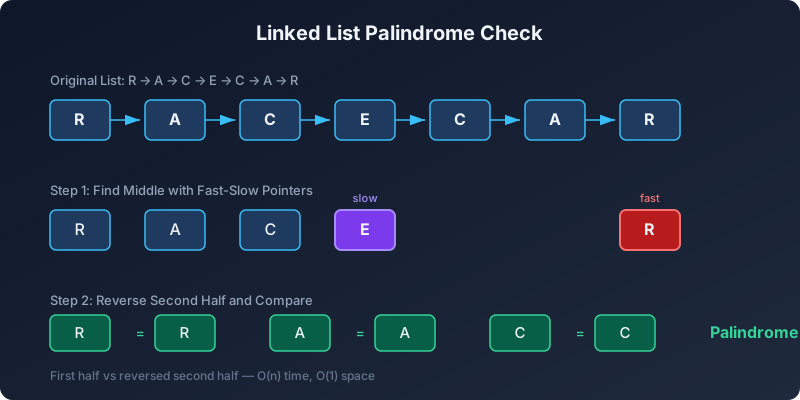
A palindrome reads the same forwards and backwards. The string "racecar" is a palindrome. Checking this with a string or array is trivial — compare s[i] with s[n-1-i]. But a singly linked list has no backward traversal and no random access. That constraint forces us to think differently.
In this article we’ll build three solutions, each teaching a different technique that shows up repeatedly in linked list problems.
Problem statement
Given the
headof a singly linked list, returnTrueif the list is a palindrome,Falseotherwise.LeetCode 234 — Palindrome Linked List
Examples:
1 -> 2 -> 2 -> 1        =>  True
1 -> 2 -> 3 -> 2 -> 1   =>  True
1 -> 2 -> 3             =>  False
1                        =>  True  (single node)
None                     =>  True  (empty list)
Node definition
Every solution below uses the same node class:
class ListNode:
    def __init__(self, val=0, next=None):
        self.val = val
        self.next = next
Approach 1: Stack-based (O(n) space)
Intuition
If we could compare the first half of the list against the reversed second half, we’d know immediately. A stack naturally reverses order — push every value, then walk the list a second time, popping and comparing.
Algorithm
- Traverse the list once; push every value onto a stack.
- Traverse the list a second time. At each node, pop from the stack and compare.
- If every comparison matches, it’s a palindrome.
We only need to compare the first half against the stack (the second half reversed), but comparing the full list works just as well because a palindrome is symmetric.
Implementation
def is_palindrome_stack(head: ListNode) -> bool:
    # Step 1: Push all values onto a stack
    stack = []
    current = head
    while current:
        stack.append(current.val)
        current = current.next

    # Step 2: Walk the list again, comparing against reversed order
    current = head
    while current:
        if current.val != stack.pop():
            return False
        current = current.next

    return True
Walkthrough
List: 1 -> 2 -> 2 -> 1

Pass 1 — build stack:
  stack = [1, 2, 2, 1]

Pass 2 — compare:
  Node 1, pop 1  =>  match
  Node 2, pop 2  =>  match
  Node 2, pop 2  =>  match
  Node 1, pop 1  =>  match

All matched => True
Complexity
| Metric | Value |
|---|---|
| Time | O(n) — two passes over the list |
| Space | O(n) — the stack stores every value |
Optimization: half-stack
We can cut the stack in half. Use the slow/fast pointer trick to find the midpoint, then only push values from the second half:
def is_palindrome_half_stack(head: ListNode) -> bool:
    # Find the middle using slow/fast pointers
    slow = fast = head
    while fast and fast.next:
        slow = slow.next
        fast = fast.next.next

    # Push second half onto stack
    stack = []
    while slow:
        stack.append(slow.val)
        slow = slow.next

    # Compare first half against stack
    current = head
    while stack:
        if current.val != stack.pop():
            return False
        current = current.next

    return True
This still uses O(n/2) = O(n) space, but in practice it uses half the memory.
Approach 2: Reverse second half (O(1) space)
Intuition
The key insight: reverse the second half of the list in-place, then compare the two halves node by node. This avoids any extra data structure.
Algorithm
- Use slow/fast pointers to find the middle of the list.
- Reverse the second half starting from
slow. - Compare the first half and the reversed second half node by node.
- (Optional) Restore the list by reversing the second half again.
Visual walkthrough
Original:    1 -> 2 -> 3 -> 2 -> 1

Step 1 — Find middle (slow lands on 3):
  First half:  1 -> 2
  Middle:      3
  Second half: 2 -> 1

Step 2 — Reverse second half starting from middle:
  1 -> 2 -> 3    1 -> 2 -> 3
                  |
  Reversed:       1 -> 2 -> 3 {'<'}- 2 {'<'}- 1

  Actually after reverse from node 3:
  second_half: 1 -> 2 -> 3 -> None
  But we reverse from slow:
  1 -> 2 -> 3 -> 2 -> 1
       ^slow
  reverse from slow.next:
  second_half_reversed: 1 -> 2 -> None

Step 3 — Compare:
  p1: 1 -> 2 -> ...
  p2: 1 -> 2 -> None
  Node 1 == Node 1  =>  match
  Node 2 == Node 2  =>  match
  p2 is None => done => True
Implementation
def is_palindrome_reverse(head: ListNode) -> bool:
    if not head or not head.next:
        return True

    # Step 1: Find the middle
    slow = fast = head
    while fast and fast.next:
        slow = slow.next
        fast = fast.next.next

    # Step 2: Reverse the second half
    prev = None
    current = slow
    while current:
        next_node = current.next
        current.next = prev
        prev = current
        current = next_node
    # prev is now the head of the reversed second half

    # Step 3: Compare both halves
    left = head
    right = prev
    while right:
        if left.val != right.val:
            return False
        left = left.next
        right = right.next

    return True
Why this works for odd-length lists
For a list of length 5 like 1 -> 2 -> 3 -> 2 -> 1:
After finding middle, slow is at node 3.
Reversed second half: 1 -> 2 -> 3 -> None

First half comparison:  1, 2
Second half comparison: 1, 2, 3

We compare until the shorter half (left side) is exhausted.
Actually, right pointer exhausts first or both at same time.
The middle element (3) compares against itself — always matches.
Restoring the list (optional)
In interviews, they may ask you to restore the original list. Just reverse the second half again after comparing:
def is_palindrome_reverse_restore(head: ListNode) -> bool:
    if not head or not head.next:
        return True

    # Find middle
    slow = fast = head
    prev_slow = None
    while fast and fast.next:
        prev_slow = slow
        slow = slow.next
        fast = fast.next.next

    # Reverse second half
    prev = None
    current = slow
    while current:
        next_node = current.next
        current.next = prev
        prev = current
        current = next_node
    second_half_head = prev

    # Compare
    result = True
    left, right = head, second_half_head
    while right:
        if left.val != right.val:
            result = False
            break
        left = left.next
        right = right.next

    # Restore: reverse the second half back
    prev = None
    current = second_half_head
    while current:
        next_node = current.next
        current.next = prev
        prev = current
        current = next_node

    return result
Complexity
| Metric | Value |
|---|---|
| Time | O(n) — find middle O(n/2) + reverse O(n/2) + compare O(n/2) |
| Space | O(1) — only pointer variables |
This is the optimal solution in terms of space.
Approach 3: Recursive
Intuition
Recursion naturally reaches the end of the list first (base case), then unwinds. If we keep a front pointer that advances during the unwinding, we can compare the front and back simultaneously.
Algorithm
- Maintain a
frontpointer starting athead. - Recurse to the end of the list.
- During unwinding, compare
front.valwith the current node’s val. - Advance
frontafter each comparison.
Implementation
def is_palindrome_recursive(head: ListNode) -> bool:
    front = [head]  # Use a list to allow mutation in nested scope

    def check(node):
        if node is None:
            return True

        # Recurse to the end
        if not check(node.next):
            return False

        # Compare front with current (unwinding from the end)
        if front[0].val != node.val:
            return False

        # Advance front pointer
        front[0] = front[0].next
        return True

    return check(head)
Walkthrough
List: 1 -> 2 -> 2 -> 1
front starts at node 1

Recursion goes deep:
  check(1) -> check(2) -> check(2) -> check(1) -> check(None)

Unwinding:
  check(None) returns True
  check(1): front=1, node=1 => match, advance front to 2
  check(2): front=2, node=2 => match, advance front to 2
  check(2): front=2, node=2 => match, advance front to 1
  check(1): front=1, node=1 => match => True
Complexity
| Metric | Value |
|---|---|
| Time | O(n) — visit each node once |
| Space | O(n) — recursion call stack depth |
The recursive approach is elegant but uses O(n) stack space — the same as the stack-based approach. Its main value is as a teaching tool for understanding recursion on linked lists.
Comparison of all three approaches
| Approach | Time | Space | Modifies list? | Best for |
|---|---|---|---|---|
| Stack | O(n) | O(n) | No | Simplicity, quick implementation |
| Reverse second half | O(n) | O(1) | Yes (restorable) | Optimal space, interviews |
| Recursive | O(n) | O(n) | No | Understanding recursion |
For interviews, Approach 2 (reverse second half) is the gold standard. Interviewers want to see:
- Slow/fast pointer technique
- In-place list reversal
- Careful handling of odd vs even lengths
Edge cases to handle
# Empty list
assert is_palindrome_reverse(None) == True

# Single node
n1 = ListNode(1)
assert is_palindrome_reverse(n1) == True

# Two nodes — palindrome
n1 = ListNode(1, ListNode(1))
assert is_palindrome_reverse(n1) == True

# Two nodes — not palindrome
n1 = ListNode(1, ListNode(2))
assert is_palindrome_reverse(n1) == False
Common mistakes
-
Off-by-one with slow/fast pointers. When
fastcan move two steps,slowmoves one. For even-length lists,slowends up at the start of the second half. For odd-length,slowis at the exact middle. -
Not handling even vs odd lengths. The reverse approach naturally handles both, but be careful if you try to split the list explicitly.
-
Forgetting to restore the list. If the problem says “do not modify the input,” you need to reverse the second half back after comparing.
-
Stack comparison going too far. When using the half-stack approach, make sure you only compare
n/2elements.
Practice problems
| Problem | Difficulty | Link |
|---|---|---|
| Palindrome Linked List | Easy | LeetCode 234 |
| Palindrome Number | Easy | LeetCode 9 |
| Valid Palindrome | Easy | LeetCode 125 |
| Reverse Linked List | Easy | LeetCode 206 |
| Middle of the Linked List | Easy | LeetCode 876 |
Key takeaways
- The slow/fast pointer pattern is essential for linked list problems — it finds the middle in one pass without knowing the length.
- In-place reversal of a sublist is a building block you’ll use over and over. Practice it until it’s second nature.
- When an interviewer asks for O(1) space on a linked list problem, think about whether you can restructure the list itself to avoid extra storage.
- The recursive approach teaches you how the call stack can act as implicit storage — useful for many tree and list problems.
Next, we’ll look at another classic linked list problem: removing the nth node from the end using a similar two-pointer gap technique.
Related articles
- DSA Add Two Numbers as Linked Lists
Learn to add two numbers represented as linked lists — both reverse order (LeetCode 2) and forward order (LeetCode 445). Covers carry handling, different-length lists, and Python implementations with Big-O analysis.
- DSA Copy Linked List with Random Pointer
Learn two approaches to deep copy a linked list with random pointers — HashMap O(n) space and the interleaving O(1) space technique. Step-by-step walkthroughs with Python code and Big-O analysis.
- DSA Flatten a Multilevel Linked List
Learn to flatten a multilevel doubly linked list (LeetCode 430) and flatten sorted linked lists. Covers iterative and recursive DFS approaches with Python implementations and Big-O analysis.
- DSA Partition and Rearrange Linked Lists
Master linked list partitioning — partition around a value (LeetCode 86), odd-even rearrangement (LeetCode 328), segregate 0s/1s/2s, with full Python implementations and Big-O analysis.