Detect Redundant Parentheses Using a Stack
Learn to detect redundant parentheses in expressions using a stack. Covers the algorithm, Python implementation, and edge cases with traces.
What you'll learn
- ✓What redundant parentheses are and why detecting them matters
- ✓Stack-based detection algorithm in O(n)
- ✓Handling nested and multiple redundancies
- ✓Common interview variations
Prerequisites
- •Stack basics — see Stacks & Queues Intro
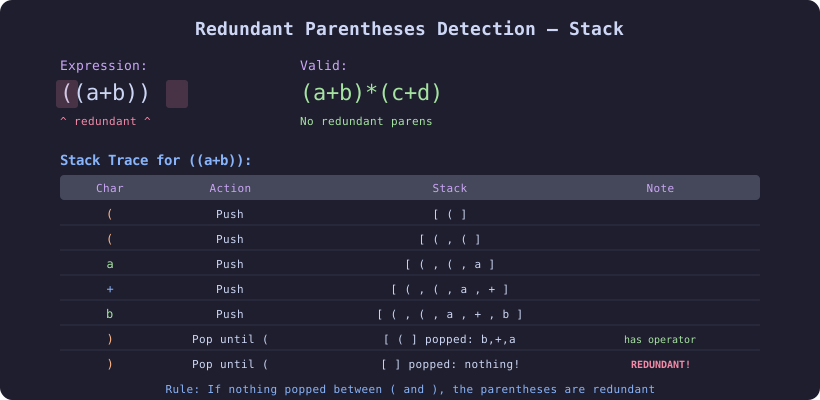
Parentheses are redundant if removing them doesn’t change the expression’s meaning. For example, ((a+b)) has redundant outer parentheses, and (a) wraps a single operand unnecessarily.
Examples
| Expression | Redundant? | Why |
|---|---|---|
(a+b) | No | Parentheses group an operation |
((a+b)) | Yes | Outer pair is unnecessary |
(a) | Yes | Single operand needs no grouping |
a+(b*c) | No | Controls precedence |
a+((b*c)) | Yes | Inner pair suffices |
The Algorithm
Push characters onto the stack. When you encounter ), pop until you find (. If you popped no operators between the parentheses, they are redundant.
def has_redundant_parentheses(expression):
    """
    Detect redundant parentheses in an expression.
    Time: O(n), Space: O(n)
    """
    stack = []
    operators = {'+', '-', '*', '/'}

    for char in expression:
        if char == ')':
            has_operator = False

            while stack and stack[-1] != '(':
                top = stack.pop()
                if top in operators:
                    has_operator = True

            stack.pop()  # Remove the '('

            if not has_operator:
                return True
        else:
            stack.append(char)

    return False
Trace
Expression: ((a+b))
char | stack              | action
-----|--------------------|---------
(    | [(]                | push
(    | [(, (]             | push
a    | [(, (, a]          | push
+    | [(, (, a, +]       | push
b    | [(, (, a, +, b]    | push
)    | [(, (]             | pop b,+,a → found operator ✓
)    | []                 | pop ( → NO operator ✗ → REDUNDANT!
Expression: (a+b)
char | stack          | action
-----|----------------|---------
(    | [(]            | push
a    | [(, a]         | push
+    | [(, a, +]      | push
b    | [(, a, +, b]   | push
)    | []             | pop b,+,a → found operator ✓ → OK
Count All Redundant Pairs
To count how many redundant pairs exist:
def count_redundant_parentheses(expression):
    """Count the number of redundant parenthesis pairs."""
    stack = []
    operators = {'+', '-', '*', '/'}
    count = 0

    for char in expression:
        if char == ')':
            has_operator = False
            while stack and stack[-1] != '(':
                if stack.pop() in operators:
                    has_operator = True
            stack.pop()
            if not has_operator:
                count += 1
        else:
            stack.append(char)

    return count
Edge Cases
- Empty expression — returns False
- No parentheses — returns False (nothing to be redundant)
(((a)))— two redundant pairs detected- Unary operators —
(-a)depends on interpretation; typically considered not redundant - Spaces in expression — filter them out before processing
When to Use This Pattern
- Expression parsers and compilers that simplify or lint code
- Code formatters that remove unnecessary grouping
- Interview problems involving parenthesis validation
Related Problems
- Valid Parentheses (LeetCode 20) — check if balanced
- Minimum Remove to Make Valid Parentheses (LeetCode 1249)
- Remove Outermost Parentheses (LeetCode 1021)
- Score of Parentheses (LeetCode 856)
Related articles
- DSA Implement Stack Using Two Queues — Two Approaches Explained
Implement a stack using two queues with costly push and costly pop approaches. Complete Python solutions with complexity analysis.
- DSA Asteroid Collision Problem Using Stacks
Solve the asteroid collision problem (LeetCode 735) using a stack. Covers collision rules, Python implementation, and all edge cases.
- DSA Car Fleet Problem — Stack-Based Arrival Time Solution
Solve LeetCode 853 Car Fleet using a stack. Sort by position, compare arrival times, and count fleets. Python solution with visual trace.
- DSA The Celebrity Problem Using Stack-Based Elimination
Solve the celebrity problem in O(n) time using a stack elimination technique. Includes proof of correctness, Python code, and matrix examples.