Sliding Window on Strings: Patterns and Templates
Sliding window on strings with reusable templates — longest substring without repeating, minimum window substring, K distinct characters, and permutation check.
What you'll learn
- ✓The two flavors of sliding window: fixed-size and variable-size
- ✓A reusable template that solves most string window problems
- ✓Longest substring without repeating characters — LeetCode 3
- ✓Minimum window substring — LeetCode 76
- ✓Longest substring with at most K distinct characters — LeetCode 340
- ✓Permutation in string and find all anagrams — LeetCode 567 and 438
- ✓Big-O analysis for every solution
Prerequisites
- •Python dictionaries and string basics
- •Two-pointer technique — see Two Pointers
- •Big O notation — see Big-O Explained
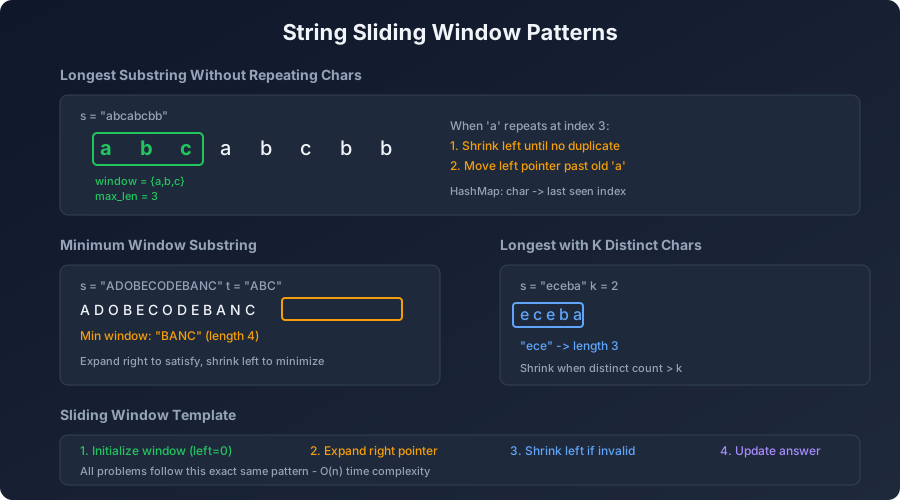
The sliding window is one of the most powerful patterns for string problems. Instead of checking every possible substring (which is O(n^2) or worse), you maintain a window that expands and contracts as you scan left to right. The result is usually an O(n) solution that feels almost magical once you see the template.
Why sliding window works on strings
Strings are sequences, and many problems ask you to find a substring that satisfies some condition — the longest one, the shortest one, or all positions where one exists. Brute force generates every substring, checks each, and takes O(n^2) or O(n^3) time. The sliding window avoids this by maintaining two pointers — left and right — and a state object (usually a hash map) that tracks what is inside the current window.
The key insight: when you expand right, you add one character. When you shrink left, you remove one character. Each character enters and leaves the window at most once, so the total work is O(n).
The two flavors
Fixed-size window
The window has a known length k. You slide it across the string one position at a time. Useful for anagram detection and problems where the substring length is given.
Variable-size window
The window grows and shrinks to find the optimal substring. You expand right until a condition is met, then shrink left to tighten. This handles “longest substring” and “minimum window” problems.
The universal template
Here is the template that covers most variable-size window problems:
def sliding_window(s: str) -> int:
    from collections import defaultdict

    freq = defaultdict(int)
    left = 0
    result = 0  # or float('inf') for minimum problems

    for right in range(len(s)):
        # 1. Expand: add s[right] to window state
        freq[s[right]] += 1

        # 2. Shrink: while the window is invalid, remove s[left]
        while window_is_invalid(freq):
            freq[s[left]] -= 1
            if freq[s[left]] == 0:
                del freq[s[left]]
            left += 1

        # 3. Update result
        result = max(result, right - left + 1)

    return result
The only parts that change between problems are:
- What state you track — frequency map, count of distinct chars, etc.
- When the window is invalid — too many distinct chars, missing a required char, etc.
- How you update the result — max length, min length, collect positions, etc.
Problem 1: Longest Substring Without Repeating Characters
LeetCode 3. Given a string s, find the length of the longest substring without repeating characters.
Approach
Use a variable-size window. The window is invalid when any character appears more than once. Track character frequencies in a hash map.
def length_of_longest_substring(s: str) -> int:
    freq = {}
    left = 0
    max_len = 0

    for right in range(len(s)):
        ch = s[right]
        freq[ch] = freq.get(ch, 0) + 1

        # Shrink while we have a duplicate
        while freq[ch] > 1:
            freq[s[left]] -= 1
            if freq[s[left]] == 0:
                del freq[s[left]]
            left += 1

        max_len = max(max_len, right - left + 1)

    return max_len
Walkthrough
For s = "abcabcbb":
- Window grows:
a,ab,abc— all unique, max_len = 3. righthits seconda: freq ofabecomes 2. Shrinkleftpast the firsta. Window is nowbca, max_len stays 3.- Continue until end. Answer is 3.
Optimized version with last-seen index
Instead of shrinking one step at a time, jump left directly to the position after the last occurrence:
def length_of_longest_substring_optimized(s: str) -> int:
    last_seen = {}
    left = 0
    max_len = 0

    for right in range(len(s)):
        ch = s[right]
        if ch in last_seen and last_seen[ch] >= left:
            left = last_seen[ch] + 1
        last_seen[ch] = right
        max_len = max(max_len, right - left + 1)

    return max_len
Time complexity: O(n) — each character is visited once. Space complexity: O(min(n, m)) where m is the character set size (26 for lowercase English).
Problem 2: Minimum Window Substring
LeetCode 76. Given strings s and t, return the minimum window substring of s that contains all characters in t (including duplicates). If no such window exists, return "".
Approach
This is a “find the shortest valid window” problem. Expand right until the window contains all characters of t, then shrink left to minimize.
def min_window(s: str, t: str) -> str:
    from collections import Counter

    if not t or not s:
        return ""

    t_count = Counter(t)
    required = len(t_count)  # number of unique chars needed

    # formed tracks how many unique chars in current window
    # match their required frequency
    formed = 0
    window_counts = {}

    # (window length, left, right)
    ans = (float('inf'), 0, 0)
    left = 0

    for right in range(len(s)):
        ch = s[right]
        window_counts[ch] = window_counts.get(ch, 0) + 1

        # Check if frequency of ch matches the required frequency
        if ch in t_count and window_counts[ch] == t_count[ch]:
            formed += 1

        # Try to shrink the window
        while formed == required:
            # Update answer
            window_len = right - left + 1
            if window_len {'<'} ans[0]:
                ans = (window_len, left, right)

            # Remove s[left] from window
            out = s[left]
            window_counts[out] -= 1
            if out in t_count and window_counts[out] {'<'} t_count[out]:
                formed -= 1
            left += 1

    return "" if ans[0] == float('inf') else s[ans[1]:ans[2] + 1]
Walkthrough
For s = "ADOBECODEBANC", t = "ABC":
- Expand until window
ADOBECcontains A, B, C. Length 6. - Shrink left: remove A — now missing A, stop. Record length 6.
- Expand right to find next A in
CODEBA. WindowDOBECODEBAis not minimal yet. - Continue shrinking. Eventually find
BANCwith length 4. - Answer:
"BANC".
Time complexity: O(|s| + |t|) — each character in s is visited at most twice (once by right, once by left).
Space complexity: O(|s| + |t|) in the worst case for the hash maps.
Problem 3: Longest Substring with At Most K Distinct Characters
LeetCode 340. Given a string s and an integer k, find the length of the longest substring that contains at most k distinct characters.
Approach
Variable-size window. The window is invalid when the number of distinct characters exceeds k.
def longest_k_distinct(s: str, k: int) -> int:
    from collections import defaultdict

    freq = defaultdict(int)
    left = 0
    max_len = 0

    for right in range(len(s)):
        freq[s[right]] += 1

        # Shrink while too many distinct characters
        while len(freq) > k:
            freq[s[left]] -= 1
            if freq[s[left]] == 0:
                del freq[s[left]]
            left += 1

        max_len = max(max_len, right - left + 1)

    return max_len
Example
For s = "eceba", k = 2:
e— 1 distinct, max_len = 1.ec— 2 distinct, max_len = 2.ece— 2 distinct, max_len = 3.eceb— 3 distinct, shrink: removeeat index 0.cebstill has 3. Removec.ebhas 2. max_len stays 3.eba— 3 distinct, shrink again. Eventually max_len = 3.- Answer: 3 (
"ece").
Time complexity: O(n). Space complexity: O(k).
Problem 4: Permutation in String
LeetCode 567. Given two strings s1 and s2, return True if s2 contains a permutation of s1.
Approach
A permutation of s1 is an anagram — same characters, same frequencies. Use a fixed-size window of length len(s1) and slide it across s2. Compare frequency maps.
def check_inclusion(s1: str, s2: str) -> bool:
    from collections import Counter

    if len(s1) > len(s2):
        return False

    s1_count = Counter(s1)
    window_count = Counter(s2[:len(s1)])

    if window_count == s1_count:
        return True

    for right in range(len(s1), len(s2)):
        # Add new character on the right
        ch_in = s2[right]
        window_count[ch_in] = window_count.get(ch_in, 0) + 1

        # Remove character going out on the left
        ch_out = s2[right - len(s1)]
        window_count[ch_out] -= 1
        if window_count[ch_out] == 0:
            del window_count[ch_out]

        if window_count == s1_count:
            return True

    return False
Optimized with a match counter
Comparing two Counter objects every step is O(26) for lowercase English, which is fine. But you can optimize further by tracking how many characters have matching frequencies:
def check_inclusion_optimized(s1: str, s2: str) -> bool:
    if len(s1) > len(s2):
        return False

    s1_count = [0] * 26
    window = [0] * 26

    for ch in s1:
        s1_count[ord(ch) - ord('a')] += 1
    for ch in s2[:len(s1)]:
        window[ord(ch) - ord('a')] += 1

    matches = sum(1 for i in range(26) if s1_count[i] == window[i])

    for right in range(len(s1), len(s2)):
        if matches == 26:
            return True

        # Add right character
        idx = ord(s2[right]) - ord('a')
        window[idx] += 1
        if window[idx] == s1_count[idx]:
            matches += 1
        elif window[idx] == s1_count[idx] + 1:
            matches -= 1

        # Remove left character
        idx = ord(s2[right - len(s1)]) - ord('a')
        window[idx] -= 1
        if window[idx] == s1_count[idx]:
            matches += 1
        elif window[idx] == s1_count[idx] - 1:
            matches -= 1

    return matches == 26
Time complexity: O(n) where n = len(s2). Space complexity: O(1) — fixed arrays of size 26.
Problem 5: Find All Anagrams in a String
LeetCode 438. Given strings s and p, return all start indices of p’s anagrams in s.
Approach
This is almost identical to the permutation problem, but instead of returning True on the first match, collect all matching positions.
def find_anagrams(s: str, p: str) -> list:
    from collections import Counter

    if len(p) > len(s):
        return []

    p_count = Counter(p)
    window = Counter(s[:len(p)])
    result = []

    if window == p_count:
        result.append(0)

    for right in range(len(p), len(s)):
        ch_in = s[right]
        window[ch_in] = window.get(ch_in, 0) + 1

        ch_out = s[right - len(p)]
        window[ch_out] -= 1
        if window[ch_out] == 0:
            del window[ch_out]

        if window == p_count:
            result.append(right - len(p) + 1)

    return result
Example
For s = "cbaebabacd", p = "abc":
- Window
cbamatches — add index 0. - Slide:
bae,aeb,eba,bab,aba,bac— index 6 matches. - Slide:
acd— no match. - Answer:
[0, 6].
Time complexity: O(n) where n = len(s). Comparing Counters is O(26) = O(1) for lowercase. Space complexity: O(1) — at most 26 keys.
Summary of patterns
| Problem | Window Type | Invalid When | Track | Complexity |
|---|---|---|---|---|
| Longest without repeats | Variable | Any char freq > 1 | Frequency map | O(n) |
| Minimum window substring | Variable | Missing required chars | Freq + match count | O(n) |
| At most K distinct | Variable | Distinct count > k | Frequency map size | O(n) |
| Permutation in string | Fixed | Frequencies mismatch | Two frequency maps | O(n) |
| Find all anagrams | Fixed | Frequencies mismatch | Two frequency maps | O(n) |
Common mistakes
- Off-by-one errors. The window length is
right - left + 1, notright - left. Double-check when shrinking. - Not cleaning up zero-count entries. When a character’s frequency drops to 0, delete it from the map. Otherwise
len(freq)will overcount distinct characters. - Forgetting to check the initial window in fixed-size problems. The first window needs to be checked before the sliding loop starts.
- Using the wrong comparison. For “at most K distinct”, the shrink condition is
len(freq) > k, not>= k.
When to use sliding window vs other techniques
- Sliding window: Contiguous substrings or subarrays with a constraint on content.
- Two pointers (non-window): Sorted arrays, palindromes, pair sums.
- Hash map alone: Non-contiguous patterns, counting across the whole string.
- Dynamic programming: Subsequences (not substrings), optimal partition problems.
Practice problems
Try these to solidify the pattern:
- LeetCode 3 — Longest Substring Without Repeating Characters
- LeetCode 76 — Minimum Window Substring
- LeetCode 340 — Longest Substring with At Most K Distinct Characters
- LeetCode 567 — Permutation in String
- LeetCode 438 — Find All Anagrams in a String
- LeetCode 424 — Longest Repeating Character Replacement
- LeetCode 1004 — Max Consecutive Ones III
- LeetCode 904 — Fruit Into Baskets
- LeetCode 1208 — Get Equal Substrings Within Budget
- LeetCode 30 — Substring with Concatenation of All Words
Final thoughts
The sliding window is not just a technique — it is a way of thinking. Every time you see “find a substring that satisfies X”, your first instinct should be to ask: can I maintain a window and slide it? The answer is usually yes, and the template above will get you 80% of the way there. The remaining 20% is understanding what state to track and when the window is invalid.
Master these five problems and you will recognize the pattern instantly in interviews. The template is your weapon — internalize it.
Related articles
- DSA Minimum Remove to Make Valid Parentheses — Stack Solution
Solve LeetCode 1249 Minimum Remove to Make Valid Parentheses using a stack. Two-pass and one-pass approaches with Python code and traces.
- DSA Simplify Unix Path Using a Stack — LeetCode 71 Solution
Solve Simplify Path LeetCode 71 with a stack. Handle ., .., multiple slashes, and edge cases. Python solution with step-by-step trace.
- DSA Anagram Problems: Patterns and Solutions
Master anagram problems — valid anagram checks, grouping anagrams by sorted and frequency keys, finding all anagrams in a string with sliding windows, and the minimum window substring problem.
- DSA String Encoding and Decoding Patterns
Master string encoding and decoding — delimiter-based encode/decode, run-length encoding, decoding nested bracket strings with stacks, string compression, and serialization patterns.