Zigzag Level Order Traversal — BFS with Deque in Python
Zigzag level order traversal of a binary tree using BFS and deque. Step-by-step Python solution with visual trace, complexity analysis, and interview tips.
What you'll learn
- ✓How zigzag (spiral) level order traversal works
- ✓BFS approach using deque with direction toggling
- ✓Complete Python solution with step-by-step trace
- ✓Time and space complexity analysis
- ✓Edge cases and related interview problems
Prerequisites
- •Binary tree basics — see Binary Trees Intro
- •Queue / BFS basics — see Queues Intro
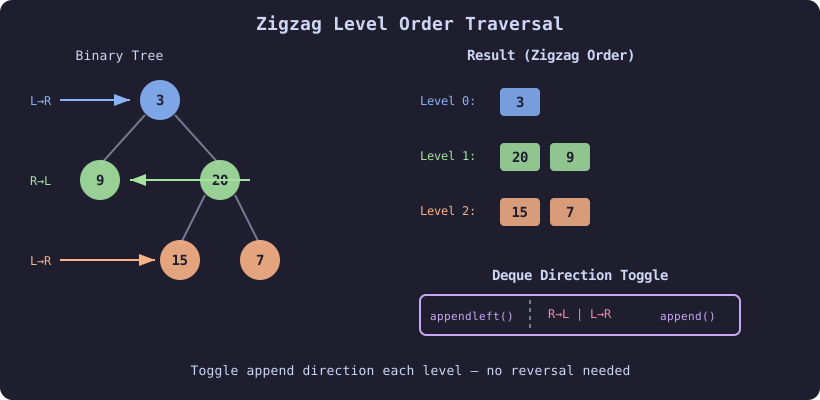
Zigzag Level Order Traversal (LeetCode 103) asks you to traverse a binary tree level by level, but alternating direction each level — left-to-right, then right-to-left, then left-to-right again. It is a classic BFS variation that appears frequently in interviews.
The Problem
Given a binary tree, return its zigzag level order traversal — the values of nodes at each level, alternating between left-to-right and right-to-left.
        3
       / \
      9   20
         / \
        15   7

Output: [[3], [20, 9], [15, 7]]

Level 0 (L→R): [3]
Level 1 (R→L): [20, 9]
Level 2 (L→R): [15, 7]
Why Not Just Reverse?
A naive approach: do a normal level order BFS, then reverse every other level. This works, but it adds O(n) work for reversals. A cleaner approach uses a deque and toggles which end we append to — no reversal needed.
Approach: BFS with Deque
The key insight: instead of reversing after collecting a level, we control where we insert each node’s value.
- Left-to-right level: append values to the right of the level deque
- Right-to-left level: append values to the left of the level deque
from collections import deque

class TreeNode:
    def __init__(self, val=0, left=None, right=None):
        self.val = val
        self.left = left
        self.right = right

def zigzagLevelOrder(root):
    """
    Zigzag level order traversal using BFS + deque.
    Time: O(n), Space: O(n)
    """
    if not root:
        return []

    result = []
    queue = deque([root])
    left_to_right = True

    while queue:
        level_size = len(queue)
        level = deque()

        for _ in range(level_size):
            node = queue.popleft()

            # Toggle insertion direction
            if left_to_right:
                level.append(node.val)
            else:
                level.appendleft(node.val)

            # Always enqueue children left then right
            if node.left:
                queue.append(node.left)
            if node.right:
                queue.append(node.right)

        result.append(list(level))
        left_to_right = not left_to_right

    return result
Step-by-Step Trace
Using the tree [3, 9, 20, null, null, 15, 7]:
Step 1: queue = [3], left_to_right = True
  Process 3 → level.append(3) → level = [3]
  Enqueue: 9, 20
  Result: [[3]]

Step 2: queue = [9, 20], left_to_right = False
  Process 9 → level.appendleft(9)  → level = [9]
  Process 20 → level.appendleft(20) → level = [20, 9]
  Enqueue: 15, 7
  Result: [[3], [20, 9]]

Step 3: queue = [15, 7], left_to_right = True
  Process 15 → level.append(15) → level = [15]
  Process 7  → level.append(7)  → level = [15, 7]
  Result: [[3], [20, 9], [15, 7]]
Alternative: Simple Reverse Approach
If you find the deque method hard to remember under pressure, the reverse approach is perfectly valid:
def zigzagLevelOrder_reverse(root):
    """Simpler but slightly less elegant — reverse odd levels."""
    if not root:
        return []

    result = []
    queue = deque([root])
    level_num = 0

    while queue:
        level = []
        for _ in range(len(queue)):
            node = queue.popleft()
            level.append(node.val)
            if node.left:
                queue.append(node.left)
            if node.right:
                queue.append(node.right)

        if level_num % 2 == 1:
            level.reverse()
        result.append(level)
        level_num += 1

    return result
Both are O(n) time and O(n) space. The deque approach avoids the in-place reverse but both are accepted in interviews.
Complexity Analysis
| Metric | Value |
|---|---|
| Time | O(n) — visit each node exactly once |
| Space | O(n) — queue holds at most one full level (up to n/2 nodes at leaf level) |
Edge Cases
# Empty tree
assert zigzagLevelOrder(None) == []

# Single node
root = TreeNode(1)
assert zigzagLevelOrder(root) == [[1]]

# Left-skewed tree: 1 → 2 → 3
# Each level has one node, so zigzag has no visible effect
# Output: [[1], [2], [3]]

# Right-skewed tree: same behavior
When to Use This Pattern
Use zigzag BFS when:
- The problem asks for spiral or zigzag traversal of a tree
- You need level-order output but with alternating direction
- You see “snake order” or “S-shaped traversal” in the problem statement
The deque-based direction toggling generalizes nicely: you can extend it to n-ary trees, or any graph where you want alternating-direction BFS layers.
Common Mistakes
- Forgetting to toggle
left_to_rightafter each level - Reversing children enqueue order — always enqueue left then right; only change where you insert the value
- Off-by-one on level numbering — level 0 is left-to-right by convention
Related Problems
| Problem | Key Difference |
|---|---|
| Binary Tree Level Order (LC 102) | Standard BFS, no zigzag |
| Binary Tree Right Side View (LC 199) | Only last node per level |
| N-ary Tree Level Order (LC 429) | Multiple children per node |
| Binary Tree Vertical Order (LC 314) | Columns instead of rows |
| Spiral Matrix (LC 54) | Same zigzag idea on 2D grids |
Key Takeaways
- Zigzag level order is a BFS problem with a twist: alternate the insertion direction per level
- Using a deque for each level and toggling
appendvsappendleftavoids post-processing reversal - Both approaches (deque toggle and simple reverse) are O(n) and interview-valid
- The pattern generalizes to any “alternating direction by layer” traversal
Related articles
- DSA Deque Design Patterns — Sliding Window, Palindrome, Work Stealing
Master deque design patterns including sliding window maximum, palindrome checking, work stealing, and BFS/DFS hybrid. Python implementations.
- DSA Design Front Middle Back Queue — Two Deques (LeetCode 1670)
Design Front Middle Back Queue using two balanced deques. Python solution with O(1) operations, step-by-step trace, and complexity analysis for LeetCode 1670.
- DSA Open the Lock — BFS on State Space (LeetCode 752)
Open the Lock problem solved with BFS on 4-digit state space. Python solution with deadend handling, bidirectional BFS optimization, and complexity analysis.
- DSA Sliding Window Maximum Using Deque
Solve the sliding window maximum problem in O(n) using a monotonic deque. Covers the algorithm, Python code, visual traces, and variations.