Snakes and Ladders BFS — Shortest Path on Game Board (LeetCode 909)
Solve Snakes and Ladders with BFS to find minimum dice rolls. Python solution with 1D-2D conversion, boustrophedon layout, and step-by-step trace.
What you'll learn
- ✓Why BFS gives the minimum number of dice rolls
- ✓How to convert between 1D square numbers and 2D board coordinates
- ✓The boustrophedon (zigzag) numbering pattern
- ✓Complete Python BFS implementation
- ✓How snakes and ladders modify the graph edges
Prerequisites
- •Queue basics — see Queues Intro
- •BFS fundamentals — see BFS Traversal
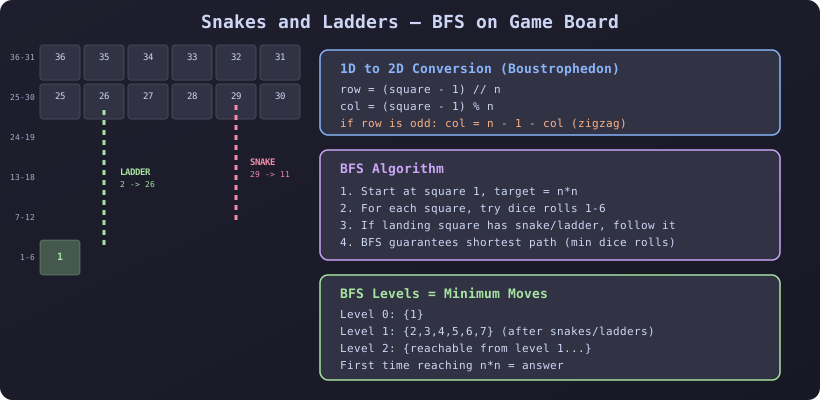
Snakes and Ladders (LeetCode 909) is a BFS problem disguised as a board game. You need to find the minimum number of dice rolls to reach the final square. The tricky part is converting between the board’s 2D layout and 1D square numbers.
The Problem
Given an n x n board with snakes and ladders, find the minimum number of moves to reach square n*n starting from square 1.
- Each move: roll a die (1 to 6) and move forward
- If you land on a snake or ladder, you must take it (teleport to the destination)
- Board uses boustrophedon numbering (alternating left-right, right-left per row, starting from bottom-left)
board[r][c] = -1means no snake/ladder; otherwiseboard[r][c]is the destination
Why BFS?
Each square on the board is a node. From each node, you have up to 6 edges (dice rolls 1-6). BFS explores all nodes reachable in 1 move, then 2 moves, and so on. The first time you reach square n*n, that is the minimum number of moves.
This is unweighted shortest path — exactly what BFS is designed for.
The 1D-to-2D Conversion
The board is numbered bottom-to-top with alternating direction per row (boustrophedon pattern). Given a 1-indexed square number s on an n x n board:
def square_to_coords(s, n):
    """Convert 1-indexed square number to (row, col) in the 2D board."""
    # Row from bottom (0-indexed)
    row_from_bottom = (s - 1) // n
    col = (s - 1) % n

    # Odd rows from bottom go right-to-left
    if row_from_bottom % 2 == 1:
        col = n - 1 - col

    # Convert to top-indexed row for the board array
    row = n - 1 - row_from_bottom

    return row, col
Example for a 6x6 board:
Square 1  → row_from_bottom=0, col=0 → board row 5, col 0
Square 6  → row_from_bottom=0, col=5 → board row 5, col 5
Square 7  → row_from_bottom=1, col=0 → zigzag: col=5 → row 4, col 5
Square 12 → row_from_bottom=1, col=5 → zigzag: col=0 → row 4, col 0
Square 36 → row_from_bottom=5, col=5 → zigzag: col=0 → row 0, col 0
Python BFS Implementation
from collections import deque

def snakes_and_ladders(board):
    """
    BFS to find minimum dice rolls to reach the last square.
    Time: O(n^2) — each square visited at most once.
    Space: O(n^2) — for visited set and queue.
    """
    n = len(board)
    target = n * n

    def get_board_value(s):
        """Get board value at 1-indexed square s."""
        row_from_bottom = (s - 1) // n
        col = (s - 1) % n
        if row_from_bottom % 2 == 1:
            col = n - 1 - col
        row = n - 1 - row_from_bottom
        return board[row][col]

    # BFS
    queue = deque([(1, 0)])  # (square, moves)
    visited = {1}

    while queue:
        square, moves = queue.popleft()

        # Try all dice rolls
        for dice in range(1, 7):
            next_sq = square + dice
            if next_sq > target:
                continue

            # Check for snake or ladder
            val = get_board_value(next_sq)
            if val != -1:
                next_sq = val  # teleport

            if next_sq == target:
                return moves + 1

            if next_sq not in visited:
                visited.add(next_sq)
                queue.append((next_sq, moves + 1))

    return -1  # unreachable
Step-by-Step Trace
Consider a simplified 3x3 board:
board = [
    [-1, -1,  9],   # row 0: squares 9, 8, 7
    [-1, -1, -1],   # row 1: squares 4, 5, 6
    [-1, -1, -1],   # row 2: squares 1, 2, 3
]
Square 7 has a ladder to square 9 (board[0][2] = 9).
Target = 9

BFS:
  Start: queue=[(1,0)], visited={1}

  Process (1, 0):
    dice 1 → sq 2, val=-1, not visited → queue=[(2,1)], visited={1,2}
    dice 2 → sq 3, val=-1 → queue=[(2,1),(3,1)], visited={1,2,3}
    dice 3 → sq 4, val=-1 → add (4,1)
    dice 4 → sq 5, val=-1 → add (5,1)
    dice 5 → sq 6, val=-1 → add (6,1)
    dice 6 → sq 7, val=9 → next_sq=9 → TARGET! return 0+1 = 1

Answer: 1 (roll a 6, land on 7 which has ladder to 9)
Handling Edge Cases
What if a snake/ladder destination has another snake/ladder?
Per LeetCode’s rules, you only take one snake/ladder per move. If you land on square X that sends you to Y, you stay at Y even if Y has its own snake/ladder. The BFS naturally handles this because Y will be processed in a future move.
What about landing beyond the board?
If square + dice > n*n, skip that dice roll. You cannot move beyond the last square.
Complete Solution with All Edge Cases
from collections import deque

def snakes_and_ladders(board):
    n = len(board)
    target = n * n

    def get_value(s):
        r = (s - 1) // n
        c = (s - 1) % n
        if r % 2 == 1:
            c = n - 1 - c
        return board[n - 1 - r][c]

    queue = deque([(1, 0)])
    visited = {1}

    while queue:
        sq, moves = queue.popleft()

        for d in range(1, 7):
            nxt = sq + d
            if nxt > target:
                continue

            val = get_value(nxt)
            if val != -1:
                nxt = val

            if nxt == target:
                return moves + 1

            if nxt not in visited:
                visited.add(nxt)
                queue.append((nxt, moves + 1))

    return -1
Common Mistakes
- Wrong 1D-to-2D conversion — forgetting the zigzag pattern or getting row direction wrong
- Not handling the target check after teleport — you can land on the target via a ladder
- Visiting the pre-teleport square instead of post — mark the final destination as visited
- Allowing multiple teleports in one move — per problem rules, at most one
- Off-by-one errors — squares are 1-indexed, board array is 0-indexed
Complexity Analysis
| Metric | Value |
|---|---|
| Time | O(n^2) — each of the n^2 squares visited at most once |
| Space | O(n^2) — visited set + queue |
The BFS visits each square at most once. From each square, we do constant work (6 dice rolls). Total: O(6 * n^2) = O(n^2).
When to Use This Pattern
Use BFS shortest path when:
- You need the minimum number of steps/moves to reach a target
- The graph is unweighted (each step costs the same)
- There are teleportation mechanics (snakes, ladders, portals)
- The state space is finite and can be enumerated
Related Problems
| Problem | Difficulty | Key Idea |
|---|---|---|
| LeetCode 909 — Snakes and Ladders | Medium | This problem |
| LeetCode 127 — Word Ladder | Hard | BFS shortest transformation |
| LeetCode 1091 — Shortest Path in Binary Matrix | Medium | BFS on grid |
| LeetCode 752 — Open the Lock | Medium | BFS on state space |
Key Takeaway
Snakes and Ladders is BFS on a graph where nodes are board squares and edges are dice rolls (possibly modified by snakes/ladders). The hardest part is the 1D-to-2D boustrophedon conversion. Once you model the board correctly, standard BFS gives you the answer.
Related articles
- DSA BFS Pattern with Queues: Level-Order and Shortest Path
Master BFS using queues for tree level-order traversal and shortest path in unweighted graphs. Python implementations with detailed traces.
- DSA Design Circular Deque — Array-Based Implementation (LeetCode 641)
Design a Circular Deque with front/rear pointers on a fixed-size array. Python solution with all O(1) operations, visual trace, and edge case handling.
- DSA Design Hit Counter Using Queue
Design a hit counter that counts hits in the past 5 minutes using a queue. LeetCode 362 solution with O(1) amortized operations.
- DSA First Non-Repeating Character in a Stream
Find the first non-repeating character in a character stream using a queue and hash map. Python solution with O(1) amortized per query.