Number of Recent Calls — Queue-Based Sliding Window (LeetCode 933)
Solve Number of Recent Calls using a queue as a 3000ms sliding window counter. Python solution with deque, step-by-step trace, and amortized analysis.
What you'll learn
- ✓How a queue naturally solves sliding window counting
- ✓Why timestamps in sorted order make queue perfect
- ✓Complete Python implementation with deque
- ✓Amortized O(1) analysis for each ping call
- ✓Variations and real-world applications
Prerequisites
- •Queue basics — see Queues Intro
- •Python collections.deque
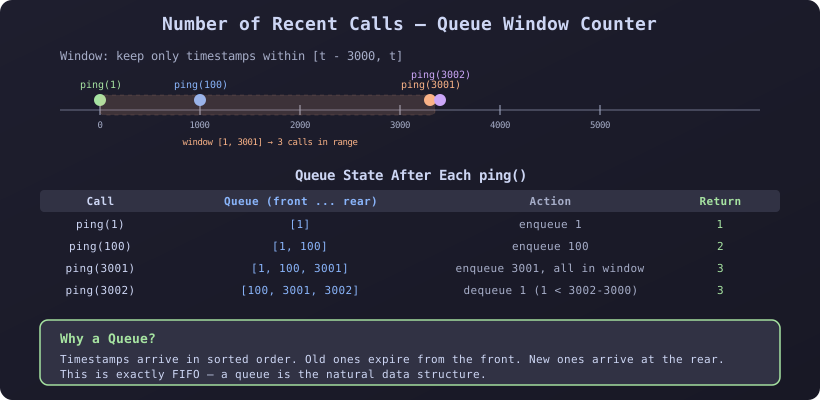
Number of Recent Calls (LeetCode 933) is an easy problem that perfectly demonstrates when to use a queue. You maintain a sliding window of timestamps and count how many fall within the last 3000 milliseconds.
The Problem
Design a class RecentCounter that counts the number of recent requests within a certain time frame.
RecentCounter()— initializes the counter with zero requestsping(t)— adds a new request at timet(in milliseconds) and returns the number of requests in the inclusive range[t - 3000, t]
It is guaranteed that every call to ping uses a strictly larger value of t than the previous call.
ping(1)    → 1   (window [−2999, 1], requests: {1})
ping(100)  → 2   (window [−2900, 100], requests: {1, 100})
ping(3001) → 3   (window [1, 3001], requests: {1, 100, 3001})
ping(3002) → 3   (window [2, 3002], requests: {100, 3001, 3002})
Notice that at ping(3002), timestamp 1 falls outside the window and is removed.
Why a Queue?
Two key observations:
- Timestamps arrive in sorted order — each
tis strictly increasing - Old timestamps expire from the front — the oldest timestamp expires first
This is exactly FIFO (First In, First Out). A queue lets us:
- Enqueue each new timestamp at the rear
- Dequeue expired timestamps from the front
- Return the queue length as the count
Python Implementation
from collections import deque

class RecentCounter:
    """
    Queue-based sliding window counter.
    Time: O(1) amortized per ping.
    Space: O(W) where W = max requests in a 3000ms window.
    """

    def __init__(self):
        self.queue = deque()

    def ping(self, t: int) -> int:
        # Add the new request
        self.queue.append(t)

        # Remove requests outside the window
        while self.queue[0] < t - 3000:
            self.queue.popleft()

        return len(self.queue)
That is the entire solution. Let us break down why it works.
Step-by-Step Trace
RecentCounter()
  queue = []

ping(1):
  append 1         queue = [1]
  check: 1 < 1-3000 = -2999? No
  return len = 1

ping(100):
  append 100        queue = [1, 100]
  check: 1 < 100-3000 = -2900? No
  return len = 2

ping(3001):
  append 3001       queue = [1, 100, 3001]
  check: 1 < 3001-3000 = 1? No (1 is not < 1)
  return len = 3

ping(3002):
  append 3002       queue = [1, 100, 3001, 3002]
  check: 1 < 3002-3000 = 2? Yes → popleft
  queue = [100, 3001, 3002]
  check: 100 < 2? No
  return len = 3
Why Not a List?
You might try using a plain list:
# BAD — O(n) per ping due to pop(0)
class RecentCounterBad:
    def __init__(self):
        self.requests = []

    def ping(self, t):
        self.requests.append(t)
        while self.requests[0] < t - 3000:
            self.requests.pop(0)  # O(n) — shifts all elements!
        return len(self.requests)
list.pop(0) is O(n) because it shifts all remaining elements. deque.popleft() is O(1) because it uses a doubly-linked list internally.
Amortized Complexity
Each timestamp is:
- Enqueued once — O(1)
- Dequeued at most once — O(1)
Across n calls to ping, total enqueues = n, total dequeues are at most n. So total work = O(n), meaning amortized O(1) per call.
The while loop may run multiple times in one call, but across all calls, the total number of pops equals the total number of pushes.
Alternative: Binary Search
Since the queue is always sorted, you could use binary search instead of dequeuing:
import bisect

class RecentCounterBS:
    def __init__(self):
        self.requests = []

    def ping(self, t):
        self.requests.append(t)
        # Find first index >= t - 3000
        idx = bisect.bisect_left(self.requests, t - 3000)
        return len(self.requests) - idx
This is O(log n) per ping but uses O(n) total memory (never removes old timestamps). The queue approach is better because it keeps memory bounded.
Edge Cases
- First call —
ping(1)→ always returns 1 - Exactly 3000ms apart —
ping(1)thenping(3001)→ both are in window[1, 3001], returns 2 - Rapid pings — many pings within 3000ms → queue grows but is bounded by the rate
- Large gap —
ping(1)thenping(10000)→ all old pings removed, returns 1 - Minimum input —
t = 1(smallest valid timestamp)
Space Complexity
The queue never holds more timestamps than the number of pings within any 3000ms window. In the worst case (continuous pings every millisecond), that is 3001 elements.
| Metric | Value |
|---|---|
| Time per ping | O(1) amortized |
| Space | O(min(n, W)) where W = 3001 |
Real-World Applications
This pattern appears in:
- Rate limiters — “allow at most 100 requests per minute”
- Monitoring dashboards — “requests per second” counters
- Network protocols — sliding window flow control
- Analytics — “active users in the last 5 minutes”
When to Use This Pattern
Use a queue-based sliding window when:
- Events arrive in chronological order
- You need to count events within a fixed time window
- Old events expire and should be discarded
- You want amortized O(1) per event
Related Problems
| Problem | Difficulty | Key Idea |
|---|---|---|
| LeetCode 933 — Number of Recent Calls | Easy | This problem |
| LeetCode 346 — Moving Average from Data Stream | Easy | Queue with fixed window |
| LeetCode 239 — Sliding Window Maximum | Hard | Deque for max tracking |
| LeetCode 362 — Design Hit Counter | Medium | Similar time window counter |
Key Takeaway
Number of Recent Calls is the textbook use case for a queue: events arrive in order, old ones expire from the front, new ones enter at the rear. The deque gives O(1) operations on both ends, making the solution clean and efficient.
Related articles
- DSA Deque Design Patterns — Sliding Window, Palindrome, Work Stealing
Master deque design patterns including sliding window maximum, palindrome checking, work stealing, and BFS/DFS hybrid. Python implementations.
- DSA BFS Pattern with Queues: Level-Order and Shortest Path
Master BFS using queues for tree level-order traversal and shortest path in unweighted graphs. Python implementations with detailed traces.
- DSA Design Circular Deque — Array-Based Implementation (LeetCode 641)
Design a Circular Deque with front/rear pointers on a fixed-size array. Python solution with all O(1) operations, visual trace, and edge case handling.
- DSA Design Front Middle Back Queue — Two Deques (LeetCode 1670)
Design Front Middle Back Queue using two balanced deques. Python solution with O(1) operations, step-by-step trace, and complexity analysis for LeetCode 1670.