Implement Queue Using Two Stacks — Amortized O(1) Solution
Implement a queue using two stacks with amortized O(1) operations. Covers costly enqueue vs costly dequeue approaches with Python code.
What you'll learn
- ✓Two approaches: costly enqueue vs costly dequeue
- ✓Why amortized O(1) works for the lazy transfer approach
- ✓Complete Python implementation with edge case handling
- ✓When and why interviewers ask this classic problem
Prerequisites
- •Stack basics — see Stacks & Queues Intro
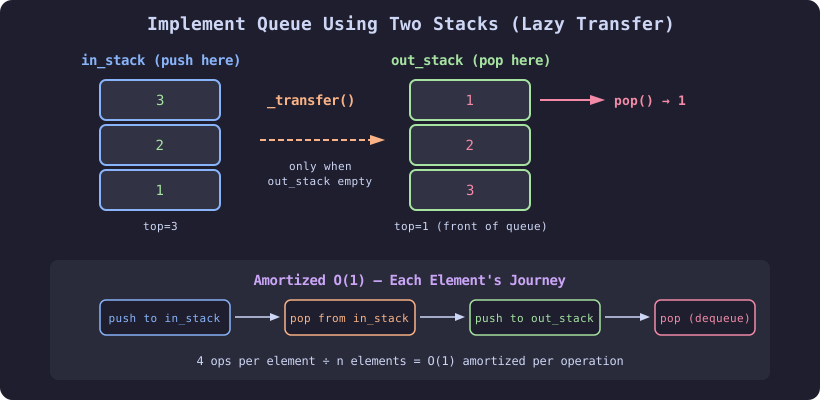
A queue follows FIFO (First In, First Out). A stack follows LIFO (Last In, First Out). These are opposite orderings. So how do you make a queue from two stacks? By using one stack to reverse the order of the other.
This is LeetCode 232 and one of the most frequently asked design questions in interviews.
Core Insight
If you push elements onto Stack A in order [1, 2, 3], then pop them all into Stack B, Stack B contains [3, 2, 1]. Now popping from Stack B gives 1, 2, 3 — exactly FIFO order.
Push 1, 2, 3 onto Stack A:    Stack A = [1, 2, 3] (top = 3)

Transfer to Stack B:
  Pop 3 → push to B           Stack B = [3]
  Pop 2 → push to B           Stack B = [3, 2]
  Pop 1 → push to B           Stack B = [3, 2, 1] (top = 1)

Pop from Stack B → 1 ✓ (FIFO)
Pop from Stack B → 2 ✓ (FIFO)
Approach 1: Costly Enqueue
Every time we enqueue, transfer everything to maintain order.
class QueueCostlyEnqueue:
    """
    Queue using two stacks — O(n) enqueue, O(1) dequeue.
    """
    def __init__(self):
        self.s1 = []  # main stack (front of queue on top)
        self.s2 = []  # temporary

    def enqueue(self, val):
        # Move everything to s2
        while self.s1:
            self.s2.append(self.s1.pop())

        # Push new element to bottom of s1
        self.s1.append(val)

        # Move everything back
        while self.s2:
            self.s1.append(self.s2.pop())

    def dequeue(self):
        if not self.s1:
            raise IndexError("Queue is empty")
        return self.s1.pop()

    def peek(self):
        if not self.s1:
            raise IndexError("Queue is empty")
        return self.s1[-1]

    def is_empty(self):
        return len(self.s1) == 0
Trace
enqueue(1): s1=[1]
enqueue(2): move 1→s2, push 2→s1, move 1 back → s1=[2,1]
enqueue(3): move 1,2→s2, push 3→s1, move 2,1 back → s1=[3,2,1]
dequeue():  pop → 1 ✓
dequeue():  pop → 2 ✓
Complexity
| Operation | Time | Space |
|---|---|---|
| enqueue | O(n) | O(n) |
| dequeue | O(1) | O(1) |
| peek | O(1) | O(1) |
Approach 2: Costly Dequeue (Lazy Transfer)
This is the preferred approach. Only transfer when the output stack is empty.
class MyQueue:
    """
    Queue using two stacks — amortized O(1) for all operations.
    LeetCode 232.
    """
    def __init__(self):
        self.in_stack = []   # for push
        self.out_stack = []  # for pop/peek

    def push(self, x: int) -> None:
        self.in_stack.append(x)

    def pop(self) -> int:
        self._transfer()
        return self.out_stack.pop()

    def peek(self) -> int:
        self._transfer()
        return self.out_stack[-1]

    def empty(self) -> bool:
        return not self.in_stack and not self.out_stack

    def _transfer(self):
        """Only transfer when out_stack is empty."""
        if not self.out_stack:
            while self.in_stack:
                self.out_stack.append(self.in_stack.pop())
Why This Is Better: Amortized O(1) Analysis
Each element goes through exactly 4 operations in its lifetime:
- Push onto
in_stack— O(1) - Pop from
in_stack— O(1) - Push onto
out_stack— O(1) - Pop from
out_stack— O(1)
Total cost per element = 4 operations. Spread across n elements, the amortized cost per operation is O(1).
Trace
push(1):   in=[1]         out=[]
push(2):   in=[1,2]       out=[]
push(3):   in=[1,2,3]     out=[]
pop():     transfer!       in=[]  out=[3,2,1]  → returns 1
push(4):   in=[4]         out=[3,2]
pop():     out not empty   in=[4] out=[3,2]    → returns 2
pop():     out not empty   in=[4] out=[3]      → returns 3
pop():     transfer!       in=[]  out=[]        → returns 4
Notice: we only transfer when out_stack is empty. Elements pushed after a transfer wait in in_stack until the next transfer.
Edge Cases
# Empty queue operations
q = MyQueue()
assert q.empty() == True

# Single element
q.push(1)
assert q.peek() == 1
assert q.pop() == 1
assert q.empty() == True

# Interleaved push/pop
q.push(1)
q.push(2)
assert q.pop() == 1    # triggers transfer
q.push(3)
assert q.pop() == 2    # no transfer needed
assert q.pop() == 3    # triggers transfer
Comparing the Two Approaches
| Approach | Enqueue | Dequeue | Best When |
|---|---|---|---|
| Costly Enqueue | O(n) | O(1) | Many more dequeues than enqueues |
| Lazy Transfer | O(1) | Amortized O(1) | General use, interviews |
The lazy transfer approach is almost always preferred because:
- Both operations are amortized O(1)
- No wasted work — elements only transfer once
- Simpler to reason about
When to Use This Pattern
- Interview question: This is asked directly or as part of larger designs
- Functional programming: Languages without built-in queues but with stacks
- Undo/redo systems: Understanding stack-to-queue conversion helps design these
- Message processing: When you need FIFO from LIFO storage
Common Interview Follow-ups
- Can you implement it with one stack? Yes, using recursion (the call stack acts as the second stack), but it is O(n) per dequeue.
- What about thread safety? You would need locks around
_transferand the push/pop operations. - Can you make it with O(1) worst case? Not with plain stacks — amortized O(1) is the best you can achieve.
Related Problems
- Implement Stack using Queues — the reverse problem
- Min Stack — another stack design problem
- Circular Queue — queue with fixed size
Related articles
- DSA Implement Stack Using Two Queues — Two Approaches Explained
Implement a stack using two queues with costly push and costly pop approaches. Complete Python solutions with complexity analysis.
- DSA Real-World Applications of Stacks and Queues — From Undo/Redo to BFS Crawlers
Real-world applications of stacks and queues: undo/redo systems, browser history, call stacks, task scheduling, message queues, and BFS web crawlers with Python examples.
- DSA Stacks & Queues: 8 Practice Problems with Solutions
Eight classic stack and queue interview problems with worked Python solutions — Valid Parentheses, Min Stack, Daily Temperatures, Sliding Window Maximum, and more.
- DSA BFS Pattern with Queues: Level-Order and Shortest Path
Master BFS using queues for tree level-order traversal and shortest path in unweighted graphs. Python implementations with detailed traces.