Open the Lock — BFS on State Space (LeetCode 752)
Open the Lock problem solved with BFS on 4-digit state space. Python solution with deadend handling, bidirectional BFS optimization, and complexity analysis.
What you'll learn
- ✓How to model the 4-digit lock as a graph / state space
- ✓BFS to find shortest path from "0000" to target
- ✓Handling deadends as blocked nodes
- ✓Bidirectional BFS optimization
- ✓Time and space complexity analysis
Prerequisites
- •BFS basics — see Queues Intro
- •Graph traversal concepts — see Graph BFS/DFS
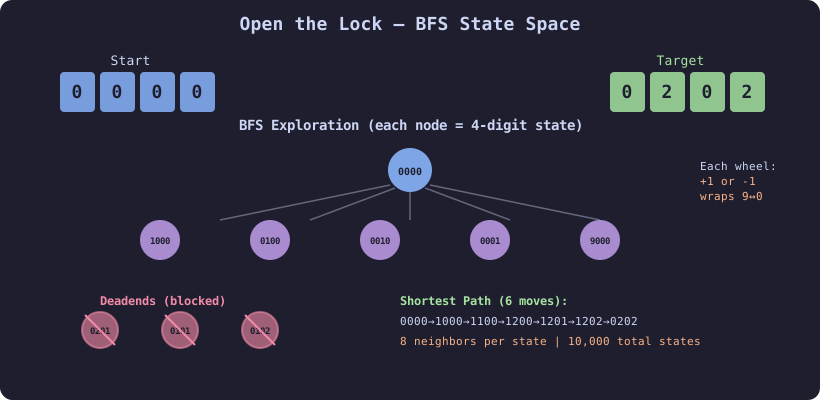
Open the Lock (LeetCode 752) is a brilliant example of BFS on an implicit graph. You have a 4-digit lock starting at "0000". Each move turns one wheel by one position (up or down, wrapping 9 to 0 and 0 to 9). Some combinations are deadends. Find the minimum number of moves to reach the target.
The Problem
Input: deadends = ["0201","0101","0102","1212","2002"], target = "0202"
Output: 6

Explanation: "0000" → "1000" → "1100" → "1200" → "1201" → "1202" → "0202"
Each step turns exactly one wheel by one position.
Why BFS?
Each lock state is a node in an implicit graph. Each node has exactly 8 neighbors (4 wheels x 2 directions). We want the shortest path from "0000" to target. BFS on an unweighted graph always finds the shortest path.
The state space has 10^4 = 10,000 possible combinations — completely manageable.
BFS Solution
from collections import deque

def openLock(deadends, target):
    """
    BFS on 4-digit lock state space.
    Time: O(10^4 * 4) = O(40,000) — constant
    Space: O(10^4) for visited set
    """
    dead = set(deadends)

    # Edge case: start is a deadend
    if "0000" in dead:
        return -1
    if target == "0000":
        return 0

    visited = {"0000"}
    queue = deque([("0000", 0)])

    while queue:
        state, moves = queue.popleft()

        # Try turning each of the 4 wheels
        for i in range(4):
            digit = int(state[i])

            for delta in (1, -1):
                new_digit = (digit + delta) % 10
                new_state = state[:i] + str(new_digit) + state[i+1:]

                if new_state == target:
                    return moves + 1

                if new_state not in visited and new_state not in dead:
                    visited.add(new_state)
                    queue.append((new_state, moves + 1))

    return -1  # Target unreachable
Step-by-Step Trace
deadends = {"0201", "0101", "0102", "1212", "2002"}, target = "0202"

Move 0: queue = ["0000"]
  From "0000", generate 8 neighbors:
    "1000", "9000", "0100", "0900", "0010", "0090", "0001", "0009"
  None are deadends → all enqueued

Move 1: process "1000", "9000", "0100", ...
  From "1000" → "2000", "0000"(visited), "1100", "1900", ...
  From "0100" → "1100"(dup), "0200", "0110", ...
  "0101" is a deadend → skip
  "0200" enqueued

Move 2: process "1100", "0200", ...
  From "1100" → "1200", "1200" enqueued
  From "0200" → "0201"(deadend), "0200" neighbors...

Move 3: From "1200" → "1201" enqueued

Move 4: From "1201" → "1202" enqueued

Move 5: From "1202" → "0202" = target!

Return 6
Generating Neighbors Helper
For cleaner code, you can extract neighbor generation:
def get_neighbors(state):
    """Generate all 8 neighbors of a lock state."""
    neighbors = []
    for i in range(4):
        digit = int(state[i])
        for delta in (1, -1):
            new_digit = (digit + delta) % 10
            new_state = state[:i] + str(new_digit) + state[i+1:]
            neighbors.append(new_state)
    return neighbors
Optimization: Bidirectional BFS
Standard BFS explores outward from "0000". Bidirectional BFS explores from both "0000" and target simultaneously, meeting in the middle. This reduces the search space dramatically.
def openLock_bidirectional(deadends, target):
    """
    Bidirectional BFS — expands from both ends.
    Significantly faster in practice for large state spaces.
    """
    dead = set(deadends)
    if "0000" in dead or target in dead:
        return -1
    if target == "0000":
        return 0

    front = {"0000"}
    back = {target}
    visited = {"0000", target}
    moves = 0

    while front and back:
        # Always expand the smaller frontier
        if len(front) > len(back):
            front, back = back, front

        next_front = set()
        for state in front:
            for i in range(4):
                digit = int(state[i])
                for delta in (1, -1):
                    new_digit = (digit + delta) % 10
                    new_state = state[:i] + str(new_digit) + state[i+1:]

                    if new_state in back:
                        return moves + 1

                    if new_state not in visited and new_state not in dead:
                        visited.add(new_state)
                        next_front.add(new_state)

        front = next_front
        moves += 1

    return -1
Complexity Analysis
| Approach | Time | Space |
|---|---|---|
| Standard BFS | O(10^4 x 4) = O(40,000) | O(10^4) |
| Bidirectional BFS | O(2 x 10^2 x 4) best case | O(10^4) |
Since the state space is bounded at 10,000 nodes, both approaches are effectively constant time. Bidirectional BFS shines more on larger state spaces.
Edge Cases
# Start is a deadend
assert openLock(["0000"], "8888") == -1

# Target is "0000" (already there)
assert openLock(["8888"], "0000") == 0

# Target is unreachable (all neighbors of "0000" are deadends)
assert openLock(["1000","9000","0100","0900",
                 "0010","0090","0001","0009"], "9999") == -1

# No deadends — shortest path exists
assert openLock([], "0009") == 1
When to Use This Pattern
Use BFS on implicit state space when:
- The problem has a start state and goal state
- Each state has a finite, enumerable set of transitions
- You need the minimum number of moves/operations
- The state space is bounded (not infinite in practice)
Classic examples: sliding puzzles, word transformations, Rubik’s cube, and any “minimum operations” problem with discrete states.
Common Mistakes
- Forgetting to check if “0000” is a deadend — return -1 immediately
- Not using a visited set — BFS without visited enters infinite loops
- String mutation errors — in Python, strings are immutable; build new strings carefully
- Forgetting wraparound — 0-1 = 9 and 9+1 = 0
Related Problems
| Problem | Key Difference |
|---|---|
| Word Ladder (LC 127) | BFS on words instead of digits |
| Sliding Puzzle (LC 773) | 2x3 board state space |
| Minimum Genetic Mutation (LC 433) | BFS on gene strings |
| Shortest Path in Binary Matrix (LC 1091) | BFS on grid |
Key Takeaways
- Model the 4-digit lock as a graph with 10,000 nodes and 8 edges per node
- BFS guarantees the shortest path on this unweighted implicit graph
- Deadends are simply nodes removed from the graph
- Bidirectional BFS is a powerful optimization for state-space search
- Always handle the edge case where the start state is blocked
Related articles
- DSA Word Ladder BFS Approach — Shortest Transformation Sequence
Word Ladder solved with BFS and pattern matching optimization. Step-by-step Python solution for LeetCode 127 with complexity analysis and interview tips.
- DSA Deque Design Patterns — Sliding Window, Palindrome, Work Stealing
Master deque design patterns including sliding window maximum, palindrome checking, work stealing, and BFS/DFS hybrid. Python implementations.
- DSA Design Front Middle Back Queue — Two Deques (LeetCode 1670)
Design Front Middle Back Queue using two balanced deques. Python solution with O(1) operations, step-by-step trace, and complexity analysis for LeetCode 1670.
- DSA Sliding Window Maximum Using Deque
Solve the sliding window maximum problem in O(n) using a monotonic deque. Covers the algorithm, Python code, visual traces, and variations.