Next Smaller Element Using Stack — Monotonic Increasing Stack Pattern
Solve the Next Smaller Element problem with a monotonic increasing stack in O(n). Python code, step-by-step trace, and reusable pattern for interviews.
What you'll learn
- ✓What the Next Smaller Element problem asks
- ✓How a monotonic increasing stack solves it in O(n)
- ✓Complete Python implementation with trace
- ✓Left-side and right-side smaller variants
- ✓When to pick increasing vs decreasing monotonic stacks
Prerequisites
- •Stack basics — see Stacks Intro
- •Next Greater Element pattern — see Next Greater Element
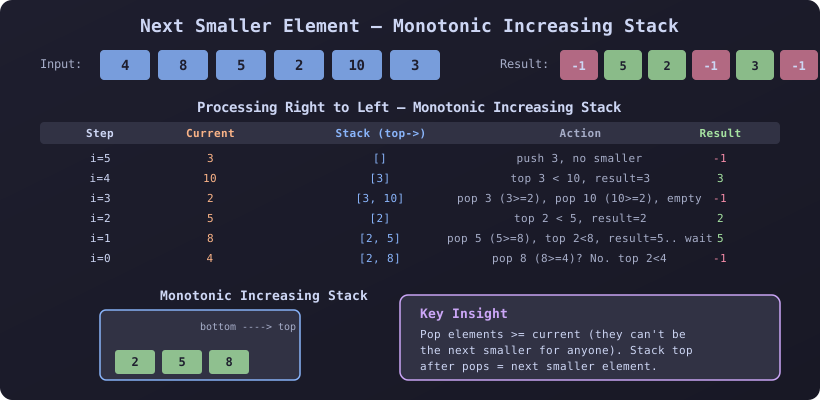
The Next Smaller Element is the mirror image of Next Greater Element. Instead of finding the first larger value to the right, you find the first smaller one. The trick is flipping the monotonic stack from decreasing to increasing.
The Problem
Given an array, for each element find the next smaller element — the first element to its right that is strictly smaller. If none exists, return -1.
Input:  [4, 8, 5, 2, 10, 3]
Output: [2, 5, 2, -1, 3, -1]

Explanation:
  4  → next smaller is 2
  8  → next smaller is 5
  5  → next smaller is 2
  2  → nothing smaller to the right → -1
  10 → next smaller is 3
  3  → nothing smaller to the right → -1
Brute Force — O(n^2)
def next_smaller_brute(arr):
    """For each element scan right — O(n^2) time."""
    n = len(arr)
    result = [-1] * n
    for i in range(n):
        for j in range(i + 1, n):
            if arr[j] < arr[i]:
                result[i] = arr[j]
                break
    return result
This works but is too slow for large inputs. We need the stack approach.
Why a Monotonic Increasing Stack?
For Next Greater we kept a decreasing stack — elements waiting for something bigger. For Next Smaller we flip the invariant: we keep an increasing stack — elements waiting for something smaller.
| Problem | Stack Type | Pop When |
|---|---|---|
| Next Greater | Decreasing | stack[-1] < current |
| Next Smaller | Increasing | stack[-1] > current |
The key rule: pop elements from the stack that are greater than the current element, because the current element is the answer (next smaller) for each popped element.
Optimal Solution — O(n)
Left-to-right approach (natural for “next smaller to the right”)
def next_smaller_element(arr):
    """
    For each element, find the next smaller element to its right.
    Uses a monotonic increasing stack.
    Time: O(n) — each element pushed and popped at most once.
    Space: O(n) — for the stack and result array.
    """
    n = len(arr)
    result = [-1] * n
    stack = []  # stores indices; values at those indices are increasing

    for i in range(n):
        # Pop all elements bigger than arr[i]
        while stack and arr[stack[-1]] > arr[i]:
            idx = stack.pop()
            result[idx] = arr[i]
        stack.append(i)

    return result
Right-to-left approach (alternative)
def next_smaller_rtl(arr):
    """Right-to-left scan — stack holds candidates."""
    n = len(arr)
    result = [-1] * n
    stack = []  # stores values

    for i in range(n - 1, -1, -1):
        # Remove elements >= current (can't be next smaller)
        while stack and stack[-1] >= arr[i]:
            stack.pop()
        if stack:
            result[i] = stack[-1]
        stack.append(arr[i])

    return result
Both approaches are O(n) time and O(n) space. The left-to-right version is slightly more intuitive for most people.
Step-by-Step Trace
Let us trace next_smaller_element([4, 8, 5, 2, 10, 3]) (left-to-right):
i=0, val=4:  stack=[]         → push 0               stack=[0]
i=1, val=8:  stack=[0]        → 4<8, no pop, push 1   stack=[0,1]
i=2, val=5:  stack=[0,1]      → 8>5, pop 1→result[1]=5
                               → 4<5, no pop, push 2   stack=[0,2]
i=3, val=2:  stack=[0,2]      → 5>2, pop 2→result[2]=2
                               → 4>2, pop 0→result[0]=2
                               → push 3                stack=[3]
i=4, val=10: stack=[3]        → 2<10, no pop, push 4  stack=[3,4]
i=5, val=3:  stack=[3,4]      → 10>3, pop 4→result[4]=3
                               → 2<3, no pop, push 5   stack=[3,5]

Remaining in stack: indices 3,5 → result stays -1

Result: [2, 5, 2, -1, 3, -1] ✓
Previous Smaller Element (Left Side)
A common variant: for each element find the nearest smaller element to its left.
def prev_smaller_element(arr):
    """Nearest smaller element to the LEFT of each position."""
    n = len(arr)
    result = [-1] * n
    stack = []  # monotonic increasing stack of values

    for i in range(n):
        while stack and stack[-1] >= arr[i]:
            stack.pop()
        if stack:
            result[i] = stack[-1]
        stack.append(arr[i])

    return result

# Example:
# Input:  [4, 8, 5, 2, 10, 3]
# Output: [-1, 4, 4, -1, 2, 2]
Combining Both Sides
Many problems need both the previous smaller and next smaller for each element (e.g., Sum of Subarray Minimums, Largest Rectangle in Histogram).
def both_smaller(arr):
    """Get previous smaller and next smaller in one pass each."""
    n = len(arr)
    prev_smaller = [-1] * n
    next_smaller = [-1] * n

    # Previous smaller (left to right)
    stack = []
    for i in range(n):
        while stack and arr[stack[-1]] >= arr[i]:
            stack.pop()
        if stack:
            prev_smaller[i] = stack[-1]
        stack.append(i)

    # Next smaller (left to right)
    stack = []
    for i in range(n):
        while stack and arr[stack[-1]] > arr[i]:
            idx = stack.pop()
            next_smaller[idx] = i
        stack.append(i)

    return prev_smaller, next_smaller
Edge Cases
- All elements equal —
[5, 5, 5]→[-1, -1, -1](no strictly smaller) - Sorted ascending —
[1, 2, 3]→[-1, -1, -1](nothing smaller to the right) - Sorted descending —
[3, 2, 1]→[2, 1, -1] - Single element —
[7]→[-1] - Duplicates — watch
>vs>=depending on strict or non-strict
Complexity Analysis
| Approach | Time | Space |
|---|---|---|
| Brute force | O(n^2) | O(n) |
| Monotonic stack | O(n) | O(n) |
Each element is pushed once and popped at most once, giving amortized O(1) per element.
When to Use This Pattern
Use Next Smaller Element (monotonic increasing stack) when you see:
- “Find the first smaller value to the right/left”
- Stock price problems asking for drops
- Histogram or bar-chart area problems
- Any problem combining previous-smaller + next-smaller boundaries
- Temperature problems looking for cooler days
Related Problems
| Problem | Difficulty | Key Idea |
|---|---|---|
| LeetCode 496 — Next Greater Element I | Easy | Decreasing stack baseline |
| LeetCode 84 — Largest Rectangle in Histogram | Hard | Prev + next smaller bounds |
| LeetCode 907 — Sum of Subarray Minimums | Medium | Contribution with both sides |
| LeetCode 739 — Daily Temperatures | Medium | Next greater variant |
Key Takeaway
The Next Smaller Element pattern is the complement of Next Greater. Swap the stack invariant from decreasing to increasing, and flip the comparison. Once you are comfortable with both, you can solve almost any monotonic-stack problem by recognizing which variant applies.
Related articles
- DSA Implement Stack Using Two Queues — Two Approaches Explained
Implement a stack using two queues with costly push and costly pop approaches. Complete Python solutions with complexity analysis.
- DSA Asteroid Collision Problem Using Stacks
Solve the asteroid collision problem (LeetCode 735) using a stack. Covers collision rules, Python implementation, and all edge cases.
- DSA Car Fleet Problem — Stack-Based Arrival Time Solution
Solve LeetCode 853 Car Fleet using a stack. Sort by position, compare arrival times, and count fleets. Python solution with visual trace.
- DSA The Celebrity Problem Using Stack-Based Elimination
Solve the celebrity problem in O(n) time using a stack elimination technique. Includes proof of correctness, Python code, and matrix examples.