Greedy vs DP: When to Use Which Approach
Learn when greedy algorithms work and when you need dynamic programming. Covers greedy choice property, optimal substructure, exchange arguments, and side-by-side comparisons.
What you'll learn
- ✓The two properties that decide greedy vs DP
- ✓Why greedy fails for coin change with arbitrary denominations
- ✓How the exchange argument proves greedy correctness
- ✓Side-by-side Python solutions comparing both approaches
- ✓A decision framework for choosing the right technique
Prerequisites
- •Recursion: [Recursion Fundamentals](/blog/recursion-fundamentals)
- •Big-O: [Big-O Notation Explained](/blog/big-o-notation-explained)
- •Arrays: [Arrays Introduction](/blog/arrays-introduction)
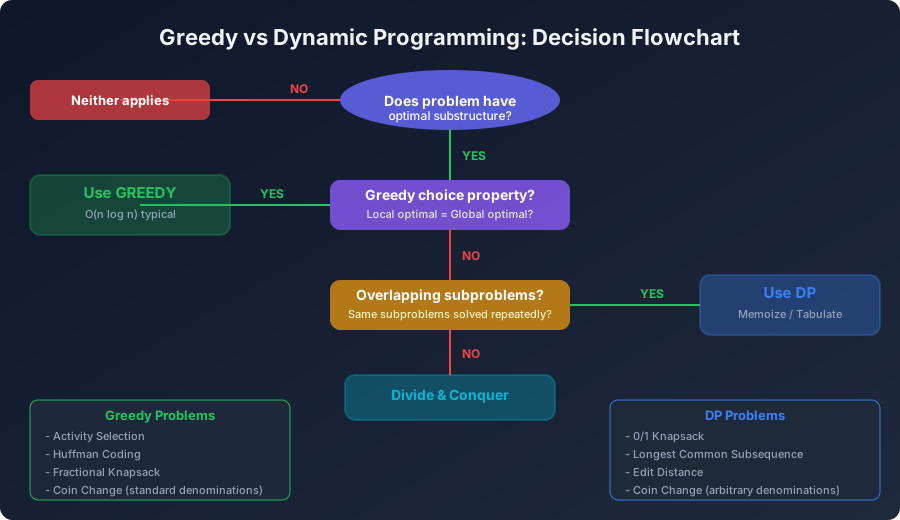
Both greedy algorithms and dynamic programming solve optimization problems, but they are fundamentally different strategies. Choosing the wrong one can lead to incorrect answers or unnecessary complexity. This guide gives you a concrete framework for deciding which to use.
The two key properties
Every optimization problem you encounter in interviews or contests has some combination of these two structural properties.
Optimal substructure
A problem has optimal substructure if the optimal solution to the whole problem contains optimal solutions to its subproblems. Both greedy and DP require this property.
For example, the shortest path from A to C through B must use the shortest path from A to B and the shortest path from B to C. If it did not, you could substitute a shorter sub-path and get a shorter total path, which is a contradiction.
Greedy choice property
A problem has the greedy choice property if a locally optimal choice at each step leads to a globally optimal solution. This is what separates greedy from DP.
When the greedy choice property holds, you never need to reconsider past decisions. You pick the best option right now and move on. When it does not hold, you need DP to explore all possibilities.
When greedy works: activity selection
The activity selection problem is the textbook example of a correct greedy approach. Given a set of activities with start and finish times, select the maximum number of non-overlapping activities.
def activity_selection(activities):
    """
    Greedy: always pick the activity that finishes earliest.
    Time: O(n log n) for sorting
    Space: O(1) extra (ignoring output)
    """
    # Sort by finish time
    activities.sort(key=lambda x: x[1])

    selected = [activities[0]]
    last_finish = activities[0][1]

    for start, finish in activities[1:]:
        if start >= last_finish:
            selected.append((start, finish))
            last_finish = finish

    return selected


# Example
activities = [(1, 4), (3, 5), (0, 6), (5, 7), (3, 9), (5, 9),
              (6, 10), (8, 11), (8, 12), (2, 14), (12, 16)]
result = activity_selection(activities)
print(f"Selected {len(result)} activities: {result}")
# Selected 4 activities: [(1, 4), (5, 7), (8, 11), (12, 16)]
Why greedy works here: Choosing the earliest-finishing activity leaves the most room for future activities. You can prove this with the exchange argument (covered below).
When greedy fails: coin change
The coin change problem asks for the minimum number of coins to make a
target amount. With standard denominations like [1, 5, 10, 25], greedy
works perfectly. But with arbitrary denominations, it can fail.
def coin_change_greedy(coins, amount):
    """
    Greedy: always pick the largest coin that fits.
    INCORRECT for arbitrary denominations!
    """
    coins.sort(reverse=True)
    count = 0
    for coin in coins:
        if amount <= 0:
            break
        count += amount // coin
        amount %= coin
    return count if amount == 0 else -1


def coin_change_dp(coins, amount):
    """
    DP: explore all possibilities.
    Time: O(amount * len(coins))
    Space: O(amount)
    """
    dp = [float('inf')] * (amount + 1)
    dp[0] = 0

    for a in range(1, amount + 1):
        for coin in coins:
            if coin <= a and dp[a - coin] + 1 < dp[a]:
                dp[a] = dp[a - coin] + 1

    return dp[amount] if dp[amount] != float('inf') else -1


# Standard denominations: greedy works
coins_standard = [1, 5, 10, 25]
print(coin_change_greedy(coins_standard, 30))  # 2 (25 + 5) - correct
print(coin_change_dp(coins_standard, 30))       # 2 - correct

# Arbitrary denominations: greedy FAILS
coins_arbitrary = [1, 3, 4]
print(coin_change_greedy(coins_arbitrary, 6))   # 3 (4 + 1 + 1) - WRONG
print(coin_change_dp(coins_arbitrary, 6))        # 2 (3 + 3) - correct
Why greedy fails: With coins [1, 3, 4] and amount 6, greedy picks
4 first, then needs two 1s for a total of 3 coins. But 3 + 3 = 6
uses only 2 coins. The locally optimal choice (pick the biggest coin) does
not lead to the globally optimal answer.
The exchange argument
The exchange argument is the standard technique for proving a greedy algorithm is correct. The steps are:
- Assume an optimal solution
OPTexists. - If
OPTalready follows the greedy strategy, we are done. - If not, find the first place where
OPTdiffers from greedy. - Show you can exchange the non-greedy choice for the greedy one without making the solution worse.
- Repeat until
OPTmatches the greedy solution entirely.
Exchange argument for activity selection
Let G be the greedy solution and OPT be any optimal solution. Suppose
the first difference is at position k: greedy picks activity g_k with
finish time f(g_k), while OPT picks o_k with finish time f(o_k).
Since greedy always picks the earliest finish time, f(g_k) <= f(o_k).
Replace o_k with g_k in OPT. This does not create any conflicts
because g_k finishes no later than o_k, so all subsequent activities in
OPT remain compatible. The size of the solution stays the same. Therefore
OPT with the swap is still optimal, and now it agrees with greedy at
position k. Repeat for all positions.
Side-by-side comparison: fractional vs 0/1 knapsack
This is the clearest illustration of when greedy works vs when you need DP.
def fractional_knapsack(items, capacity):
    """
    Greedy: sort by value/weight ratio, take greedily.
    Works because you can take fractions.
    Time: O(n log n)
    """
    # items = [(value, weight), ...]
    items.sort(key=lambda x: x[0] / x[1], reverse=True)

    total_value = 0
    for value, weight in items:
        if capacity <= 0:
            break
        take = min(weight, capacity)
        total_value += take * (value / weight)
        capacity -= take

    return total_value


def knapsack_01_dp(items, capacity):
    """
    DP: must take whole items or nothing.
    Greedy does NOT work here.
    Time: O(n * capacity)
    Space: O(capacity)
    """
    n = len(items)
    dp = [0] * (capacity + 1)

    for value, weight in items:
        # Traverse backwards to avoid using same item twice
        for w in range(capacity, weight - 1, -1):
            dp[w] = max(dp[w], dp[w - weight] + value)

    return dp[capacity]


# Example
items = [(60, 10), (100, 20), (120, 30)]  # (value, weight)
capacity = 50

print(f"Fractional knapsack: {fractional_knapsack(items, capacity)}")
# 240.0 (all of item1, all of item2, 2/3 of item3)

print(f"0/1 knapsack: {knapsack_01_dp(items, capacity)}")
# 220 (item2 + item3)
Why the difference? In fractional knapsack, taking a fraction of the best-ratio item is always safe because you can take partial items. In 0/1 knapsack, you might skip a high-ratio item to fit two smaller items that together give more value. The greedy choice of taking the best ratio first is not guaranteed to be globally optimal.
More problems where greedy works
Huffman coding
Build an optimal prefix-free code by always merging the two least-frequent symbols first.
import heapq

def huffman_coding(freq):
    """
    Build Huffman tree greedily.
    Time: O(n log n)
    """
    heap = [[f, [char, ""]] for char, f in freq.items()]
    heapq.heapify(heap)

    if len(heap) == 1:
        heap[0][1][1] = "0"
        return {heap[0][1][0]: "0"}

    while len(heap) > 1:
        lo = heapq.heappop(heap)
        hi = heapq.heappop(heap)

        for pair in lo[1:]:
            pair[1] = '0' + pair[1]
        for pair in hi[1:]:
            pair[1] = '1' + pair[1]

        merged = [lo[0] + hi[0]] + lo[1:] + hi[1:]
        heapq.heappush(heap, merged)

    codes = {}
    for pair in heap[0][1:]:
        codes[pair[0]] = pair[1]
    return codes


freq = {'a': 5, 'b': 9, 'c': 12, 'd': 13, 'e': 16, 'f': 45}
codes = huffman_coding(freq)
for char, code in sorted(codes.items()):
    print(f"  {char}: {code}")
Jump game (can you reach the end?)
def can_jump(nums):
    """
    Greedy: track the farthest reachable index.
    Time: O(n), Space: O(1)
    """
    farthest = 0
    for i, jump in enumerate(nums):
        if i > farthest:
            return False
        farthest = max(farthest, i + jump)
    return True

print(can_jump([2, 3, 1, 1, 4]))  # True
print(can_jump([3, 2, 1, 0, 4]))  # False
More problems where DP is needed
Longest Common Subsequence
def lcs(text1, text2):
    """
    DP: overlapping subproblems prevent greedy approach.
    Time: O(m * n)
    Space: O(min(m, n)) with space optimization
    """
    m, n = len(text1), len(text2)
    if m < n:
        text1, text2 = text2, text1
        m, n = n, m

    prev = [0] * (n + 1)
    curr = [0] * (n + 1)

    for i in range(1, m + 1):
        for j in range(1, n + 1):
            if text1[i - 1] == text2[j - 1]:
                curr[j] = prev[j - 1] + 1
            else:
                curr[j] = max(prev[j], curr[j - 1])
        prev, curr = curr, [0] * (n + 1)

    return prev[n]


print(lcs("abcde", "ace"))  # 3 ("ace")
Edit distance
def edit_distance(word1, word2):
    """
    DP: minimum operations to convert word1 to word2.
    Time: O(m * n)
    """
    m, n = len(word1), len(word2)
    dp = [[0] * (n + 1) for _ in range(m + 1)]

    for i in range(m + 1):
        dp[i][0] = i
    for j in range(n + 1):
        dp[0][j] = j

    for i in range(1, m + 1):
        for j in range(1, n + 1):
            if word1[i - 1] == word2[j - 1]:
                dp[i][j] = dp[i - 1][j - 1]
            else:
                dp[i][j] = 1 + min(
                    dp[i - 1][j],      # delete
                    dp[i][j - 1],      # insert
                    dp[i - 1][j - 1]   # replace
                )

    return dp[m][n]


print(edit_distance("horse", "ros"))  # 3
Decision framework
Use this checklist when you encounter an optimization problem:
| Question | Yes | No |
|---|---|---|
| Optimal substructure? | Continue | Neither greedy nor DP |
| Can you always pick the locally best option? | Try greedy | Use DP |
| Can you prove the exchange argument? | Greedy is correct | Use DP |
| Are there overlapping subproblems? | DP will be efficient | Divide and conquer |
Quick heuristics
- “Maximize/minimize something with no constraints on choices” - often greedy
- “Count all ways” or “maximize with constraints” - usually DP
- Sorting helps - leans toward greedy
- “At most K” or “exactly K” - usually DP
- Interval scheduling - greedy (sort by end time)
- Subsequence problems - DP
Common mistakes
Mistake 1: Assuming greedy works without proof.
Many problems look like they should work with greedy but do not. Always verify with counterexamples or prove correctness.
# WRONG greedy for job scheduling with profits
# Just because a job has the highest profit doesn't mean
# picking it first is optimal - it might block several
# other profitable jobs.
Mistake 2: Using DP when greedy is sufficient.
If greedy works, it is almost always faster and simpler. Activity selection is O(n log n) with greedy but O(n^2) with DP.
Mistake 3: Confusing “greedy works for a special case” with “greedy works in general.”
Coin change with [1, 5, 10, 25] works with greedy, but the general
coin change problem does not.
Complexity comparison
| Approach | Time | Space | When to use |
|---|---|---|---|
| Greedy | O(n log n) typical | O(1) typical | Greedy choice property holds |
| DP (top-down) | O(states) | O(states) | Overlapping subproblems, need memoization |
| DP (bottom-up) | O(states) | O(states) | Same, but iterative |
| Brute force | O(2^n) or O(n!) | O(n) | Only for verification |
Practice problems
| Problem | Approach | Difficulty |
|---|---|---|
| Activity Selection | Greedy | Easy |
| Fractional Knapsack | Greedy | Easy |
| Jump Game | Greedy | Medium |
| Huffman Coding | Greedy | Medium |
| Coin Change | DP | Medium |
| 0/1 Knapsack | DP | Medium |
| Longest Common Subsequence | DP | Medium |
| Edit Distance | DP | Medium |
| Job Scheduling with Deadlines | Greedy | Medium |
| Minimum Number of Platforms | Greedy | Medium |
Key takeaways
- Both greedy and DP need optimal substructure.
- Greedy additionally needs the greedy choice property - the local best is the global best.
- Use the exchange argument to prove greedy correctness.
- When in doubt, try greedy with counterexamples first. If you find one where greedy fails, switch to DP.
- Greedy is typically faster (O(n log n)) while DP is typically O(n * k) for some dimension k.
Related articles
- DSA Greedy Algorithm Patterns: From Activity Selection to Huffman
Master greedy algorithm patterns including activity selection, fractional knapsack, Huffman coding, job scheduling, and gas station. With proofs and Python code.
- DSA Interval Problems: Merge, Insert, Schedule, and Sweep
Master interval problems — merge intervals, insert interval, meeting rooms, interval scheduling, sweep line technique, and non-overlapping intervals with Python implementations.
- DSA Greedy Algorithms: When Locally Best Wins Globally
An introduction to greedy algorithms — when the locally best choice gives a globally optimal answer, when it doesn't, the exchange argument, and six classic problems.
- DSA BFS Pattern with Queues: Level-Order and Shortest Path
Master BFS using queues for tree level-order traversal and shortest path in unweighted graphs. Python implementations with detailed traces.