Subarray Sum Patterns: Prefix Sum, Kadane, and Sliding Window
Master subarray sum techniques — prefix sum for range queries, Kadane's algorithm for maximum subarray, hash map for subarray sum equals K, sliding window, and maximum product subarray.
What you'll learn
- ✓The prefix sum technique and range sum queries in O(1)
- ✓Subarray sum equals K using hash map (prefix sum + counting)
- ✓Kadane's algorithm for maximum subarray sum
- ✓Maximum product subarray — handling negatives
- ✓Sliding window for minimum size subarray sum
- ✓When to use prefix sum vs sliding window vs Kadane's
Prerequisites
- •Comfortable with arrays and basic operations
- •Familiar with Big-O notation
Subarray sum problems are among the most frequently asked interview questions. They appear simple — “find a contiguous subarray with some sum property” — but the efficient solutions require knowing the right technique. This post covers the three pillars: prefix sums, Kadane’s algorithm, and sliding window.
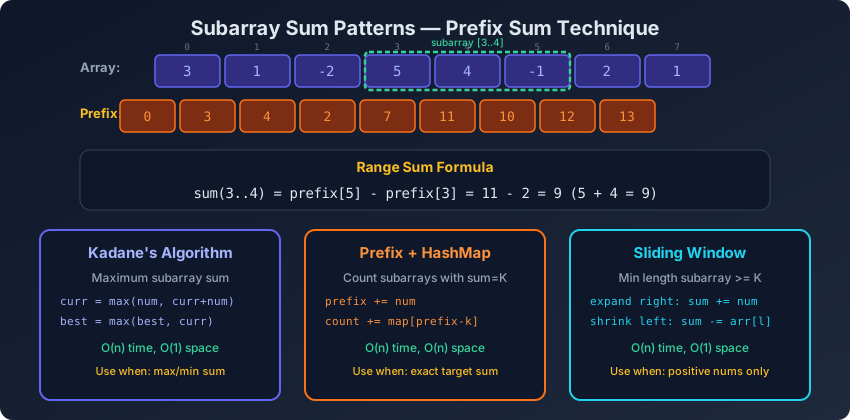
1. Prefix Sum — The Foundation
The prefix sum (or cumulative sum) of an array arr is a new array where prefix[i] = arr[0] + arr[1] + ... + arr[i-1]. With prefix sums, you can compute the sum of any subarray in O(1).
def build_prefix_sum(arr):
    """
    Build a prefix sum array.

    prefix[0] = 0 (sum of zero elements)
    prefix[i] = arr[0] + arr[1] + ... + arr[i-1]

    Time: O(n), Space: O(n)
    """
    n = len(arr)
    prefix = [0] * (n + 1)

    for i in range(n):
        prefix[i + 1] = prefix[i] + arr[i]

    return prefix


def range_sum(prefix, left, right):
    """
    Sum of arr[left..right] (inclusive) in O(1).

    sum(arr[left..right]) = prefix[right+1] - prefix[left]
    """
    return prefix[right + 1] - prefix[left]


arr = [3, 1, -2, 5, 4, -1, 2, 1]
prefix = build_prefix_sum(arr)
print(f"Prefix array: {prefix}")
# [0, 3, 4, 2, 7, 11, 10, 12, 13]

print(f"Sum of arr[2..4] = {range_sum(prefix, 2, 4)}")  # -2+5+4 = 7
print(f"Sum of arr[0..7] = {range_sum(prefix, 0, 7)}")  # 13
print(f"Sum of arr[5..6] = {range_sum(prefix, 5, 6)}")  # -1+2 = 1
2. 2D Prefix Sum
For matrices, extend prefix sums to 2D for O(1) submatrix sum queries.
def build_2d_prefix(matrix):
    """
    Build a 2D prefix sum matrix.

    prefix[i][j] = sum of all elements in matrix[0..i-1][0..j-1]

    Time: O(mn), Space: O(mn)
    """
    m, n = len(matrix), len(matrix[0])
    prefix = [[0] * (n + 1) for _ in range(m + 1)]

    for i in range(1, m + 1):
        for j in range(1, n + 1):
            prefix[i][j] = (
                matrix[i - 1][j - 1]
                + prefix[i - 1][j]
                + prefix[i][j - 1]
                - prefix[i - 1][j - 1]
            )

    return prefix


def submatrix_sum(prefix, r1, c1, r2, c2):
    """
    Sum of matrix[r1..r2][c1..c2] (inclusive) in O(1).
    Uses inclusion-exclusion.
    """
    return (
        prefix[r2 + 1][c2 + 1]
        - prefix[r1][c2 + 1]
        - prefix[r2 + 1][c1]
        + prefix[r1][c1]
    )


matrix = [
    [1, 2, 3],
    [4, 5, 6],
    [7, 8, 9],
]
prefix = build_2d_prefix(matrix)
print(submatrix_sum(prefix, 0, 0, 1, 1))  # 1+2+4+5 = 12
print(submatrix_sum(prefix, 1, 1, 2, 2))  # 5+6+8+9 = 28
3. Subarray Sum Equals K
Problem: count the number of contiguous subarrays with sum equal to k.
Key insight: if prefix[j] - prefix[i] == k, then sum(arr[i..j-1]) == k. So we need to count how many previous prefix values equal prefix[j] - k.
from collections import defaultdict

def subarray_sum_equals_k(nums, k):
    """
    LeetCode 560: Subarray Sum Equals K.

    Use prefix sum + hash map.

    Time: O(n), Space: O(n)
    """
    count = 0
    prefix = 0
    prefix_count = defaultdict(int)
    prefix_count[0] = 1  # empty prefix has sum 0

    for num in nums:
        prefix += num

        # How many previous prefixes have value (prefix - k)?
        # Each such prefix marks the start of a subarray summing to k
        count += prefix_count[prefix - k]

        prefix_count[prefix] += 1

    return count


print(subarray_sum_equals_k([1, 1, 1], 2))      # 2 ([1,1] at indices 0-1 and 1-2)
print(subarray_sum_equals_k([1, 2, 3], 3))       # 2 ([1,2] and [3])
print(subarray_sum_equals_k([1, -1, 0], 0))      # 3 ([1,-1], [-1,0], [1,-1,0])
Why Not Sliding Window?
Sliding window works only when all elements are positive (or when you need a contiguous window of fixed/variable size with monotonic behavior). With negative numbers, shrinking the window can increase the sum, breaking the sliding window invariant.
4. Kadane’s Algorithm — Maximum Subarray
Problem: find the contiguous subarray with the largest sum.
def max_subarray(nums):
    """
    LeetCode 53: Maximum Subarray (Kadane's Algorithm).

    At each position, decide: start a new subarray here,
    or extend the previous one.

    Time: O(n), Space: O(1)
    """
    max_sum = nums[0]
    current_sum = nums[0]

    for i in range(1, len(nums)):
        # Either start fresh at nums[i] or extend previous subarray
        current_sum = max(nums[i], current_sum + nums[i])
        max_sum = max(max_sum, current_sum)

    return max_sum


print(max_subarray([-2, 1, -3, 4, -1, 2, 1, -5, 4]))
# 6 (subarray [4, -1, 2, 1])

print(max_subarray([1]))           # 1
print(max_subarray([5, 4, -1, 7, 8]))  # 23 (entire array)
Finding the Subarray Itself
def max_subarray_with_indices(nums):
    """Return the maximum subarray sum and its start/end indices."""
    max_sum = nums[0]
    current_sum = nums[0]
    start = end = 0
    temp_start = 0

    for i in range(1, len(nums)):
        if nums[i] > current_sum + nums[i]:
            current_sum = nums[i]
            temp_start = i
        else:
            current_sum += nums[i]

        if current_sum > max_sum:
            max_sum = current_sum
            start = temp_start
            end = i

    return max_sum, start, end


nums = [-2, 1, -3, 4, -1, 2, 1, -5, 4]
total, s, e = max_subarray_with_indices(nums)
print(f"Max sum: {total}, subarray: {nums[s:e+1]}")
# Max sum: 6, subarray: [4, -1, 2, 1]
Kadane’s for Minimum Subarray
def min_subarray(nums):
    """Find the contiguous subarray with the smallest sum."""
    min_sum = nums[0]
    current_sum = nums[0]

    for i in range(1, len(nums)):
        current_sum = min(nums[i], current_sum + nums[i])
        min_sum = min(min_sum, current_sum)

    return min_sum


print(min_subarray([3, -4, 2, -3, -1, 7, -5]))
# -6 (subarray [-4, 2, -3, -1])
5. Maximum Subarray Sum with Circular Array
Problem: the array is circular — the subarray can wrap around.
def max_subarray_circular(nums):
    """
    LeetCode 918: Maximum Sum Circular Subarray.

    Two cases:
    1. Max subarray does NOT wrap — use Kadane's
    2. Max subarray WRAPS — total_sum - min_subarray

    Take the max of both cases.

    Edge case: if all elements are negative, min_subarray = total,
    so case 2 gives 0. Return case 1 (the least negative element).

    Time: O(n), Space: O(1)
    """
    total_sum = sum(nums)

    # Case 1: normal Kadane's
    max_kadane = nums[0]
    curr_max = nums[0]
    for i in range(1, len(nums)):
        curr_max = max(nums[i], curr_max + nums[i])
        max_kadane = max(max_kadane, curr_max)

    # Case 2: wrapping = total - min subarray
    min_kadane = nums[0]
    curr_min = nums[0]
    for i in range(1, len(nums)):
        curr_min = min(nums[i], curr_min + nums[i])
        min_kadane = min(min_kadane, curr_min)

    # If all negative, min_kadane == total_sum, and wrapping gives 0
    if total_sum == min_kadane:
        return max_kadane

    return max(max_kadane, total_sum - min_kadane)


print(max_subarray_circular([1, -2, 3, -2]))     # 3
print(max_subarray_circular([5, -3, 5]))          # 10 (wraps: [5, 5])
print(max_subarray_circular([-3, -2, -3]))        # -2 (all negative)
6. Maximum Product Subarray
Problem: find the contiguous subarray with the largest product. Negatives make this tricky — multiplying two negatives gives a positive.
def max_product(nums):
    """
    LeetCode 152: Maximum Product Subarray.

    Track both max and min products ending at each position.
    A negative number can flip min to max.

    Time: O(n), Space: O(1)
    """
    result = nums[0]
    curr_max = nums[0]
    curr_min = nums[0]

    for i in range(1, len(nums)):
        # If nums[i] is negative, max and min swap
        if nums[i] < 0:
            curr_max, curr_min = curr_min, curr_max

        curr_max = max(nums[i], curr_max * nums[i])
        curr_min = min(nums[i], curr_min * nums[i])

        result = max(result, curr_max)

    return result


print(max_product([2, 3, -2, 4]))     # 6 ([2, 3])
print(max_product([-2, 0, -1]))       # 0
print(max_product([-2, 3, -4]))       # 24 ([-2, 3, -4])
print(max_product([2, -5, -2, -4, 3])) # 24 ([-2, -4, 3]? No: [-5,-2,-4,3]=120? Let's check: -5*-2=10, 10*-4=-40, -40*3=-120. Actually [2,-5,-2,-4] = 2*-5*-2*-4 = -80. Hmm, [-2,-4,3]=24.)
7. Minimum Size Subarray Sum (Sliding Window)
Problem: find the minimal length subarray whose sum is > k. All elements are positive.
def min_subarray_len(target, nums):
    """
    LeetCode 209: Minimum Size Subarray Sum.

    Sliding window — works because all elements are positive.

    Time: O(n), Space: O(1)
    """
    n = len(nums)
    min_len = float('inf')
    window_sum = 0
    left = 0

    for right in range(n):
        window_sum += nums[right]

        while window_sum >= target:
            min_len = min(min_len, right - left + 1)
            window_sum -= nums[left]
            left += 1

    return min_len if min_len != float('inf') else 0


print(min_subarray_len(7, [2, 3, 1, 2, 4, 3]))  # 2 ([4, 3])
print(min_subarray_len(4, [1, 4, 4]))             # 1 ([4])
print(min_subarray_len(11, [1, 1, 1, 1, 1, 1]))  # 0 (impossible)
8. Subarray Sum Divisible by K
def subarrays_div_by_k(nums, k):
    """
    LeetCode 974: Subarray Sums Divisible by K.

    If prefix[j] % k == prefix[i] % k, then sum(arr[i..j-1]) is divisible by k.

    Time: O(n), Space: O(k)
    """
    count = 0
    prefix_mod = 0
    mod_count = defaultdict(int)
    mod_count[0] = 1

    for num in nums:
        prefix_mod = (prefix_mod + num) % k
        count += mod_count[prefix_mod]
        mod_count[prefix_mod] += 1

    return count


print(subarrays_div_by_k([4, 5, 0, -2, -3, 1], 5))  # 7
print(subarrays_div_by_k([5], 9))                     # 0
9. Longest Subarray with Sum at Most K
def longest_subarray_sum_at_most_k(nums, k):
    """
    Find the longest subarray with sum <= k.
    Works for non-negative elements (sliding window).

    Time: O(n), Space: O(1)
    """
    n = len(nums)
    max_len = 0
    window_sum = 0
    left = 0

    for right in range(n):
        window_sum += nums[right]

        while window_sum > k and left <= right:
            window_sum -= nums[left]
            left += 1

        max_len = max(max_len, right - left + 1)

    return max_len


print(longest_subarray_sum_at_most_k([1, 2, 1, 0, 1, 1, 0], 4))
# 5 (subarray [1, 0, 1, 1, 0] or [2, 1, 0, 1] etc.)
10. Prefix XOR — Subarray XOR Queries
Prefix sums work with any associative operation. XOR is a common variant.
def subarray_xor_equals_k(nums, k):
    """
    Count subarrays with XOR equal to k.

    prefix_xor[j] ^ prefix_xor[i] == k means subarray[i..j-1] has XOR = k.
    Equivalent to prefix_xor[i] == prefix_xor[j] ^ k.

    Time: O(n), Space: O(n)
    """
    count = 0
    prefix_xor = 0
    xor_count = defaultdict(int)
    xor_count[0] = 1

    for num in nums:
        prefix_xor ^= num
        count += xor_count[prefix_xor ^ k]
        xor_count[prefix_xor] += 1

    return count


print(subarray_xor_equals_k([4, 2, 2, 6, 4], 6))  # 4
print(subarray_xor_equals_k([5, 6, 7, 8, 9], 5))   # 2
11. Decision Guide — Which Technique to Use
| Condition | Technique | Time |
|---|---|---|
| Range sum queries (offline) | Prefix sum | O(1) per query |
| Maximum/minimum subarray sum | Kadane’s | O(n) |
| Count subarrays with sum = K | Prefix sum + hash map | O(n) |
| Minimum length subarray > K (positive) | Sliding window | O(n) |
| Maximum length subarray <= K (positive) | Sliding window | O(n) |
| Subarray sum divisible by K | Prefix sum mod + hash map | O(n) |
| Maximum product subarray | Track max and min | O(n) |
| 2D range sum queries | 2D prefix sum | O(1) per query |
Quick Decision Flowchart
- All positive numbers? Try sliding window first.
- Need exact count with target sum? Prefix sum + hash map.
- Need maximum/minimum sum? Kadane’s algorithm.
- Multiple range queries? Build prefix sum array upfront.
- Has negatives + need window? Prefix sum + hash map (not sliding window).
12. Advanced: Difference Array
The difference array is the inverse of prefix sum. It allows O(1) range updates.
def range_update_example():
    """
    Apply multiple range updates, then compute final array.

    Update: add val to arr[l..r]
    Using difference array: O(1) per update, O(n) to reconstruct.
    """
    n = 5
    diff = [0] * (n + 1)

    def add_range(l, r, val):
        diff[l] += val
        diff[r + 1] -= val

    # Add 3 to arr[1..3]
    add_range(1, 3, 3)
    # Add 5 to arr[2..4]
    add_range(2, 4, 5)

    # Reconstruct with prefix sum
    result = [0] * n
    result[0] = diff[0]
    for i in range(1, n):
        result[i] = result[i - 1] + diff[i]

    print(result)  # [0, 3, 8, 8, 5]
    # arr[1..3] += 3 -> [0, 3, 3, 3, 0]
    # arr[2..4] += 5 -> [0, 3, 8, 8, 5]


range_update_example()
13. Practice Problems
| Problem | Platform | Key Technique |
|---|---|---|
| Maximum Subarray (LC 53) | LeetCode | Kadane’s |
| Subarray Sum Equals K (LC 560) | LeetCode | Prefix + hash map |
| Minimum Size Subarray Sum (LC 209) | LeetCode | Sliding window |
| Maximum Product Subarray (LC 152) | LeetCode | Track max/min |
| Maximum Sum Circular Subarray (LC 918) | LeetCode | Kadane’s + wrapping |
| Subarray Sums Divisible by K (LC 974) | LeetCode | Prefix mod + hash map |
| Range Sum Query (LC 303) | LeetCode | Prefix sum |
| Range Sum Query 2D (LC 304) | LeetCode | 2D prefix sum |
| Contiguous Array (LC 525) | LeetCode | Prefix sum (0/1) |
| Product of Array Except Self (LC 238) | LeetCode | Prefix/suffix products |
Big-O Summary
| Algorithm | Time | Space |
|---|---|---|
| Build prefix sum | O(n) | O(n) |
| Range sum query | O(1) | O(1) |
| 2D prefix sum build | O(mn) | O(mn) |
| 2D range query | O(1) | O(1) |
| Kadane’s (max subarray) | O(n) | O(1) |
| Prefix + hash map (count) | O(n) | O(n) |
| Sliding window | O(n) | O(1) |
| Max product subarray | O(n) | O(1) |
| Difference array update | O(1) per update | O(n) |
Subarray sum problems are the bread and butter of array-based interviews. The three core techniques — prefix sum, Kadane’s, and sliding window — each handle different constraints. Know when to reach for each one, and these problems become mechanical.
Related articles
- DSA Advanced Prefix Sum: 2D, Difference Arrays, and Beyond
Master advanced prefix sum techniques — 2D prefix sums for submatrix queries, difference arrays for range updates in O(1), subarray sum divisible by K, XOR prefix, and more.
- DSA Matrix Traversal Patterns: Spiral, Diagonal, Rotation
Master matrix traversal patterns — spiral order, diagonal traversal, zigzag, boundary traversal, matrix rotation, transpose, search in 2D matrix, and set matrix zeroes with Python.
- DSA Maximum Subarray — Kadane's Algorithm Explained
A clear walkthrough of Maximum Subarray. We build Kadane's algorithm from first principles and contrast it with the divide and conquer approach.
- DSA Product of Array Except Self — Prefix and Suffix, No Division
Solve Product of Array Except Self in O(n) without division using prefix and suffix passes. Clean walkthrough plus interview script.