Flood Fill, Surrounded Regions, and Enclaves
Master flood fill, surrounded regions, number of enclaves, and Pacific Atlantic water flow using DFS and BFS grid traversal techniques in Python.
What you'll learn
- ✓How to implement flood fill with DFS and BFS
- ✓How to solve surrounded regions by inverting the problem
- ✓How to count enclaves (land cells not reachable from boundaries)
- ✓How Pacific Atlantic water flow uses dual-origin BFS
- ✓Common grid traversal patterns and edge cases
Prerequisites
- •Graphs: [Graphs: BFS and DFS](/blog/graphs-bfs-and-dfs)
- •Arrays: [Arrays Introduction](/blog/arrays-introduction)
- •Big-O basics: [Big-O Notation Explained](/blog/big-o-notation-explained)
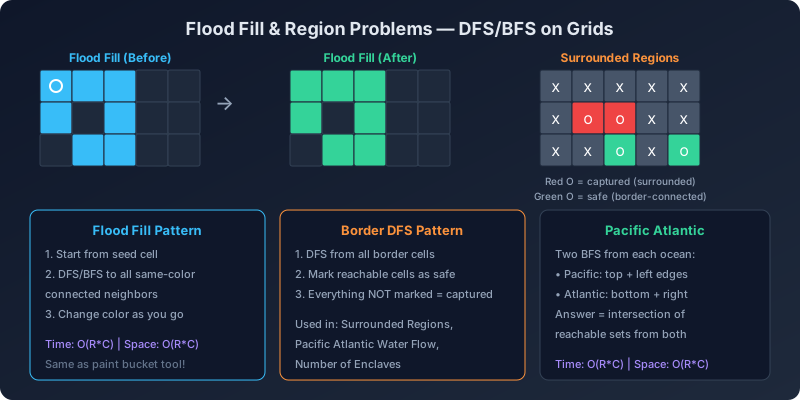
Grid-based graph problems are among the most common in coding interviews. The grid itself is an implicit graph where each cell connects to its 4-directional (or sometimes 8-directional) neighbors. Flood fill is the foundational technique: start at a cell and spread to all connected cells that meet a condition.
This article covers four classic problems that all build on the flood fill idea.
The 4-directional pattern
Almost every grid traversal uses this directional array:
DIRS = [(0, 1), (0, -1), (1, 0), (-1, 0)]A helper to check bounds:
def in_bounds(r: int, c: int, rows: int, cols: int) -> bool:
    return 0 <= r < rows and 0 <= c < cols
These two pieces appear in virtually every grid problem. Memorize them.
Problem 1: Flood Fill (LeetCode 733)
Problem: Given an image (2D grid of integers), a starting pixel
(sr, sc), and a new color, flood fill the connected region of the same
original color.
DFS approach
def flood_fill(image: list[list[int]], sr: int, sc: int, color: int) -> list[list[int]]:
    """
    LeetCode 733: Flood Fill.
    Replace the connected region starting at (sr, sc) with the new color.
    """
    rows, cols = len(image), len(image[0])
    original = image[sr][sc]

    if original == color:
        return image         # no-op: avoids infinite recursion

    def dfs(r: int, c: int):
        image[r][c] = color
        for dr, dc in [(0, 1), (0, -1), (1, 0), (-1, 0)]:
            nr, nc = r + dr, c + dc
            if 0 <= nr < rows and 0 <= nc < cols and image[nr][nc] == original:
                dfs(nr, nc)

    dfs(sr, sc)
    return image
BFS approach
from collections import deque

def flood_fill_bfs(image: list[list[int]], sr: int, sc: int, color: int) -> list[list[int]]:
    """
    BFS-based flood fill.
    """
    rows, cols = len(image), len(image[0])
    original = image[sr][sc]

    if original == color:
        return image

    queue = deque([(sr, sc)])
    image[sr][sc] = color

    while queue:
        r, c = queue.popleft()
        for dr, dc in [(0, 1), (0, -1), (1, 0), (-1, 0)]:
            nr, nc = r + dr, c + dc
            if 0 <= nr < rows and 0 <= nc < cols and image[nr][nc] == original:
                image[nr][nc] = color
                queue.append((nr, nc))

    return image
Time: O(m * n) where m and n are grid dimensions.
Space: O(m * n) worst case for the recursion stack or queue.
DFS vs BFS for grids
| Aspect | DFS | BFS |
|---|---|---|
| Implementation | Simpler (recursion) | Slightly more code (queue) |
| Stack risk | Stack overflow on large grids | No stack overflow |
| Order | Deep-first exploration | Layer-by-layer |
| When to prefer | Small grids, simpler code | Large grids, shortest path |
Problem 2: Surrounded Regions (LeetCode 130)
Problem: Given an m x n board of 'X' and 'O', capture all
regions of 'O' that are completely surrounded by 'X'. A region
is not captured if any of its cells is on the board boundary.
Key insight: invert the problem
Instead of finding surrounded regions (hard), find unsurrounded regions (easy) and mark everything else.
- Start DFS/BFS from every
'O'on the boundary. - Mark all connected
'O'cells as safe (e.g.,'S'). - Sweep the board: remaining
'O'cells become'X', and'S'cells revert to'O'.
def solve(board: list[list[str]]) -> None:
    """
    LeetCode 130: Surrounded Regions.
    Modifies board in-place.
    """
    if not board or not board[0]:
        return

    rows, cols = len(board), len(board[0])

    def dfs(r: int, c: int):
        if r < 0 or r >= rows or c < 0 or c >= cols:
            return
        if board[r][c] != 'O':
            return
        board[r][c] = 'S'    # mark as safe
        dfs(r + 1, c)
        dfs(r - 1, c)
        dfs(r, c + 1)
        dfs(r, c - 1)

    # Step 1: Mark boundary-connected O cells
    for r in range(rows):
        if board[r][0] == 'O':
            dfs(r, 0)
        if board[r][cols - 1] == 'O':
            dfs(r, cols - 1)

    for c in range(cols):
        if board[0][c] == 'O':
            dfs(0, c)
        if board[rows - 1][c] == 'O':
            dfs(rows - 1, c)

    # Step 2: Capture and restore
    for r in range(rows):
        for c in range(cols):
            if board[r][c] == 'O':
                board[r][c] = 'X'      # captured
            elif board[r][c] == 'S':
                board[r][c] = 'O'      # restored
Time: O(m * n)
Space: O(m * n) for recursion in worst case.
Why boundary-first works
Any 'O' region touching the boundary cannot be fully surrounded. By
marking these first, all remaining 'O' cells are guaranteed to be
interior and fully enclosed by 'X'.
BFS alternative to avoid stack overflow
For large boards, replace the recursive DFS with BFS:
def solve_bfs(board: list[list[str]]) -> None:
    """Surrounded Regions using BFS to avoid recursion depth issues."""
    if not board or not board[0]:
        return

    rows, cols = len(board), len(board[0])
    queue = deque()

    # Collect boundary O cells
    for r in range(rows):
        for c in range(cols):
            if (r == 0 or r == rows - 1 or c == 0 or c == cols - 1) and board[r][c] == 'O':
                queue.append((r, c))
                board[r][c] = 'S'

    # BFS from boundary
    while queue:
        r, c = queue.popleft()
        for dr, dc in [(0, 1), (0, -1), (1, 0), (-1, 0)]:
            nr, nc = r + dr, c + dc
            if 0 <= nr < rows and 0 <= nc < cols and board[nr][nc] == 'O':
                board[nr][nc] = 'S'
                queue.append((nr, nc))

    # Capture and restore
    for r in range(rows):
        for c in range(cols):
            if board[r][c] == 'O':
                board[r][c] = 'X'
            elif board[r][c] == 'S':
                board[r][c] = 'O'
Problem 3: Number of Enclaves (LeetCode 1020)
Problem: Given a binary matrix where 1 is land and 0 is water,
count the number of land cells from which you cannot walk off the
boundary.
This is almost identical to surrounded regions. The twist: we count cells instead of flipping them.
from collections import deque

def num_enclaves(grid: list[list[int]]) -> int:
    """
    LeetCode 1020: Number of Enclaves.
    """
    rows, cols = len(grid), len(grid[0])
    queue = deque()

    # Enqueue all boundary land cells
    for r in range(rows):
        for c in range(cols):
            if (r == 0 or r == rows - 1 or c == 0 or c == cols - 1) and grid[r][c] == 1:
                queue.append((r, c))
                grid[r][c] = 0    # mark as reachable from boundary

    # BFS to mark all land reachable from boundary
    while queue:
        r, c = queue.popleft()
        for dr, dc in [(0, 1), (0, -1), (1, 0), (-1, 0)]:
            nr, nc = r + dr, c + dc
            if 0 <= nr < rows and 0 <= nc < cols and grid[nr][nc] == 1:
                grid[nr][nc] = 0
                queue.append((nr, nc))

    # Count remaining land cells (enclaves)
    return sum(grid[r][c] for r in range(rows) for c in range(cols))
Time: O(m * n)
Space: O(m * n) for the queue.
Pattern recognition
Notice the similarity between Surrounded Regions and Number of Enclaves:
- Start from boundary cells.
- Mark/remove all boundary-connected cells.
- Process what remains.
This boundary-first elimination pattern appears in many grid problems.
Problem 4: Pacific Atlantic Water Flow (LeetCode 417)
Problem: Given an m x n matrix of heights, water can flow from a cell to a neighbor with height <= the current cell. The Pacific ocean touches the top and left edges; the Atlantic touches the bottom and right edges. Find all cells from which water can reach both oceans.
Key insight: reverse the flow
Instead of checking from each cell whether water reaches both oceans (expensive), start from the ocean borders and flow uphill.
from collections import deque

def pacific_atlantic(heights: list[list[int]]) -> list[list[int]]:
    """
    LeetCode 417: Pacific Atlantic Water Flow.
    """
    if not heights:
        return []

    rows, cols = len(heights), len(heights[0])

    def bfs(starts: list[tuple[int, int]]) -> set[tuple[int, int]]:
        reachable = set(starts)
        queue = deque(starts)

        while queue:
            r, c = queue.popleft()
            for dr, dc in [(0, 1), (0, -1), (1, 0), (-1, 0)]:
                nr, nc = r + dr, c + dc
                if (0 <= nr < rows and 0 <= nc < cols
                        and (nr, nc) not in reachable
                        and heights[nr][nc] >= heights[r][c]):
                    reachable.add((nr, nc))
                    queue.append((nr, nc))

        return reachable

    # Pacific: top row + left column
    pacific_starts = (
        [(0, c) for c in range(cols)] +
        [(r, 0) for r in range(1, rows)]
    )

    # Atlantic: bottom row + right column
    atlantic_starts = (
        [(rows - 1, c) for c in range(cols)] +
        [(r, cols - 1) for r in range(rows - 1)]
    )

    pacific_reach = bfs(pacific_starts)
    atlantic_reach = bfs(atlantic_starts)

    # Intersection: cells that can reach both oceans
    return [[r, c] for r, c in pacific_reach & atlantic_reach]
Time: O(m * n) — each cell is visited at most twice (once per ocean).
Space: O(m * n) for the reachable sets.
Why reverse flow works
Flowing uphill from the ocean is equivalent to asking “can water at this cell flow downhill to the ocean?” Reversing avoids redundant work: each cell is visited at most once per ocean instead of potentially starting a full DFS/BFS from every cell.
DFS alternative
def pacific_atlantic_dfs(heights: list[list[int]]) -> list[list[int]]:
    """Pacific Atlantic Water Flow using DFS."""
    if not heights:
        return []

    rows, cols = len(heights), len(heights[0])

    def dfs(r: int, c: int, reachable: set):
        reachable.add((r, c))
        for dr, dc in [(0, 1), (0, -1), (1, 0), (-1, 0)]:
            nr, nc = r + dr, c + dc
            if (0 <= nr < rows and 0 <= nc < cols
                    and (nr, nc) not in reachable
                    and heights[nr][nc] >= heights[r][c]):
                dfs(nr, nc, reachable)

    pacific = set()
    atlantic = set()

    for c in range(cols):
        dfs(0, c, pacific)
        dfs(rows - 1, c, atlantic)

    for r in range(rows):
        dfs(r, 0, pacific)
        dfs(r, cols - 1, atlantic)

    return [[r, c] for r, c in pacific & atlantic]
Iterative DFS to avoid stack overflow
For very large grids (1000 x 1000), recursive DFS may hit Python’s recursion limit. Use an explicit stack:
def flood_fill_iterative(image: list[list[int]], sr: int, sc: int, color: int) -> list[list[int]]:
    """
    Iterative DFS flood fill using an explicit stack.
    """
    rows, cols = len(image), len(image[0])
    original = image[sr][sc]

    if original == color:
        return image

    stack = [(sr, sc)]
    image[sr][sc] = color

    while stack:
        r, c = stack.pop()
        for dr, dc in [(0, 1), (0, -1), (1, 0), (-1, 0)]:
            nr, nc = r + dr, c + dc
            if 0 <= nr < rows and 0 <= nc < cols and image[nr][nc] == original:
                image[nr][nc] = color
                stack.append((nr, nc))

    return image
This uses O(m * n) space in the worst case but avoids recursion depth issues.
Multi-source BFS pattern
Problems 2, 3, and 4 all use multi-source BFS: start BFS from multiple cells simultaneously. The pattern:
- Identify all starting cells (boundary cells, ocean edges, etc.).
- Add all starting cells to the queue at once.
- Run standard BFS.
This is equivalent to adding a virtual super-source connected to all starting cells with zero-weight edges.
def multi_source_bfs_template(grid, start_condition):
    """
    Generic multi-source BFS template.
    start_condition: function(r, c) -> bool to identify start cells.
    """
    rows, cols = len(grid), len(grid[0])
    queue = deque()
    visited = [[False] * cols for _ in range(rows)]

    # Collect all starting cells
    for r in range(rows):
        for c in range(cols):
            if start_condition(r, c):
                queue.append((r, c))
                visited[r][c] = True

    # BFS from all sources simultaneously
    while queue:
        r, c = queue.popleft()
        for dr, dc in [(0, 1), (0, -1), (1, 0), (-1, 0)]:
            nr, nc = r + dr, c + dc
            if 0 <= nr < rows and 0 <= nc < cols and not visited[nr][nc]:
                # Add problem-specific condition here
                visited[nr][nc] = True
                queue.append((nr, nc))

    return visited
Big-O summary
| Problem | Time | Space |
|---|---|---|
| Flood Fill | O(m * n) | O(m * n) |
| Surrounded Regions | O(m * n) | O(m * n) |
| Number of Enclaves | O(m * n) | O(m * n) |
| Pacific Atlantic Water Flow | O(m * n) | O(m * n) |
All four problems run in linear time relative to the grid size. The space is dominated by the visited set or recursion stack.
Common mistakes
-
Forgetting the base case in flood fill: If the original color equals the new color, DFS recurses infinitely. Always check this before starting.
-
Modifying the grid during iteration incorrectly: Mark cells before adding to queue/stack, not after popping, to avoid duplicate processing and wasted work.
-
Off-by-one on boundaries: When iterating boundary cells, ensure corners are not processed twice.
-
Using a visited set when in-place marking suffices: For problems that allow grid modification, skip the extra set to save space.
-
Forgetting to handle empty grids: Always check
if not grid or not grid[0]before accessing dimensions.
Practice problems
| Problem | Difficulty | Key Concept |
|---|---|---|
| Flood Fill - LeetCode 733 | Easy | The classic starting point |
| Surrounded Regions - LeetCode 130 | Medium | Boundary-first DFS/BFS |
| Number of Enclaves - LeetCode 1020 | Medium | Count unreachable land cells |
| Pacific Atlantic Water Flow - LeetCode 417 | Medium | Dual-origin reverse BFS |
| Number of Islands - LeetCode 200 | Medium | Count connected components |
| Max Area of Island - LeetCode 695 | Medium | Flood fill with size tracking |
| Rotting Oranges - LeetCode 994 | Medium | Multi-source BFS with distance |
Key takeaways
- Flood fill is DFS or BFS on a grid treating each cell as a graph node with 4-directional edges.
- For “surrounded” problems, invert the question: mark what is NOT surrounded (boundary-connected), then capture the rest.
- Multi-source BFS handles problems where spreading starts from multiple points simultaneously.
- Reverse the flow direction when checking reachability to/from boundaries or oceans.
- Always handle the edge case where original color equals new color in flood fill to prevent infinite loops.
- Use iterative DFS with an explicit stack for large grids to avoid Python’s recursion limit.
Related articles
- DSA Bipartite Graph Check: BFS 2-Coloring and DFS Approaches
Learn how to check if a graph is bipartite using BFS 2-coloring and DFS, with applications in matching, scheduling, and conflict detection.
- DSA Clone Graph, Valid Tree, and Graph Transformations
Learn to clone graphs with BFS and DFS, validate graph trees, find minimum height trees via centroid decomposition, and reconstruct itineraries with Hierholzer's algorithm.
- DSA Connected Components: DFS, BFS, and Union-Find Approaches
Master finding connected components using DFS, BFS, and Union-Find with applications to counting islands and grid connectivity problems.
- DSA Minimum Spanning Tree: Applications and Variants
Explore MST applications in network design, clustering, and competitive programming with second-best MST, critical edges, and minimum cost to connect points.