Evaluate Reverse Polish Notation — Stack Solution Explained
Solve LeetCode 150 Evaluate Reverse Polish Notation using a stack. Python implementation with division gotcha, traces, and complexity analysis.
What you'll learn
- ✓What Reverse Polish Notation is and why it exists
- ✓Stack-based evaluation algorithm
- ✓Python integer division toward zero gotcha
- ✓Converting between infix and postfix notation
Prerequisites
- •Stack basics — see Stacks & Queues Intro
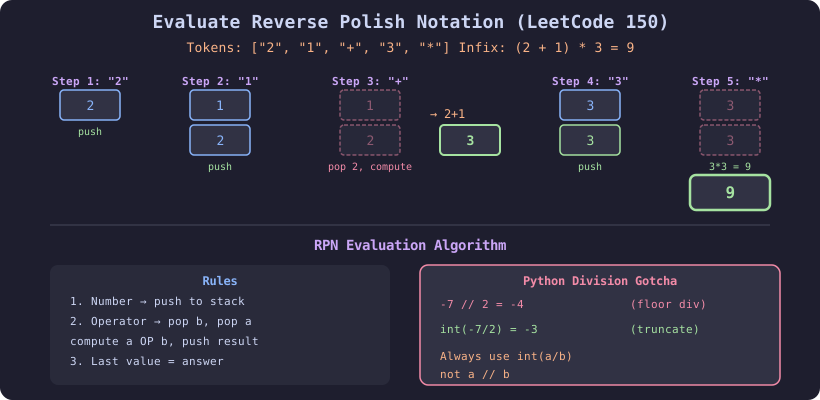
Reverse Polish Notation (RPN), also called postfix notation, places operators after their operands. Instead of writing 3 + 4, you write 3 4 +. This eliminates the need for parentheses and operator precedence rules.
This is LeetCode 150, a classic stack problem.
Why RPN Exists
| Notation | Expression | Needs Parens? | Needs Precedence? |
|---|---|---|---|
| Infix | 3 + 4 * 2 | Yes | Yes |
| Postfix (RPN) | 3 4 2 * + | No | No |
| Prefix | + 3 * 4 2 | No | No |
RPN is used in HP calculators, the Forth programming language, and internally by many compilers.
The Algorithm
The evaluation algorithm is beautifully simple:
- Scan tokens left to right
- If it is a number, push it onto the stack
- If it is an operator, pop two numbers, apply the operator, push the result
- The final value on the stack is the answer
def eval_rpn(tokens: list[str]) -> int:
    """
    Evaluate Reverse Polish Notation.
    LeetCode 150.
    Time: O(n), Space: O(n)
    """
    stack = []

    for token in tokens:
        if token in {'+', '-', '*', '/'}:
            b = stack.pop()  # second operand (popped first!)
            a = stack.pop()  # first operand

            if token == '+':
                stack.append(a + b)
            elif token == '-':
                stack.append(a - b)
            elif token == '*':
                stack.append(a * b)
            elif token == '/':
                # Truncate toward zero, not toward -infinity
                stack.append(int(a / b))
        else:
            stack.append(int(token))

    return stack[0]
Step-by-Step Trace
Example: ["2", "1", "+", "3", "*"] = (2 + 1) * 3 = 9
Token  Action              Stack
─────  ──────              ─────
"2"    push 2              [2]
"1"    push 1              [2, 1]
"+"    pop 1,2 → 2+1=3    [3]
"3"    push 3              [3, 3]
"*"    pop 3,3 → 3*3=9    [9]

Result: 9 ✓
Example: ["4", "13", "5", "/", "+"] = 4 + (13 / 5) = 6
Token  Action                Stack
─────  ──────                ─────
"4"    push 4                [4]
"13"   push 13               [4, 13]
"5"    push 5                [4, 13, 5]
"/"    pop 5,13 → 13/5=2    [4, 2]
"+"    pop 2,4 → 4+2=6      [6]

Result: 6 ✓
Complex: ["10", "6", "9", "3", "+", "-11", "*", "/", "*", "17", "+", "5", "+"]
Infix equivalent: ((10 * (6 / ((9+3) * -11))) + 17) + 5

Token   Stack after
─────   ───────────
"10"    [10]
"6"     [10, 6]
"9"     [10, 6, 9]
"3"     [10, 6, 9, 3]
"+"     [10, 6, 12]           ← 9+3=12
"-11"   [10, 6, 12, -11]
"*"     [10, 6, -132]         ← 12*-11=-132
"/"     [10, 0]               ← 6/-132=0 (truncate)
"*"     [0]                   ← 10*0=0
"17"    [0, 17]
"+"     [17]                  ← 0+17=17
"5"     [17, 5]
"+"     [22]                  ← 17+5=22

Result: 22 ✓
The Python Division Gotcha
This is a critical detail that trips up many candidates:
# Python floor division (//)
6 // -132    # = -1  (rounds toward -infinity)

# What LeetCode expects (truncation toward zero)
int(6 / -132)  # = 0  ✓

# More examples:
int(-7 / 2)    # = -3  ✓ (truncate toward zero)
-7 // 2 # = -4 ✗ (floor toward -infinity)Rule: Always use int(a / b) instead of a // b for this problem.
Operand Order Matters
When popping two values for an operator, the first popped is the right operand:
b = stack.pop()  # RIGHT operand
a = stack.pop()  # LEFT operand
result = a OP b  # a is left, b is right
This matters for subtraction and division:
["5", "3", "-"]  → 5 - 3 = 2  (not 3 - 5)
["6", "2", "/"]  → 6 / 2 = 3  (not 2 / 6)
Clean Implementation with Lambda
def eval_rpn_clean(tokens: list[str]) -> int:
    """
    Cleaner version using a dictionary of operations.
    """
    ops = {
        '+': lambda a, b: a + b,
        '-': lambda a, b: a - b,
        '*': lambda a, b: a * b,
        '/': lambda a, b: int(a / b),
    }
    stack = []

    for token in tokens:
        if token in ops:
            b, a = stack.pop(), stack.pop()
            stack.append(ops[token](a, b))
        else:
            stack.append(int(token))

    return stack[0]
Edge Cases
# Single number
assert eval_rpn(["42"]) == 42

# Negative numbers
assert eval_rpn(["-3", "2", "+"]) == -1

# Division resulting in zero
assert eval_rpn(["1", "3", "/"]) == 0

# Negative division (truncate toward zero)
assert eval_rpn(["7", "-2", "/"]) == -3
Complexity
| Metric | Value | Why |
|---|---|---|
| Time | O(n) | Process each token once |
| Space | O(n) | Stack holds at most n/2 operands |
When to Use This Pattern
- Expression evaluation: Any time you parse and evaluate mathematical expressions
- Calculator applications: RPN calculators are simpler to implement than infix ones
- Compiler internals: Many compilers convert infix to postfix before evaluation
- Stack machine emulation: JVM and Python bytecode use stack-based evaluation
Related Problems
- Basic Calculator — infix evaluation with precedence
- Expression Evaluation — infix to postfix conversion
- Valid Parentheses — simpler stack matching
Related articles
- DSA Implement Stack Using Two Queues — Two Approaches Explained
Implement a stack using two queues with costly push and costly pop approaches. Complete Python solutions with complexity analysis.
- DSA Asteroid Collision Problem Using Stacks
Solve the asteroid collision problem (LeetCode 735) using a stack. Covers collision rules, Python implementation, and all edge cases.
- DSA Car Fleet Problem — Stack-Based Arrival Time Solution
Solve LeetCode 853 Car Fleet using a stack. Sort by position, compare arrival times, and count fleets. Python solution with visual trace.
- DSA The Celebrity Problem Using Stack-Based Elimination
Solve the celebrity problem in O(n) time using a stack elimination technique. Includes proof of correctness, Python code, and matrix examples.