What Is Data Engineering? A Complete Introduction
Understand what data engineers do, how they differ from data scientists, the core skills required, and why this role is one of the most in-demand in tech.
What you'll learn
- ✓What data engineering is and why it exists
- ✓How data engineers differ from data scientists and analysts
- ✓The core skills and tools every data engineer needs
- ✓What a typical day looks like in the role
- ✓Where the field is headed in 2026 and beyond
Prerequisites
- •No prior experience required — just curiosity about data
Every company collects data. Very few can actually use it. The gap between “we have data” and “we can make decisions from data” is where data engineers live. They build and maintain the infrastructure — pipelines, warehouses, transformations, schedules — that turns raw, messy, scattered data into something analysts and machine learning teams can trust.
The problem data engineers solve
Imagine an e-commerce company. Orders live in a PostgreSQL database. Payment events arrive through Stripe webhooks. Marketing campaign data sits in Google Ads. Customer support tickets are in Zendesk. The CEO asks: “What is our customer lifetime value by acquisition channel?”
Nobody can answer that question by looking at one system. Somebody has to:
- Extract data from each source — databases, APIs, event streams, flat files.
- Transform it — clean nulls, normalize currencies, join records across systems, compute derived metrics.
- Load it into a single analytical store — a data warehouse like BigQuery, Snowflake, or Redshift.
- Schedule the whole thing to run reliably every night (or every minute).
- Monitor it — because upstream schemas change, APIs go down, and data volumes spike.
That is data engineering. It is plumbing, and it is critical.
Data engineer vs data scientist vs data analyst
These three roles work on the same data but do very different things.

| Role | Primary focus | Core tools | Output |
|---|---|---|---|
| Data Engineer | Build and maintain data pipelines and infrastructure | Python, SQL, Airflow, Kafka, Spark, dbt | Reliable, clean, queryable datasets |
| Data Scientist | Build predictive models and run experiments | Python, R, scikit-learn, TensorFlow, statistics | Models, forecasts, A/B test results |
| Data Analyst | Answer business questions with existing data | SQL, Excel, Tableau, Looker | Dashboards, reports, insights |
The simplest way to think about it: data engineers build the roads, data scientists build the cars, and data analysts drive them.
Without data engineers, scientists spend 80% of their time cleaning data instead of building models. Without clean pipelines, analyst dashboards show stale or wrong numbers. The role exists because data infrastructure does not build or maintain itself.
Core skills of a data engineer
SQL — the daily language
SQL is the most important skill in the role. Not just SELECT * FROM — production data engineering requires fluency with:
- Window functions —
ROW_NUMBER(),LAG(),LEAD(),NTILE()for ranking and time-series analysis. - CTEs — Common Table Expressions for readable, composable queries.
- Aggregations —
GROUP BY,HAVING, conditional aggregation withCASE. - Joins — inner, left, full outer, cross, and self-joins across large tables.
- Performance — understanding query plans, indexes, partitioning, and clustering.
Most data engineering interviews are 50%+ SQL. Go deeper than backend engineers go.
 Python — the pipeline language
Python is the universal glue for data pipelines. You will use it for:
- Ingestion scripts — calling REST APIs, reading files, connecting to databases.
- Transformation logic — Pandas for small data, PySpark for large data.
- Orchestration — writing Airflow DAGs that define pipeline workflows.
- Testing — unit testing transformation logic, data quality checks.
You do not need to be a Python expert, but you need to be fluent enough to write production-quality code — proper error handling, logging, typing, and tests.
Data warehousing
Understanding how analytical databases work is fundamental:
- Star schema — fact tables (events, transactions) surrounded by dimension tables (users, products, dates).
- Snowflake schema — normalized dimensions for reduced redundancy.
- Partitioning — splitting tables by date or region for query performance.
- Clustering — sorting data within partitions for faster scans.
- Materialized views — pre-computed aggregations that refresh on schedule.
Popular warehouses include Snowflake, Google BigQuery, Amazon Redshift, and Databricks SQL.
Orchestration
Pipelines need to run on schedule, in the right order, with retries and alerting. The dominant tool is 

Streaming
Not all data can wait for a nightly batch job. Real-time use cases — fraud detection, live dashboards, recommendation updates — require stream processing. 

What a typical day looks like
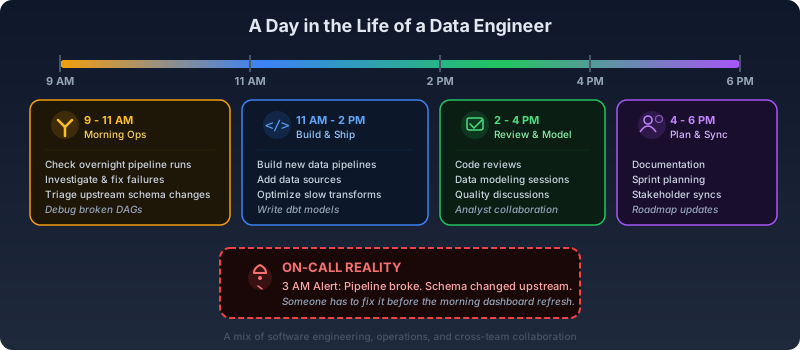
A data engineer’s day usually includes:
- Morning — check overnight pipeline runs. Investigate any failures. Fix broken DAGs, usually caused by upstream schema changes or API rate limits.
- Mid-day — build or modify a pipeline. This might mean adding a new data source, optimizing a slow transformation, or migrating a pipeline from batch to streaming.
- Afternoon — code reviews, data quality discussions with analysts, planning for new data models. Maybe write dbt models or update documentation.
- On-call — data engineers often have on-call rotations. When a critical pipeline fails at 3 AM, someone has to fix it.
The role is a mix of software engineering and operations. You write code, but you also debug systems, negotiate with upstream teams about schema changes, and explain to stakeholders why their dashboard shows yesterday’s data.
The modern data stack
The tools that data engineers use have evolved significantly. The “modern data stack” typically includes:
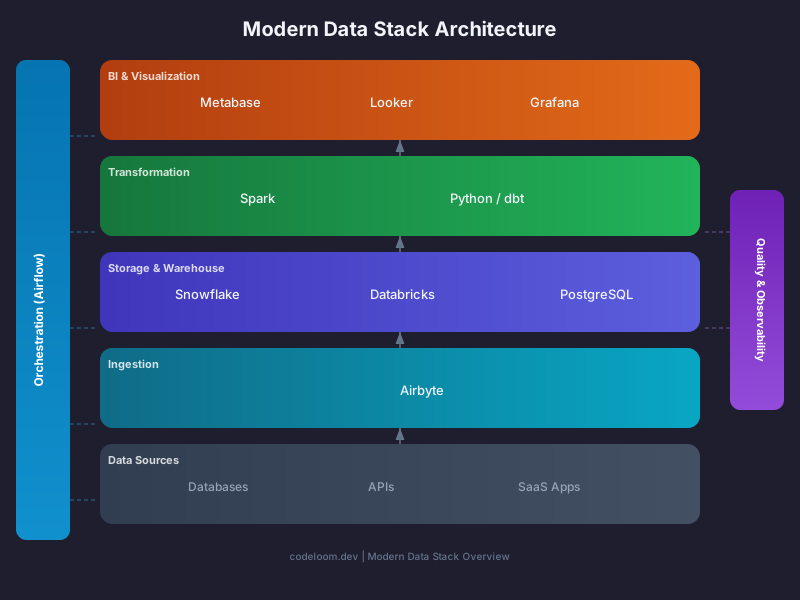
| Layer | Purpose | Popular tools |
|---|---|---|
| Ingestion | Extract data from sources | Fivetran,  Airbyte, custom scripts Airbyte, custom scripts |
| Storage | Store raw and transformed data |  Snowflake, BigQuery, Redshift, Snowflake, BigQuery, Redshift,  Databricks Databricks |
| Transformation | Clean and model data | dbt,  Spark, Pandas Spark, Pandas |
| Orchestration | Schedule and monitor pipelines | Airflow, Prefect, Dagster |
| Streaming | Real-time event processing | Kafka, Flink, Kinesis |
| Quality | Validate data correctness | Great Expectations, dbt tests, Monte Carlo |
| Visualization | Present data to stakeholders |  Looker, Tableau, Looker, Tableau,  Metabase, Superset Metabase, Superset |
Where the field is heading
Data engineering is evolving in several directions:
- Analytics engineering — tools like dbt blur the line between data engineers and analysts. SQL-first transformations with version control and testing.
- Lakehouses — platforms like Databricks and Apache Iceberg merge data lake flexibility with warehouse query performance.
- Real-time everything — batch pipelines that run daily are giving way to streaming pipelines that update in seconds.
- AI/ML pipelines — data engineers increasingly build infrastructure for model training, feature stores, and inference pipelines.
- Platform engineering — instead of building one-off pipelines, teams build self-serve data platforms that let analysts write their own transformations.
Next steps
This series covers the core tools and concepts every data engineer needs. Start here:
- ETL vs ELT Pipelines — understand the two fundamental pipeline patterns.
- Data Warehouse Concepts — star schemas, dimensions, and facts.
- What Is Apache Airflow? — the orchestration tool you will use daily.
- What Is Apache Kafka? — real-time event streaming fundamentals.
Related articles
- Data Engineering Data Engineering Interview Prep — What to Expect and How to Win
Prepare for data engineering interviews: SQL deep dives, Python coding, system design, data modeling, behavioral questions, and take-home project tips.
- Data Engineering ETL vs ELT Pipelines Explained With Examples
Understand the difference between ETL and ELT pipeline patterns, when to use each, and how modern cloud warehouses changed the default choice.
- Airflow What Is Apache Airflow? A Complete Introduction
Learn what Apache Airflow is, why Airbnb created it, how DAGs work, and when to use Airflow for orchestrating data pipelines, ETL workflows, and ML operations.
- Kafka What Is Apache Kafka? A Complete Introduction
A practical introduction to Apache Kafka — what it is, why it exists, its core concepts, and how it differs from traditional message queues. Includes your first producer and consumer code.