First Non-Repeating Character in a Stream
Find the first non-repeating character in a character stream using a queue and hash map. Python solution with O(1) amortized per query.
What you'll learn
- ✓How to track the first non-repeating character in real time
- ✓Queue + hash map combination for O(1) amortized lookups
- ✓Why a queue is the right data structure for this
- ✓Applications in data stream processing
Prerequisites
- •Queue basics — see Stacks & Queues Intro
- •Hash maps — see Hashing & Hash Maps
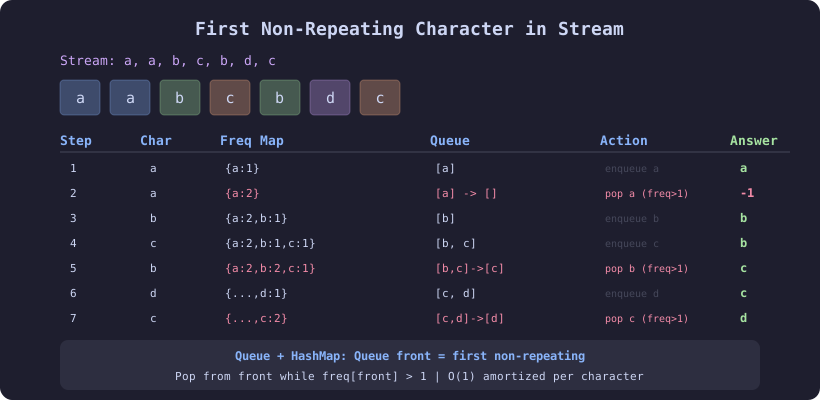
Given a stream of characters, find the first non-repeating character at any point. If all characters have repeated, return a sentinel like '#'.
Example
Stream: a, a, b, c, b, d
After a: a (first non-repeating)
After a: # (a repeated)
After b: b
After c: b
After b: c (b repeated, c is first non-repeating)
After d: c
Solution — Queue + Frequency Map
from collections import deque

class FirstNonRepeating:
    def __init__(self):
        self.queue = deque()
        self.freq = {}

    def add(self, char):
        """
        Add character and return first non-repeating.
        Time: O(1) amortized per call
        """
        self.freq[char] = self.freq.get(char, 0) + 1
        self.queue.append(char)

        # Drain repeated characters from front
        while self.queue and self.freq[self.queue[0]] > 1:
            self.queue.popleft()

        return self.queue[0] if self.queue else '#'
Trace
char | freq            | queue    | drain      | result
-----|-----------------|----------|------------|-------
a    | {a:1}           | [a]      | —          | a
a    | {a:2}           | [a]      | pop a → [] | #
b    | {a:2,b:1}       | [b]      | —          | b
c    | {a:2,b:1,c:1}   | [b,c]    | —          | b
b    | {a:2,b:2,c:1}   | [b,c]    | pop b→[c]  | c
d    | {a:2,b:2,c:1,d:1}| [c,d]   | —          | c
Why Queue?
Characters that arrived earlier should be checked first for non-repeating status. A queue’s FIFO order naturally maintains this — the front is always the oldest candidate.
Batch Processing Version
Process the entire stream and return the first non-repeating at each step:
def first_non_repeating_all(stream):
    """Return first non-repeating char after each addition."""
    queue = deque()
    freq = {}
    results = []

    for char in stream:
        freq[char] = freq.get(char, 0) + 1
        queue.append(char)

        while queue and freq[queue[0]] > 1:
            queue.popleft()

        results.append(queue[0] if queue else '#')

    return results
Complexity
| Metric | Per Call | Total for n chars |
|---|---|---|
| Time | O(1) amortized | O(n) |
| Space | O(k) where k = alphabet size | O(k) |
Each character enters the queue once and leaves once → O(2n) total operations across all calls.
Edge Cases
- All unique characters — front of queue is always the answer
- All same character — always returns
'#'after second occurrence - Single character stream — returns that character
- Large alphabet — works for any hashable characters
When to Use This Pattern
- Real-time log analysis (first unique event)
- Network packet deduplication
- Streaming data analytics
- Any “first unique in window” variant
Related Problems
- First Unique Character in a String (LeetCode 387) — static version
- Moving Average from Data Stream (LeetCode 346)
- Design Hit Counter (LeetCode 362)
Related articles
- DSA BFS Pattern with Queues: Level-Order and Shortest Path
Master BFS using queues for tree level-order traversal and shortest path in unweighted graphs. Python implementations with detailed traces.
- DSA Design Circular Deque — Array-Based Implementation (LeetCode 641)
Design a Circular Deque with front/rear pointers on a fixed-size array. Python solution with all O(1) operations, visual trace, and edge case handling.
- DSA Design Hit Counter Using Queue
Design a hit counter that counts hits in the past 5 minutes using a queue. LeetCode 362 solution with O(1) amortized operations.
- DSA Implement Stack Using Two Queues — Two Approaches Explained
Implement a stack using two queues with costly push and costly pop approaches. Complete Python solutions with complexity analysis.