Stack and Queue Interview Patterns — 15+ Patterns Catalog
Comprehensive catalog of 15+ stack and queue interview patterns with when-to-use guide, Python templates, complexity analysis, and problem mapping for coding interviews.
What you'll learn
- ✓How to recognize which stack/queue pattern fits a problem
- ✓15+ named patterns with Python templates
- ✓Decision flowchart for pattern selection
- ✓Common variations and traps in interviews
- ✓Pattern-to-problem mapping for targeted practice
Prerequisites
- •Stack basics — see Stacks Intro
- •Queue / BFS basics — see Queues Intro
- •Monotonic stack — see Next Greater Element
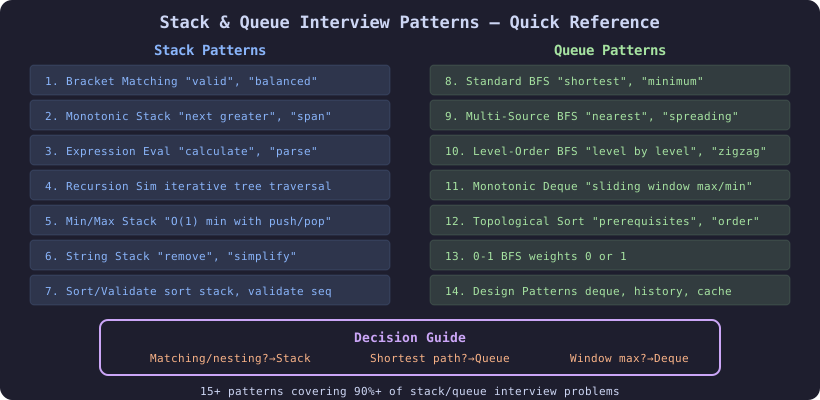
Stacks and queues appear in interviews more than almost any other data structure. This article catalogs 15+ patterns with recognition signals, Python templates, and the problems they solve. Bookmark this as your interview pattern reference.
Pattern Decision Flowchart
Does the problem involve...
├── Matching/nesting (brackets, tags, HTML)?
│   └── Pattern 1: Bracket Matching
├── "Next greater/smaller" or span?
│   └── Pattern 2: Monotonic Stack
├── Expression evaluation or parsing?
│   └── Pattern 3: Expression Stack
├── BFS / shortest path / level order?
│   └── Pattern 4-7: Queue BFS variants
├── "Design a data structure"?
│   └── Pattern 8-10: Design patterns
├── Undo/redo or history?
│   └── Pattern 11: Two-Stack History
├── Sliding window min/max?
│   └── Pattern 12: Monotonic Deque
└── Simulation of stack/queue behavior?
    └── Pattern 13-15: Simulation patterns
Stack Patterns
Pattern 1: Bracket Matching
Signal: Matching parentheses, brackets, tags, or nested structures.
def is_valid(s: str) -> bool:
    """Template: bracket matching."""
    stack = []
    pairs = {')': '(', ']': '[', '}': '{'}
    for char in s:
        if char in pairs.values():
            stack.append(char)
        elif char in pairs:
            if not stack or stack[-1] != pairs[char]:
                return False
            stack.pop()
return not stackProblems: Valid Parentheses (LC 20), Valid Parenthesis String (LC 678), Tag Validator (LC 591), Remove Invalid Parentheses (LC 301).
Pattern 2: Monotonic Stack
Signal: “Next greater”, “next smaller”, “previous greater”, spans, or histogram-type problems.
def next_greater(arr):
    """Template: monotonic decreasing stack."""
    n = len(arr)
    result = [-1] * n
    stack = []  # indices
    for i in range(n):
        while stack and arr[i] > arr[stack[-1]]:
            result[stack.pop()] = arr[i]
        stack.append(i)
return resultVariants:
- Monotonic decreasing stack → next greater element
- Monotonic increasing stack → next smaller element
- Iterate right to left → previous greater/smaller
Problems: Next Greater Element I/II (LC 496, 503), Daily Temperatures (LC 739), Largest Rectangle in Histogram (LC 84), Stock Span (LC 901).
Pattern 3: Expression Evaluation
Signal: Evaluate math expressions, calculators, nested operations with parentheses.
def calculate(s: str) -> int:
    """Template: expression evaluation with stack."""
    stack = []
    num = 0
    sign = 1
    result = 0

    for char in s:
        if char.isdigit():
            num = num * 10 + int(char)
        elif char in '+-':
            result += sign * num
            num = 0
            sign = 1 if char == '+' else -1
        elif char == '(':
            stack.append(result)
            stack.append(sign)
            result = 0
            sign = 1
        elif char == ')':
            result += sign * num
            num = 0
            result *= stack.pop()  # sign before paren
            result += stack.pop()  # result before paren

return result + sign * numProblems: Basic Calculator I/II/III (LC 224, 227, 772), Evaluate RPN (LC 150), Decode String (LC 394).
Pattern 4: Stack as Recursion Simulation
Signal: Tree traversals iteratively, or converting recursive DFS to iterative.
def inorder_iterative(root):
    """Template: iterative inorder traversal."""
    result = []
    stack = []
    current = root
    while current or stack:
        while current:
            stack.append(current)
            current = current.left
        current = stack.pop()
        result.append(current.val)
        current = current.right
return resultProblems: Inorder Traversal (LC 94), Preorder (LC 144), Flatten Binary Tree (LC 114).
Pattern 5: Min/Max Stack
Signal: “Get minimum/maximum in O(1)” alongside push/pop.
class MinStack:
    """Template: track min alongside each element."""
    def __init__(self):
        self.stack = []  # (value, current_min)

    def push(self, val):
        min_val = min(val, self.stack[-1][1] if self.stack else val)
        self.stack.append((val, min_val))

    def pop(self):
        return self.stack.pop()[0]

    def getMin(self):
return self.stack[-1][1]Problems: Min Stack (LC 155), Max Stack (LC 716), Max Frequency Stack (LC 895).
Queue Patterns
Pattern 6: Standard BFS
Signal: Shortest path in unweighted graph, level-order traversal, “minimum moves”.
from collections import deque

def bfs(graph, start, target):
    """Template: standard BFS shortest path."""
    queue = deque([(start, 0)])
    visited = {start}
    while queue:
        node, dist = queue.popleft()
        if node == target:
            return dist
        for neighbor in graph[node]:
            if neighbor not in visited:
                visited.add(neighbor)
                queue.append((neighbor, dist + 1))
return -1Problems: Word Ladder (LC 127), Open the Lock (LC 752), Shortest Path in Binary Matrix (LC 1091).
Pattern 7: Multi-Source BFS
Signal: Multiple starting points, “distance from nearest X”, “rotting” problems.
def multi_source_bfs(grid, sources):
    """Template: BFS from all sources simultaneously."""
    queue = deque()
    visited = set()
    for r, c in sources:
        queue.append((r, c, 0))
        visited.add((r, c))
    while queue:
        r, c, dist = queue.popleft()
        for dr, dc in [(0,1),(0,-1),(1,0),(-1,0)]:
            nr, nc = r + dr, c + dc
            if 0 <= nr < len(grid) and 0 <= nc < len(grid[0]):
                if (nr, nc) not in visited:
                    visited.add((nr, nc))
queue.append((nr, nc, dist + 1))Problems: Rotting Oranges (LC 994), Walls and Gates (LC 286), 01 Matrix (LC 542).
Pattern 8: Level-Order BFS
Signal: Process nodes level by level, zigzag, right side view.
def level_order(root):
    """Template: level-by-level BFS."""
    if not root:
        return []
    result = []
    queue = deque([root])
    while queue:
        level = []
        for _ in range(len(queue)):
            node = queue.popleft()
            level.append(node.val)
            if node.left: queue.append(node.left)
            if node.right: queue.append(node.right)
        result.append(level)
return resultProblems: Level Order Traversal (LC 102), Zigzag (LC 103), Right Side View (LC 199), Average of Levels (LC 637).
Pattern 9: Monotonic Deque (Sliding Window)
Signal: Sliding window minimum/maximum, “max in every window of size k”.
def max_sliding_window(nums, k):
    """Template: monotonic decreasing deque for sliding window max."""
    dq = deque()  # indices, front is always the max
    result = []
    for i, num in enumerate(nums):
        # Remove elements outside window
        while dq and dq[0] < i - k + 1:
            dq.popleft()
        # Remove smaller elements (they cannot be max)
        while dq and nums[dq[-1]] < num:
            dq.pop()
        dq.append(i)
        if i >= k - 1:
            result.append(nums[dq[0]])
return resultProblems: Sliding Window Maximum (LC 239), Shortest Subarray with Sum at Least K (LC 862), Jump Game VI (LC 1696).
Pattern 10: Stack for String Building / Simplification
Signal: Remove characters, simplify paths, deduplicate, “remove k digits”.
def remove_duplicates(s: str) -> str:
    """Template: stack for character removal."""
    stack = []
    for char in s:
        if stack and stack[-1] == char:
            stack.pop()
        else:
            stack.append(char)
return ''.join(stack)Problems: Remove All Adjacent Duplicates (LC 1047), Remove K Digits (LC 402), Simplify Path (LC 71), Remove Duplicate Letters (LC 316).
Pattern 11: Two-Stack History (Undo/Redo)
Signal: Browser history, undo/redo, back/forward navigation.
class BrowserHistory:
    """Template: two-stack navigation."""
    def __init__(self, homepage):
        self.back_stack = [homepage]
        self.forward_stack = []

    def visit(self, url):
        self.back_stack.append(url)
        self.forward_stack.clear()  # clear forward history

    def back(self, steps):
        while steps > 0 and len(self.back_stack) > 1:
            self.forward_stack.append(self.back_stack.pop())
            steps -= 1
        return self.back_stack[-1]

    def forward(self, steps):
        while steps > 0 and self.forward_stack:
            self.back_stack.append(self.forward_stack.pop())
            steps -= 1
return self.back_stack[-1]Problems: Design Browser History (LC 1472), Implement Queue using Stacks (LC 232).
Pattern 12: Stack Sort / Reorganize
Signal: Sort a stack, validate a sequence of push/pop operations.
def sort_stack(stack):
    """Template: sort stack using auxiliary stack."""
    aux = []
    while stack:
        temp = stack.pop()
        while aux and aux[-1] > temp:
            stack.append(aux.pop())
        aux.append(temp)
return auxProblems: Sort a Stack (LC interview classic), Validate Stack Sequences (LC 946).
Pattern 13: Priority Queue / Heap BFS (0-1 BFS)
Signal: Graph with edge weights 0 or 1, shortest path with two types of edges.
def zero_one_bfs(graph, start):
    """Template: 0-1 BFS using deque."""
    dist = {start: 0}
    dq = deque([start])
    while dq:
        node = dq.popleft()
        for neighbor, weight in graph[node]:
            new_dist = dist[node] + weight
            if neighbor not in dist or new_dist < dist[neighbor]:
                dist[neighbor] = new_dist
                if weight == 0:
                    dq.appendleft(neighbor)
                else:
                    dq.append(neighbor)
return distProblems: Minimum Cost to Make at Least One Valid Path (LC 1368), Shortest Path with Alternating Colors (LC 1129).
Pattern 14: Topological Sort (Kahn’s / Queue)
Signal: Dependencies, course scheduling, ordering with prerequisites.
from collections import deque, defaultdict

def topological_sort(n, edges):
    """Template: Kahn's algorithm with queue."""
    indegree = [0] * n
    graph = defaultdict(list)
    for u, v in edges:
        graph[u].append(v)
        indegree[v] += 1

    queue = deque(i for i in range(n) if indegree[i] == 0)
    order = []

    while queue:
        node = queue.popleft()
        order.append(node)
        for neighbor in graph[node]:
            indegree[neighbor] -= 1
            if indegree[neighbor] == 0:
                queue.append(neighbor)

return order if len(order) == n else [] # empty = cycleProblems: Course Schedule I/II (LC 207, 210), Alien Dictionary (LC 269).
Pattern 15: Deque for Double-Ended Operations
Signal: Push/pop from both ends, palindrome checking, design problems.
from collections import deque

# Palindrome check
def is_palindrome(s):
    dq = deque(s)
    while len(dq) > 1:
        if dq.popleft() != dq.pop():
            return False
return TrueProblems: Design Circular Deque (LC 641), Front Middle Back Queue (LC 1670).
Quick Reference Table
| Pattern | Signal Words | Data Structure | Complexity |
|---|---|---|---|
| Bracket Matching | ”valid”, “balanced”, “matching” | Stack | O(n) |
| Monotonic Stack | ”next greater”, “span”, “histogram” | Stack | O(n) |
| Expression Eval | ”calculate”, “evaluate”, “parse” | Stack | O(n) |
| Standard BFS | ”shortest path”, “minimum moves” | Queue | O(V+E) |
| Multi-Source BFS | ”nearest”, “rotting”, “spreading” | Queue | O(V+E) |
| Level-Order BFS | ”level by level”, “zigzag” | Queue | O(n) |
| Monotonic Deque | ”sliding window max/min” | Deque | O(n) |
| String Stack | ”remove”, “simplify”, “deduplicate” | Stack | O(n) |
| Min/Max Stack | ”O(1) min/max with push/pop” | Stack | O(1) per op |
| Topological Sort | ”prerequisites”, “ordering” | Queue | O(V+E) |
Interview Strategy
- Read the problem — identify signal words from the table above
- Pick the pattern — match signals to the appropriate template
- Confirm with examples — trace through the template with the given input
- Code the template — adapt it to the specific problem
- Handle edge cases — empty input, single element, all same values
Key Takeaways
- Most stack/queue interview problems fit one of these 15 patterns
- Pattern recognition is faster than deriving solutions from scratch
- Signal words in problem statements map directly to patterns
- Practice 2-3 problems per pattern for interview readiness
- When stuck, ask yourself: “What do I need to remember?” (stack) or “What order should I process?” (queue)
Related articles
- DSA Deque Design Patterns — Sliding Window, Palindrome, Work Stealing
Master deque design patterns including sliding window maximum, palindrome checking, work stealing, and BFS/DFS hybrid. Python implementations.
- DSA Design Front Middle Back Queue — Two Deques (LeetCode 1670)
Design Front Middle Back Queue using two balanced deques. Python solution with O(1) operations, step-by-step trace, and complexity analysis for LeetCode 1670.
- DSA Implement Stack Using Two Queues — Two Approaches Explained
Implement a stack using two queues with costly push and costly pop approaches. Complete Python solutions with complexity analysis.
- DSA Open the Lock — BFS on State Space (LeetCode 752)
Open the Lock problem solved with BFS on 4-digit state space. Python solution with deadend handling, bidirectional BFS optimization, and complexity analysis.