Largest Rectangle in Histogram Using Stack
Find the largest rectangle in a histogram using a monotonic stack in O(n). Detailed walkthrough, Python code, visual trace, and common pitfalls.
What you'll learn
- ✓Why the brute force approach is O(n²) and how stacks make it O(n)
- ✓The monotonic stack technique for finding boundaries
- ✓How to handle the sentinel trick for cleaner code
- ✓Extending this to the maximal rectangle in a matrix
Prerequisites
- •Monotonic stack basics — see Monotonic Stack Patterns
- •Big-O basics — see Big-O Notation
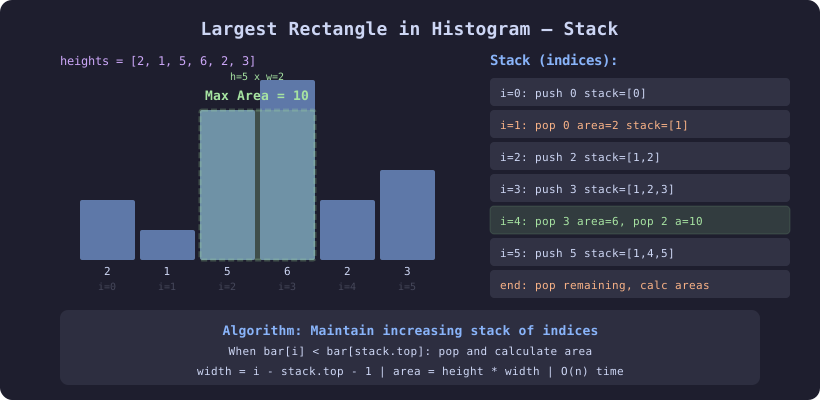
Given an array of bar heights representing a histogram, find the area of the largest rectangle that fits entirely within the histogram.
Why Stacks?
For each bar, the largest rectangle using that bar as the shortest bar extends left and right until a shorter bar is found. We need the Previous Smaller Element (PSE) and Next Smaller Element (NSE) for each bar — exactly what a monotonic stack computes.
Solution
def largest_rectangle_area(heights):
    """
    Find largest rectangle in histogram.
    Time: O(n), Space: O(n)
    """
    stack = []  # Indices of bars in increasing height order
    max_area = 0
    heights.append(0)  # Sentinel to flush remaining bars

    for i, h in enumerate(heights):
        while stack and heights[stack[-1]] > h:
            height = heights[stack.pop()]
            width = i if not stack else i - stack[-1] - 1
            max_area = max(max_area, height * width)
        stack.append(i)

    heights.pop()  # Remove sentinel
    return max_area
Trace
Heights: [2, 1, 5, 6, 2, 3]
i=0, h=2: push → stack=[0]
i=1, h=1: pop 0(h=2), width=1, area=2   → stack=[1]
i=2, h=5: push → stack=[1,2]
i=3, h=6: push → stack=[1,2,3]
i=4, h=2: pop 3(h=6), width=1, area=6
           pop 2(h=5), width=2, area=10  ← MAX
           push → stack=[1,4]
i=5, h=3: push → stack=[1,4,5]
i=6, h=0: pop 5(h=3), width=1, area=3
           pop 4(h=2), width=4, area=8
           pop 1(h=1), width=6, area=6

Max area: 10
Without Sentinel (Explicit Cleanup)
def largest_rectangle_area_v2(heights):
    stack = []
    max_area = 0
    n = len(heights)

    for i in range(n):
        while stack and heights[stack[-1]] > heights[i]:
            height = heights[stack.pop()]
            width = i if not stack else i - stack[-1] - 1
            max_area = max(max_area, height * width)
        stack.append(i)

    while stack:
        height = heights[stack.pop()]
        width = n if not stack else n - stack[-1] - 1
        max_area = max(max_area, height * width)

    return max_area
Why It Works
The stack maintains bars in increasing order of height. When a shorter bar arrives:
- All taller bars in the stack can’t extend right anymore
- For each popped bar, the width = distance between current index and the new stack top
- This gives us the exact rectangle dimensions
Each bar is pushed once and popped once → O(n) total.
Common Pitfalls
- Forgetting the cleanup — bars remaining in the stack after the loop need processing
- Width calculation — when stack is empty after pop, width extends to the start (width = i)
- Mutating input — the sentinel approach modifies the array; restore it or use a copy
Edge Cases
- All same heights — rectangle is
n * h - Ascending order — cleanup phase finds the answer
- Descending order — each bar triggers a pop immediately
- Single bar — area = heights[0]
When to Use This Pattern
The “find boundaries using monotonic stack” pattern solves many problems:
| Problem | What We Find |
|---|---|
| Largest Rectangle | PSE and NSE for each bar |
| Trapping Rain Water | Previous and Next Greater |
| Sum of Subarray Minimums | Contribution of each element |
| Maximum Width Ramp | Monotonic decreasing stack |
Related Problems
- Maximal Rectangle (LeetCode 85) — 2D version using this as subroutine
- Trapping Rain Water (LeetCode 42) — similar stack technique
- Sum of Subarray Minimums (LeetCode 907)
- Maximum Width Ramp (LeetCode 962)
Related articles
- DSA 132 Pattern — Monotonic Stack with Reverse Traversal (LeetCode 456)
Solve the 132 Pattern problem using a monotonic stack scanning right to left. Python solution tracking s3 candidates and s2 maximum, with detailed trace.
- DSA Basic Calculator I, II, III — Complete Expression Evaluation Guide
Solve Basic Calculator problems LeetCode 224, 227, and 772. Master stack-based expression evaluation with +, -, *, /, and parentheses in Python.
- DSA Maximal Rectangle in Binary Matrix
Find the maximal rectangle containing only 1s in a binary matrix. Builds on the largest rectangle in histogram technique with detailed explanation.
- DSA Maximum Frequency Stack — HashMap + Stack Groups (LeetCode 895)
Maximum Frequency Stack solved with HashMap and stack groups by frequency. Python implementation with step-by-step trace, complexity analysis, and design insights.