Path Sum Problems: All Variants Explained
Solve all Path Sum variants — root-to-leaf existence, find all paths, any-to-any with prefix sums. Complete Python solutions with Big-O analysis.
What you'll learn
- ✓Path Sum I: does a root-to-leaf path with target exist?
- ✓Path Sum II: find all root-to-leaf paths that sum to target
- ✓Path Sum III: count any-to-any paths using prefix sums
- ✓Maximum path sum (any-to-any node)
- ✓Sum of all root-to-leaf numbers
- ✓Backtracking patterns for path problems
Prerequisites
- •Comfortable with DFS traversal
- •Understanding of binary tree basics
- •Familiarity with prefix sums (helpful for Path Sum III)
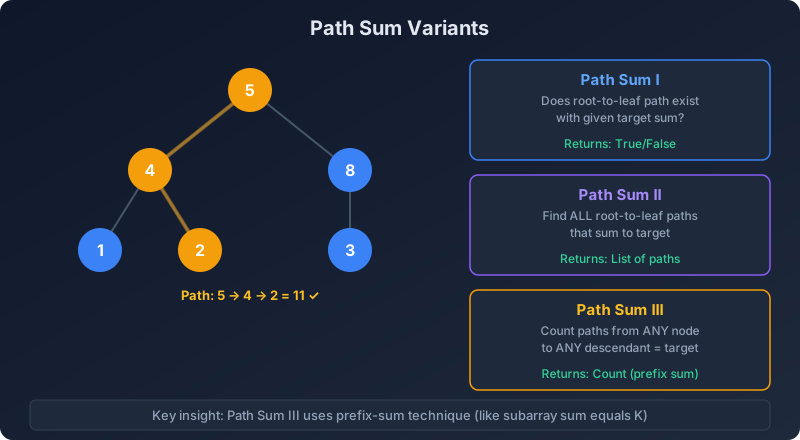
Path sum problems are among the most popular tree interview questions. They start simple (does a path exist?) and progressively get harder (count all paths from any node to any descendant). The key progression is:
- Path Sum I: Yes/no question, root-to-leaf
- Path Sum II: Collect all paths, root-to-leaf
- Path Sum III: Count paths, any-to-any descendant (prefix sum technique)
Mastering this progression covers a huge range of tree + DFS patterns.
TreeNode definition
class TreeNode:
    def __init__(self, val=0, left=None, right=None):
        self.val = val
        self.left = left
        self.right = right
Path Sum I — does a path exist?
LeetCode 112: Given the root and a target sum, return True if there exists a root-to-leaf path where the sum of node values equals the target.
         5
        / \
       4   8
      /   / \
     11  13  4
    / \       \
   7   2       1

Target = 22
Path: 5 → 4 → 11 → 2 = 22 ✓
Solution: subtract as you go
Instead of tracking the running sum, subtract the current node’s value from the target. When you reach a leaf, check if the remaining target is 0.
def hasPathSum(root, targetSum):
    """
    Path Sum I: does a root-to-leaf path sum to target?
    Time: O(n)  Space: O(h) recursion stack
    """
    if not root:
        return False

    # Subtract current value
    targetSum -= root.val

    # Leaf check
    if not root.left and not root.right:
        return targetSum == 0

    return (hasPathSum(root.left, targetSum) or
            hasPathSum(root.right, targetSum))
Why subtract instead of accumulate?
Both work, but subtraction is cleaner — you avoid passing an extra current_sum parameter. The check becomes remaining == 0 instead of current_sum == target.
Iterative version with stack
def hasPathSum(root, targetSum):
    """Iterative DFS with stack."""
    if not root:
        return False

    stack = [(root, targetSum - root.val)]

    while stack:
        node, remaining = stack.pop()

        # Leaf with sum matched
        if not node.left and not node.right and remaining == 0:
            return True

        if node.right:
            stack.append((node.right, remaining - node.right.val))
        if node.left:
            stack.append((node.left, remaining - node.left.val))

    return False
Common mistake: forgetting the leaf check
A node with one child is not a leaf. If you check if node is None and remaining == 0, you will incorrectly match non-leaf paths:
# WRONG — treats null children as valid endpoints
def hasPathSum_wrong(root, target):
    if not root:
        return target == 0  # Bug: null is not a leaf
    return (hasPathSum_wrong(root.left, target - root.val) or
            hasPathSum_wrong(root.right, target - root.val))
The correct approach explicitly checks not root.left and not root.right.
Path Sum II — find all paths
LeetCode 113: Return all root-to-leaf paths where the sum equals the target.
def pathSum(root, targetSum):
    """
    Path Sum II: find all root-to-leaf paths that sum to target.
    Time: O(n * h) — n nodes, each path up to h long
    Space: O(h) recursion + O(n * h) for result
    """
    result = []

    def dfs(node, remaining, path):
        if not node:
            return

        path.append(node.val)

        # Leaf with sum matched
        if not node.left and not node.right and remaining == node.val:
            result.append(path[:])  # Copy the path

        dfs(node.left, remaining - node.val, path)
        dfs(node.right, remaining - node.val, path)

        path.pop()  # Backtrack

    dfs(root, targetSum, [])
    return result
Backtracking explained
The path.pop() after recursive calls is the backtracking step. We reuse a single path list and undo each addition as we return up the tree. This is more memory-efficient than creating a new list at each recursive call.
Without backtracking (creates new lists):
def pathSum_no_backtrack(root, targetSum):
    """Less efficient — creates new list at each call."""
    result = []

    def dfs(node, remaining, path):
        if not node:
            return
        new_path = path + [node.val]  # New list each time
        if not node.left and not node.right and remaining == node.val:
            result.append(new_path)
        dfs(node.left, remaining - node.val, new_path)
        dfs(node.right, remaining - node.val, new_path)

    dfs(root, targetSum, [])
    return result
The backtracking version uses O(h) space for the path, while this version uses O(h) at each level, totaling O(h^2) in the worst case.
Why path[:] instead of path?
path is a mutable list that changes as we traverse. If we append path directly to result, we store a reference to the same list. By the time the function ends, that list will be empty (all elements popped). path[:] creates a snapshot copy.
Path Sum III — any-to-any (prefix sum)
LeetCode 437: Count paths from any node to any descendant where the sum equals the target. The path does not need to start at root or end at a leaf.
This is a significant jump in difficulty. The key insight: this is the tree version of “subarray sum equals K” — and the solution uses the same prefix sum + hashmap technique.
Brute force: O(n^2)
For each node, try starting a path from it and count valid paths going downward:
def pathSum3_brute(root, targetSum):
    """
    Brute force: try every node as path start.
    Time: O(n^2) in worst case (skewed tree)
    Space: O(h) recursion
    """
    if not root:
        return 0

    def countFrom(node, remaining):
        """Count paths starting from this node going down."""
        if not node:
            return 0
        count = 1 if node.val == remaining else 0
        count += countFrom(node.left, remaining - node.val)
        count += countFrom(node.right, remaining - node.val)
        return count

    # Try every node as starting point
    return (countFrom(root, targetSum) +
            pathSum3_brute(root.left, targetSum) +
            pathSum3_brute(root.right, targetSum))
Optimal: prefix sum O(n)
The prefix sum approach tracks the cumulative sum from root to the current node. If current_sum - target has been seen before, then the subpath from that earlier point to now sums to target.
from collections import defaultdict

def pathSum3(root, targetSum):
    """
    Prefix sum approach — O(n) time.
    Same technique as 'subarray sum equals K'.
    Time: O(n)  Space: O(h) for recursion + hashmap
    """
    prefix_counts = defaultdict(int)
    prefix_counts[0] = 1  # Empty prefix (path starting from root)

    def dfs(node, current_sum):
        if not node:
            return 0

        current_sum += node.val
        # How many times have we seen (current_sum - target)?
        count = prefix_counts[current_sum - targetSum]

        # Record this prefix sum
        prefix_counts[current_sum] += 1

        # Continue to children
        count += dfs(node.left, current_sum)
        count += dfs(node.right, current_sum)

        # Backtrack — remove this prefix when leaving the subtree
        prefix_counts[current_sum] -= 1

        return count

    return dfs(root, 0)
Why backtrack the prefix map?
The prefix sum technique works for arrays because subarrays are contiguous. In trees, when we move to a sibling subtree, the path from root changes. We must remove the current node’s prefix from the map to avoid counting paths that jump across branches.
         1
        / \
       2   3

At node 2: prefix_counts = {0:1, 1:1, 3:1}
After leaving node 2: remove 3 → {0:1, 1:1}
At node 3: prefix_counts = {0:1, 1:1, 4:1}  ← correct, 3 not counted
Step-by-step example
Tree:     10
         /  \
        5   -3
       / \    \
      3   2   11
     / \   \
    3  -2   1

Target = 8
Valid paths:
5 → 3= 85 → 2 → 1= 8-3 → 11= 810 → 5 → 3 → -2= (wrong, that’s 16)
Wait, let me recalculate: 10 → -3 → 11 is not a path (not root-to-descendant in a line). Actually, -3 → 11 = 8 is valid. And 10 → 5 → 3 is not 8, but 5 → 3 = 8 is valid.
Answer: 3 paths.
Maximum path sum (any-to-any)
LeetCode 124: Find the maximum sum of any path in the tree. The path can start and end at any node (not necessarily root or leaf).
def maxPathSum(root):
    """
    Maximum path sum — any node to any node.
    Time: O(n)  Space: O(h)
    """
    max_sum = float('-inf')

    def dfs(node):
        nonlocal max_sum
        if not node:
            return 0

        # Max sum from left/right subtrees (ignore negative branches)
        left_gain = max(dfs(node.left), 0)
        right_gain = max(dfs(node.right), 0)

        # Path through this node connecting left and right
        path_through = node.val + left_gain + right_gain
        max_sum = max(max_sum, path_through)

        # Return max gain if we continue upward (can only go one direction)
        return node.val + max(left_gain, right_gain)

    dfs(root)
    return max_sum
Key insight: return vs update
At each node, we make two different calculations:
-
Update global max: Consider the path that goes
left → node → right(using both branches). This might be the answer but cannot be extended upward. -
Return to parent: The parent can only use one branch. Return
node.val + max(left, right)so the parent can extend the path.
The max(..., 0) ensures we never take a negative branch — it is better to not include a subtree than to include one with negative sum.
Sum root-to-leaf numbers
LeetCode 129: Each root-to-leaf path forms a number (e.g., path 1→2→3 = 123). Return the sum of all such numbers.
def sumNumbers(root):
    """
    Sum of all root-to-leaf numbers.
    Time: O(n)  Space: O(h)
    """
    def dfs(node, current_num):
        if not node:
            return 0

        current_num = current_num * 10 + node.val

        # Leaf — return the formed number
        if not node.left and not node.right:
            return current_num

        return dfs(node.left, current_num) + dfs(node.right, current_num)

    return dfs(root, 0)
Complexity comparison
| Problem | Time | Space | Technique |
|---|---|---|---|
| Path Sum I | O(n) | O(h) | DFS + subtraction |
| Path Sum II | O(n*h) | O(h) + result | DFS + backtracking |
| Path Sum III (brute) | O(n^2) | O(h) | DFS from every node |
| Path Sum III (optimal) | O(n) | O(h) | Prefix sum + hashmap |
| Max Path Sum | O(n) | O(h) | Post-order DFS |
| Sum Root-to-Leaf | O(n) | O(h) | Pre-order DFS |
Pattern recognition
All path sum problems share a DFS skeleton. The differences are:
- What do you track? Running sum, prefix map, or formed number
- Where do you check? At leaves only, or at every node
- What do you return? Boolean, count, list of paths, or max value
- Do you backtrack? Yes for Path Sum II and III, no for I
# Generic path DFS skeleton
def pathDFS(node, state):
    if not node:
        return BASE_CASE

    # Update state with current node
    update(state, node)

    # Check condition (at leaf? at every node?)
    if condition(node, state):
        record_result()

    # Recurse
    pathDFS(node.left, state)
    pathDFS(node.right, state)

    # Backtrack if needed
    undo(state, node)
Edge cases
def test_edge_cases():
    # Single node equals target
    root = TreeNode(5)
    assert hasPathSum(root, 5) == True
    assert hasPathSum(root, 3) == False

    # Negative values
    root = TreeNode(-2, None, TreeNode(-3))
    assert hasPathSum(root, -5) == True

    # All zeros
    root = TreeNode(0, TreeNode(0), TreeNode(0))
    assert pathSum3(root, 0) == 4  # Many zero-sum paths

    # Single negative node
    root = TreeNode(-3)
    assert maxPathSum(root) == -3  # Must include at least one node
Practice problems
| Problem | Difficulty | Link |
|---|---|---|
| Path Sum | Easy | LeetCode 112 |
| Path Sum II | Medium | LeetCode 113 |
| Path Sum III | Medium | LeetCode 437 |
| Binary Tree Maximum Path Sum | Hard | LeetCode 124 |
| Sum Root to Leaf Numbers | Medium | LeetCode 129 |
| Longest Univalue Path | Medium | LeetCode 687 |
| Diameter of Binary Tree | Easy | LeetCode 543 |
Key takeaways
- Path Sum I/II are root-to-leaf DFS — check only at leaf nodes
- Path Sum III is the “subarray sum = K” technique applied to trees — use prefix sums with backtracking
- Maximum path sum uses post-order DFS — return single-branch gain, update global with both-branch path
- Always backtrack mutable state (path list, prefix map) when leaving a subtree
- The
max(gain, 0)trick lets you ignore negative subtrees cleanly
Related articles
- DSA Flatten Binary Tree to Linked List
Learn how to flatten a binary tree to a linked list using preorder threading, Morris traversal, and how to convert a BST to a sorted doubly linked list — with full Python implementations and Big-O analysis.
- DSA BST Iterator, Range Queries, and Closest Value
Master BST iterator using stack-based controlled in-order traversal, range sum queries, counting nodes in range, closest value, and closest K values — with full Python implementations.
- DSA Boundary Traversal of Binary Tree
Complete guide to boundary traversal — left boundary, leaf nodes, and right boundary in reverse. Multiple Python approaches with edge case handling.
- DSA Distance Problems in Binary Trees
Solve distance problems in binary trees — distance between two nodes, all nodes at distance K, burning a tree from a node, and sum of distances using rerooting. Full Python implementations.