Design Hit Counter Using Queue
Design a hit counter that counts hits in the past 5 minutes using a queue. LeetCode 362 solution with O(1) amortized operations.
What you'll learn
- ✓Queue-based sliding window for time-series data
- ✓Amortized O(1) hit recording and counting
- ✓Scaling considerations for high-throughput systems
- ✓Fixed-size circular buffer optimization
Prerequisites
- •Queue basics — see Stacks & Queues Intro
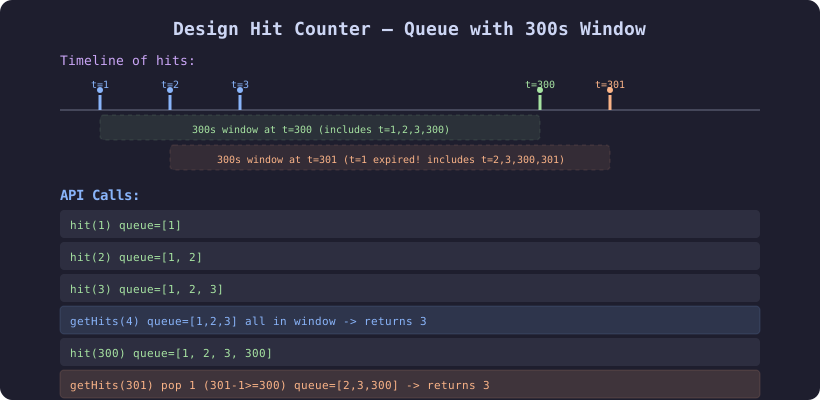
Design a hit counter that records hits and returns the number of hits in the past 5 minutes (300 seconds). Timestamps are in seconds and are monotonically increasing.
Queue Solution
Store timestamps in a queue. To count hits, remove expired timestamps from the front.
from collections import deque

class HitCounter:
    def __init__(self):
        self.queue = deque()

    def hit(self, timestamp):
        """Record a hit. Time: O(1)"""
        self.queue.append(timestamp)

    def get_hits(self, timestamp):
        """
        Return hits in past 300 seconds.
        Time: O(1) amortized
        """
        while self.queue and self.queue[0] <= timestamp - 300:
            self.queue.popleft()
        return len(self.queue)
Trace
hit(1)       queue: [1]
hit(2)       queue: [1, 2]
hit(3)       queue: [1, 2, 3]
getHits(4)   → 3 (all within 300s)
hit(300)     queue: [1, 2, 3, 300]
getHits(300) → 4
getHits(301) → remove 1 → queue: [2, 3, 300] → 3
Optimized — Fixed-Size Array
For high throughput, use a fixed-size circular buffer:
class HitCounterOptimized:
    def __init__(self):
        self.times = [0] * 300
        self.hits = [0] * 300

    def hit(self, timestamp):
        """Time: O(1)"""
        idx = timestamp % 300
        if self.times[idx] != timestamp:
            self.times[idx] = timestamp
            self.hits[idx] = 1
        else:
            self.hits[idx] += 1

    def get_hits(self, timestamp):
        """Time: O(300) = O(1)"""
        total = 0
        for i in range(300):
            if timestamp - self.times[i] < 300:
                total += self.hits[i]
        return total
Comparison
| Approach | hit() | getHits() | Space |
|---|---|---|---|
| Queue | O(1) | O(1) amortized | O(hits in window) |
| Array | O(1) | O(300) | O(300) |
The array approach uses constant space regardless of hit volume — better for high-throughput systems.
Edge Cases
- No hits — getHits returns 0
- Multiple hits same timestamp — queue stores duplicates; array increments counter
- Timestamps exactly 300 apart —
hit(1), getHits(301)→ 0 (expired) - Very high throughput — queue grows large; array stays at 300
When to Use This Pattern
- Rate limiting (API request counters)
- Metrics and monitoring dashboards
- Sliding window aggregations
- Session tracking
Related Problems
- Logger Rate Limiter (LeetCode 359)
- Moving Average from Data Stream (LeetCode 346)
- Number of Recent Calls (LeetCode 933)
Related articles
- DSA BFS Pattern with Queues: Level-Order and Shortest Path
Master BFS using queues for tree level-order traversal and shortest path in unweighted graphs. Python implementations with detailed traces.
- DSA Design Circular Deque — Array-Based Implementation (LeetCode 641)
Design a Circular Deque with front/rear pointers on a fixed-size array. Python solution with all O(1) operations, visual trace, and edge case handling.
- DSA First Non-Repeating Character in a Stream
Find the first non-repeating character in a character stream using a queue and hash map. Python solution with O(1) amortized per query.
- DSA Implement Stack Using Two Queues — Two Approaches Explained
Implement a stack using two queues with costly push and costly pop approaches. Complete Python solutions with complexity analysis.