Sort a Stack Using Another Stack
Learn how to sort a stack using only one additional stack. Step-by-step trace, Python implementation, and O(n²) complexity analysis.
What you'll learn
- ✓How to sort a stack using only one temporary stack
- ✓The insertion-sort-like approach for stacks
- ✓Why this runs in O(n²) time and O(n) space
- ✓Variations: sorting with recursion and limited operations
Prerequisites
- •Stack basics — see Stacks & Queues Intro
- •Big-O basics — see Big-O Notation
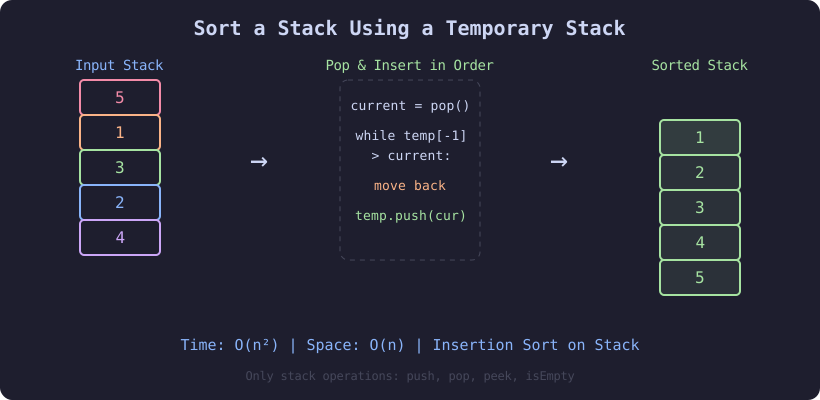
Sorting a stack with only stack operations (push, pop, peek, isEmpty) is a classic interview question. You cannot use arrays, heaps, or any other data structure — just one additional stack.
The Algorithm
The idea mirrors insertion sort: maintain a sorted temporary stack, and for each element from the input stack, find its correct position in the temporary stack.
def sort_stack(stack):
    """
    Sort a stack so that the smallest element is on top.
    Time: O(n²), Space: O(n)
    """
    temp = []

    while stack:
        current = stack.pop()

        # Move elements from temp back to stack
        # until we find the right position for current
        while temp and temp[-1] > current:
            stack.append(temp.pop())

        temp.append(current)

    # Copy sorted elements back
    while temp:
        stack.append(temp.pop())

    return stack
Step-by-Step Trace
Input stack (top → bottom): [5, 1, 3, 2, 4]
Step | current | stack         | temp (sorted)
-----|---------|---------------|---------------
  1  |    4    | [5,1,3,2]    | [4]
  2  |    2    | [5,1,3]      | [4] → move 4 back → [2,4]
  3  |    3    | [5,1,4]      | [2] → [2,3] then 4 back → [2,3,4]
  4  |    1    | [5]          | [2,3,4] → move all back → [1,2,3,4]
  5  |    5    | []           | [1,2,3,4,5]
Final sorted stack (top → bottom): [1, 2, 3, 4, 5]
Why O(n²)?
In the worst case (reverse sorted input), every element requires moving all elements from temp back to the input stack. For n elements, this creates roughly n + (n-1) + … + 1 = n(n+1)/2 moves.
| Case | Time | Example |
|---|---|---|
| Best | O(n) | Already sorted |
| Average | O(n²) | Random order |
| Worst | O(n²) | Reverse sorted |
Recursive Approach
You can also sort a stack using recursion (the call stack acts as the temporary storage):
def sort_stack_recursive(stack):
    """
    Sort stack using recursion.
    Time: O(n²), Space: O(n) call stack
    """
    if not stack:
        return

    top = stack.pop()
    sort_stack_recursive(stack)
    _insert_sorted(stack, top)


def _insert_sorted(stack, value):
    if not stack or stack[-1] <= value:
        stack.append(value)
        return

    top = stack.pop()
    _insert_sorted(stack, value)
    stack.append(top)
Sorting in Descending Order
To sort so the largest element is on top, just flip the comparison:
def sort_stack_descending(stack):
    temp = []

    while stack:
        current = stack.pop()
        while temp and temp[-1] < current:  # Changed > to <
            stack.append(temp.pop())
        temp.append(current)

    while temp:
        stack.append(temp.pop())

    return stack
Edge Cases
- Empty stack — returns immediately
- Single element — already sorted
- All duplicates — works correctly, duplicates stay adjacent
- Already sorted — runs in O(n) since inner loop never executes
When to Use This Pattern
- Interview questions that restrict you to stack operations only
- When you need to maintain sorted order in a stack-based system
- As a building block for more complex stack problems
Related Problems
- Min Stack — maintain minimum in O(1) with an auxiliary stack
- Stack with getMax() — similar auxiliary stack technique
- Sort a linked list — merge sort is preferred (O(n log n))
- Implement a priority queue with stacks — uses this as a subroutine
Related articles
- DSA Implement Stack Using Two Queues — Two Approaches Explained
Implement a stack using two queues with costly push and costly pop approaches. Complete Python solutions with complexity analysis.
- DSA Asteroid Collision Problem Using Stacks
Solve the asteroid collision problem (LeetCode 735) using a stack. Covers collision rules, Python implementation, and all edge cases.
- DSA Car Fleet Problem — Stack-Based Arrival Time Solution
Solve LeetCode 853 Car Fleet using a stack. Sort by position, compare arrival times, and count fleets. Python solution with visual trace.
- DSA The Celebrity Problem Using Stack-Based Elimination
Solve the celebrity problem in O(n) time using a stack elimination technique. Includes proof of correctness, Python code, and matrix examples.