Detecting Negative Cycles in Graphs
Learn how to detect negative cycles using Bellman-Ford's nth relaxation, SPFA algorithm, and apply it to arbitrage detection in currency exchange graphs.
What you'll learn
- ✓What a negative cycle is and why it matters for shortest paths
- ✓How the Bellman-Ford algorithm detects negative cycles via an extra relaxation pass
- ✓How to trace back the actual cycle once detected
- ✓Currency arbitrage detection modelled as a negative cycle problem
- ✓The SPFA algorithm as an optimized BFS-based approach for negative cycle detection
Prerequisites
- •Graphs: [Graphs: BFS and DFS](/blog/graphs-bfs-and-dfs)
- •Big-O basics: [Big-O Notation Explained](/blog/big-o-notation-explained)
- •Shortest paths: familiarity with relaxation-based algorithms
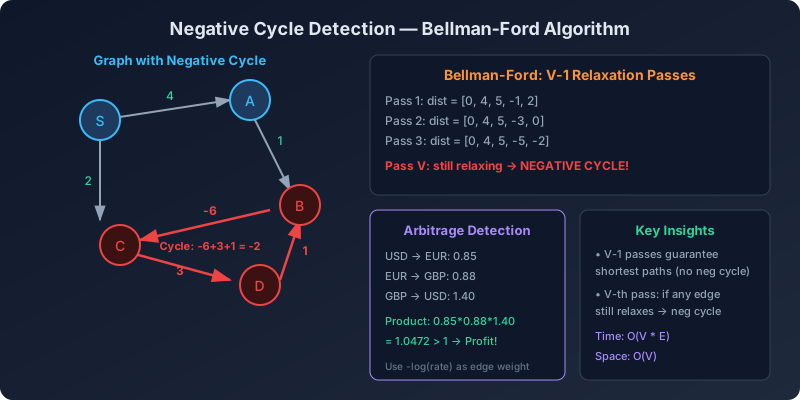
A negative cycle is a cycle in a weighted directed graph whose edge weights sum to a negative value. When such a cycle is reachable from a source vertex, the concept of a “shortest path” breaks down because you can keep traversing the cycle to reduce the total cost indefinitely.
Detecting negative cycles is critical in several domains:
- Currency arbitrage: a sequence of exchanges that yields more money than you started with.
- Game AI: finding infinite resource loops.
- Network routing: identifying unstable routing configurations.
Why shortest-path algorithms fail
Dijkstra’s algorithm assumes all edge weights are non-negative. When a negative cycle exists, Dijkstra may loop forever or return incorrect results. Bellman-Ford handles negative edges gracefully and, with one extra pass, can detect whether a negative cycle exists.
Bellman-Ford refresher
Bellman-Ford relaxes every edge |V| - 1 times. After |V| - 1
iterations the shortest-path estimates are final unless a negative
cycle is reachable.
def bellman_ford(n: int, edges: list[tuple[int, int, float]], src: int):
    """
    Returns (dist, predecessor) arrays.
    dist[v] = shortest distance from src to v.
    If no negative cycle, all values are optimal after n-1 passes.
    """
    INF = float('inf')
    dist = [INF] * n
    pred = [-1] * n
    dist[src] = 0

    for _ in range(n - 1):
        for u, v, w in edges:
            if dist[u] + w < dist[v]:
                dist[v] = dist[u] + w
                pred[v] = u

    return dist, pred
Time complexity: O(V * E)
Space complexity: O(V)
Detecting a negative cycle: the nth relaxation
The key insight is straightforward: after |V| - 1 relaxation passes,
all shortest distances are finalized if no negative cycle exists. If we
run one more pass and any distance can still be reduced, a negative
cycle is reachable.
def has_negative_cycle(n: int, edges: list[tuple[int, int, float]], src: int) -> bool:
    """
    Returns True if a negative cycle is reachable from src.
    """
    INF = float('inf')
    dist = [INF] * n
    dist[src] = 0

    # Standard n-1 relaxation passes
    for _ in range(n - 1):
        for u, v, w in edges:
            if dist[u] != INF and dist[u] + w < dist[v]:
                dist[v] = dist[u] + w

    # nth pass: if any edge can still be relaxed, negative cycle exists
    for u, v, w in edges:
        if dist[u] != INF and dist[u] + w < dist[v]:
            return True

    return False
Why does this work?
In a graph without negative cycles, the shortest path between any two
vertices uses at most |V| - 1 edges (a simple path). After |V| - 1
relaxation rounds, every shortest path has been discovered. If the nth
round still finds a shorter path, that path must use |V| or more
edges, which means it revisits a vertex, forming a cycle that reduces
cost — a negative cycle.
Tracing the actual negative cycle
Knowing a negative cycle exists is often not enough. We need to find the cycle itself. The approach:
- Run the nth relaxation pass and record any vertex
vthat gets relaxed. - Follow predecessors from
vfor|V|steps to ensure you land on a vertex that is definitely on the cycle. - Trace back from that vertex until you revisit it.
def find_negative_cycle(n: int, edges: list[tuple[int, int, float]]):
    """
    Returns a list of vertices forming a negative cycle, or empty list
    if none exists.
    """
    INF = float('inf')
    dist = [0] * n          # start all at 0 to detect any reachable cycle
    pred = [-1] * n

    changed = -1
    for i in range(n):
        changed = -1
        for u, v, w in edges:
            if dist[u] + w < dist[v]:
                dist[v] = dist[u] + w
                pred[v] = u
                changed = v

    if changed == -1:
        return []            # no negative cycle

    # Walk back n steps to land inside the cycle
    v = changed
    for _ in range(n):
        v = pred[v]

    # Trace the cycle
    cycle = []
    cur = v
    while True:
        cycle.append(cur)
        cur = pred[cur]
        if cur == v:
            cycle.append(v)
            break

    cycle.reverse()
    return cycle
Key detail: We initialize all distances to 0 instead of infinity.
This lets us detect negative cycles anywhere in the graph, not just
those reachable from a single source.
Finding nodes affected by negative cycles
Sometimes you need to know which specific nodes have their shortest path affected (i.e., can reach negative infinity). Run V additional passes after the standard V-1 passes, propagating negative infinity to all reachable nodes:
def bellman_ford_affected_nodes(
    n: int, edges: list[tuple[int, int, float]], source: int
) -> list[float]:
    """
    Returns distances, with -inf for nodes affected by negative cycles.
    """
    dist = [float('inf')] * n
    dist[source] = 0

    # V-1 passes
    for _ in range(n - 1):
        for u, v, w in edges:
            if dist[u] != float('inf') and dist[u] + w < dist[v]:
                dist[v] = dist[u] + w

    # V more passes to propagate negative cycle effects
    for _ in range(n - 1):
        for u, v, w in edges:
            if dist[u] != float('inf') and dist[u] + w < dist[v]:
                dist[v] = float('-inf')
            if dist[u] == float('-inf'):
                dist[v] = float('-inf')

    return dist
Currency arbitrage detection
One of the most famous applications of negative cycle detection is currency arbitrage. Given exchange rates between currencies, can you start with one unit of a currency, perform a series of exchanges, and end up with more than one unit of the same currency?
Modelling the problem
Given exchange rates rate[i][j] (1 unit of currency i buys
rate[i][j] units of currency j):
- We want to find if a cycle
c1 -> c2 -> ... -> c1exists whererate[c1][c2] * rate[c2][c3] * ... * rate[ck][c1] {'>'} 1. - Taking the negative logarithm of each rate transforms the
multiplicative problem into an additive one: we need a cycle where
the sum of
-log(rate)values is negative.
Why logarithms?
Exchange rates are multiplicative: starting with $1, exchanging
USD->EUR->GBP->USD gives you rate1 * rate2 * rate3 dollars. Arbitrage
exists when the product exceeds 1. Taking -log of each rate converts
multiplication to addition: -log(rate1) + (-log(rate2)) + (-log(rate3)).
If this sum is negative, the product of rates exceeds 1, meaning
arbitrage exists.
import math

def detect_arbitrage(rates: list[list[float]]) -> bool:
    """
    rates[i][j] = exchange rate from currency i to currency j.
    Returns True if an arbitrage opportunity exists.
    """
    n = len(rates)
    edges = []

    for i in range(n):
        for j in range(n):
            if i != j and rates[i][j] > 0:
                # Transform: weight = -log(rate)
                weight = -math.log(rates[i][j])
                edges.append((i, j, weight))

    # Use Bellman-Ford with all distances starting at 0
    dist = [0.0] * n

    for _ in range(n - 1):
        for u, v, w in edges:
            if dist[u] + w < dist[v]:
                dist[v] = dist[u] + w

    # Check for negative cycle
    for u, v, w in edges:
        if dist[u] + w < dist[v]:
            return True

    return False
Finding the arbitrage cycle
def find_arbitrage_cycle(
    currencies: list[str],
    rates: dict[tuple[str, str], float]
) -> list[str]:
    """Find the actual arbitrage cycle, if it exists."""
    n = len(currencies)
    currency_idx = {c: i for i, c in enumerate(currencies)}

    edges = []
    for (from_c, to_c), rate in rates.items():
        u = currency_idx[from_c]
        v = currency_idx[to_c]
        edges.append((u, v, -math.log(rate)))

    dist = [float('inf')] * n
    parent = [-1] * n
    dist[0] = 0

    last_updated = -1

    for i in range(n):
        last_updated = -1
        for u, v, w in edges:
            if dist[u] != float('inf') and dist[u] + w < dist[v]:
                dist[v] = dist[u] + w
                parent[v] = u
                last_updated = v

    if last_updated == -1:
        return []  # no arbitrage

    # Trace back the cycle
    node = last_updated
    for _ in range(n):
        node = parent[node]

    cycle = []
    current = node
    while True:
        cycle.append(currencies[current])
        current = parent[current]
        if current == node:
            cycle.append(currencies[current])
            break

    cycle.reverse()
    return cycle
Example
Rates: USD->EUR: 0.85, EUR->GBP: 0.88, GBP->USD: 1.40
Product: 0.85 * 0.88 * 1.40 = 1.0472 > 1
Edge weights: -log(0.85) = 0.163, -log(0.88) = 0.128, -log(1.40) = -0.336
Cycle weight: 0.163 + 0.128 + (-0.336) = -0.045 < 0
Negative cycle detected. Arbitrage is possible: start with $1000, get $1047.20 after one round.
The SPFA algorithm
Shortest Path Faster Algorithm (SPFA) is a queue-based optimization of Bellman-Ford. It only relaxes edges from vertices whose distances have recently changed, often running much faster in practice.
For negative cycle detection, we track how many times each vertex enters
the queue. If any vertex enters more than |V| times, a negative cycle
exists.
from collections import deque

def spfa_negative_cycle(n: int, adj: list[list[tuple[int, float]]], src: int) -> bool:
    """
    adj[u] = list of (v, weight) edges from u.
    Returns True if a negative cycle is reachable from src.
    """
    INF = float('inf')
    dist = [INF] * n
    dist[src] = 0
    in_queue = [False] * n
    count = [0] * n          # times each vertex entered the queue

    queue = deque([src])
    in_queue[src] = True
    count[src] = 1

    while queue:
        u = queue.popleft()
        in_queue[u] = False

        for v, w in adj[u]:
            if dist[u] + w < dist[v]:
                dist[v] = dist[u] + w

                if not in_queue[v]:
                    queue.append(v)
                    in_queue[v] = True
                    count[v] += 1

                    if count[v] > n:
                        return True   # negative cycle detected

    return False
SPFA complexity
| Case | Time |
|---|---|
| Best case | O(E) |
| Average | O(E) |
| Worst case | O(V * E) |
| Space | O(V) |
SPFA degrades to Bellman-Ford on adversarial inputs, but for random graphs it is significantly faster. Some competitive programmers avoid SPFA because it can be forced into worst-case behavior with crafted inputs.
Cheapest Flights with K Stops (LeetCode 787)
A modified Bellman-Ford where you limit the number of edges (stops):
def find_cheapest_price(
    n: int, flights: list[list[int]], src: int, dst: int, k: int
) -> int:
    """
    LeetCode 787: Find cheapest flight with at most k stops.
    Use Bellman-Ford with exactly k+1 passes.
    """
    dist = [float('inf')] * n
    dist[src] = 0

    # k stops = k+1 edges maximum
    for _ in range(k + 1):
        # Important: use a copy to avoid using updated values
        # from the same pass
        new_dist = dist[:]

        for u, v, w in flights:
            if dist[u] != float('inf') and dist[u] + w < new_dist[v]:
                new_dist[v] = dist[u] + w

        dist = new_dist

    return dist[dst] if dist[dst] != float('inf') else -1
Note the critical detail: we use a copy of dist for each pass. Without
the copy, we might use a distance updated in the current pass, effectively
using more edges than allowed.
Detecting negative cycles in all components
When the graph is disconnected, a single-source Bellman-Ford only checks cycles reachable from the source. Two approaches handle this:
Approach 1: virtual super-source
Add a virtual vertex S with zero-weight edges to every other vertex,
then run Bellman-Ford from S.
def negative_cycle_any_component(n: int, edges: list[tuple[int, int, float]]) -> bool:
    """
    Detects negative cycle in any connected component.
    """
    # Add super-source with id = n
    extended_edges = edges[:]
    for v in range(n):
        extended_edges.append((n, v, 0))

    return has_negative_cycle(n + 1, extended_edges, n)
Approach 2: initialize all distances to zero
Set dist[v] = 0 for all v. This simulates having a super-source
without actually adding one, as we did in the find_negative_cycle
function above.
Shortest path in DAGs with negative weights
A graph can have negative edges without having negative cycles. A DAG (no cycles at all) can have negative edges, and shortest paths are well-defined. Use topological sort + relaxation for O(V + E) performance:
def shortest_path_dag_negative(
    n: int, adj: list[list[tuple[int, int]]], source: int
) -> list[float]:
    """
    Shortest path in a DAG (can have negative edges).
    Topological sort + relaxation. O(V + E).
    """
    from collections import deque

    in_degree = [0] * n
    for u in range(n):
        for v, w in adj[u]:
            in_degree[v] += 1

    # Topological sort
    queue = deque([i for i in range(n) if in_degree[i] == 0])
    topo_order = []

    while queue:
        u = queue.popleft()
        topo_order.append(u)
        for v, w in adj[u]:
            in_degree[v] -= 1
            if in_degree[v] == 0:
                queue.append(v)

    # Relax in topological order
    dist = [float('inf')] * n
    dist[source] = 0

    for u in topo_order:
        if dist[u] == float('inf'):
            continue
        for v, w in adj[u]:
            dist[v] = min(dist[v], dist[u] + w)

    return dist
This is O(V + E), much faster than Bellman-Ford, but only works for DAGs.
Negative cycles in undirected graphs
An undirected graph can have a negative cycle if any edge has a negative
weight. Why? Traversing a negative-weight edge back and forth creates a
cycle of weight 2w {'<'} 0. So negative cycle detection in undirected
graphs is trivially a scan for any negative edge weight.
Common pitfalls
-
Floating-point precision: When using log-transformed weights (as in arbitrage), floating-point errors can cause false positives. Use an epsilon threshold:
dist[u] + w {'<'} dist[v] - 1e-9. -
Unreachable cycles: Standard Bellman-Ford from a single source only detects cycles reachable from that source. Use the super-source technique for global detection.
-
Confusing “has negative edges” with “has negative cycle”: A graph can have negative edges without any negative cycle. Bellman-Ford handles negative edges fine; it is only negative cycles that are problematic.
-
Forgetting the INF check: When relaxing
dist[u] + w {'<'} dist[v], ensuredist[u] != INFto avoid arithmetic on infinity. -
Not copying the distance array in K-stops problems: Without copying, you may use distances updated in the same pass, effectively using more edges than allowed.
Big-O summary
| Algorithm | Time | Space | Detects cycle? |
|---|---|---|---|
| Bellman-Ford + nth pass | O(V * E) | O(V) | Yes |
| SPFA | O(V * E)* | O(V) | Yes |
| Floyd-Warshall (all-pairs) | O(V^3) | O(V^2) | Yes (diagonal) |
| Dijkstra | O(E log V) | O(V) | No |
| DAG topo sort + relax | O(V + E) | O(V) | N/A (no cycles) |
*SPFA is O(E) on average but O(V * E) worst case.
Practice problems
| Problem | Difficulty | Key Concept |
|---|---|---|
| LeetCode 787: Cheapest Flights K Stops | Medium | Limited Bellman-Ford |
| LeetCode 743: Network Delay Time | Medium | Shortest path (Dijkstra or BF) |
| LeetCode 1334: Find City with Smallest Neighbors | Medium | All-pairs shortest path |
| Negative Weight Cycle - GeeksforGeeks | Medium | Standard negative cycle |
| Shortest Path with Negative Weights - CSES | Hard | Negative cycles + infinite paths |
Key takeaways
- Run Bellman-Ford for
|V|iterations instead of|V| - 1. If the nth pass still relaxes an edge, a negative cycle exists. - SPFA provides a practical speedup: track queue-entry counts and flag
a cycle when any vertex exceeds
|V|entries. - Currency arbitrage maps directly to negative cycle detection via log-transformation of exchange rates.
- For disconnected graphs, use a virtual super-source or initialize all distances to zero.
- For DAGs with negative weights, use topological sort + relaxation in O(V + E) instead of Bellman-Ford.
- SPFA is faster in practice but has the same worst case. Use it when speed matters, but understand its limitations on adversarial inputs.
Related articles
- DSA Alien Dictionary: Topological Sort from Word Ordering
Derive character ordering from sorted alien words using topological sort, with course schedule variants and prerequisite chain problems.
- DSA Word Search, Boggle Solver, and Word Ladder: Grid + String Graph Problems
Solve word search with DFS backtracking, Boggle with Trie pruning, and word ladder with BFS for efficient string transformation problems.
- DSA A* Search Algorithm: Heuristic Pathfinding Explained
Learn the A* search algorithm with f=g+h, admissible heuristics, grid pathfinding, and Python implementation compared to Dijkstra and BFS.
- DSA Articulation Points and Bridges in Graphs
Find critical nodes and edges in graphs using Tarjan's algorithm with discovery and low-link arrays, with Python code and network applications.