BST Operations Deep Dive: Insert, Delete & Search
Master Binary Search Tree operations — insert, search, and all three delete cases with in-order successor. Full Python implementation with time complexity analysis.
What you'll learn
- ✓The BST property and why it enables fast operations
- ✓Step-by-step insertion with path tracing
- ✓Search in O(log n) average case
- ✓Delete with all three cases: leaf, one child, two children
- ✓In-order successor and predecessor
- ✓Complete Python BST class implementation
- ✓Time complexity: balanced vs skewed trees
Prerequisites
- •Comfortable with binary tree basics and recursion
- •Understanding of tree traversals
A Binary Search Tree is the most natural way to organize data for fast lookup. Every node enforces a single rule: everything in the left subtree is smaller, everything in the right subtree is larger. This one invariant gives us O(log n) search, insert, and delete — when the tree stays balanced.
The BST property
For every node n in a BST:
- All values in
n.leftare strictly less thann.val - All values in
n.rightare strictly greater thann.val
This must hold recursively for every subtree, not just direct children.
        20
       /  \
      10   30        Valid BST
     / \   / \
    5  15 25  35
A common mistake is only checking the immediate children. The value 25 must be greater than 20 (the root), not just less than 30. The property is global, not local.
The TreeNode class
class TreeNode:
    def __init__(self, val):
        self.val = val
        self.left = None
        self.right = None
Every BST operation starts from the root and navigates left or right based on comparisons.
Search
Search is the simplest operation. Start at the root, compare, go left or right.
def search(root, target):
    """Return the node with value target, or None."""
    if root is None or root.val == target:
        return root
    if target < root.val:
        return search(root.left, target)
    return search(root.right, target)
Iterative version (saves stack space):
def search_iterative(root, target):
    current = root
    while current:
        if current.val == target:
            return current
        elif target < current.val:
            current = current.left
        else:
            current = current.right
    return None
At each step we eliminate roughly half the tree, giving us O(log n) for a balanced tree.
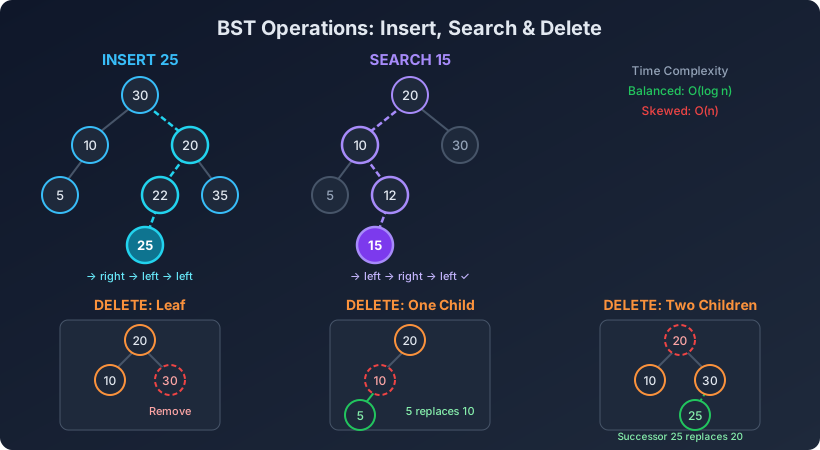
Search trace example
Search for 15 in:
        20
       /  \
      10   30
     / \
    5  15

Step 1: 15 < 20 → go left
Step 2: 15 > 10 → go right
Step 3: 15 == 15 → found!

Comparisons: 3 (which is the depth of node 15)
Insert
Insertion follows the same path as search. When we reach a None position, that is where the new node belongs.
def insert(root, val):
    """Insert val into BST rooted at root. Return the root."""
    if root is None:
        return TreeNode(val)
    if val < root.val:
        root.left = insert(root.left, val)
    elif val > root.val:
        root.right = insert(root.right, val)
    # If val == root.val, we skip (no duplicates)
    return root
Iterative version:
def insert_iterative(root, val):
    new_node = TreeNode(val)
    if root is None:
        return new_node

    parent = None
    current = root
    while current:
        parent = current
        if val < current.val:
            current = current.left
        elif val > current.val:
            current = current.right
        else:
            return root  # duplicate, skip

    if val < parent.val:
        parent.left = new_node
    else:
        parent.right = new_node
    return root
Insertion order matters
The shape of the BST depends entirely on the insertion order:
# Inserting [4, 2, 6, 1, 3, 5, 7] gives a balanced tree:
#        4
#       / \
#      2   6
#     / \ / \
#    1  3 5  7

# Inserting [1, 2, 3, 4, 5, 6, 7] gives a skewed tree:
# 1
#  \
#   2
#    \
#     3
#      \
#       4  ... (essentially a linked list)
This is why balanced BSTs (AVL, Red-Black) exist — they prevent degradation.
In-order successor and predecessor
Before tackling delete, we need these two concepts.
In-order successor: The node with the smallest value greater than the current node. It is the leftmost node in the right subtree.
In-order predecessor: The node with the largest value smaller than the current node. It is the rightmost node in the left subtree.
def find_min(node):
    """Find the leftmost (minimum) node in the subtree."""
    current = node
    while current.left:
        current = current.left
    return current

def find_max(node):
    """Find the rightmost (maximum) node in the subtree."""
    current = node
    while current.right:
        current = current.right
    return current
For a node with value 20 that has a right subtree, its in-order successor is find_min(node.right).
Delete
Delete is the most complex BST operation because removing a node must preserve the BST property. There are three cases.
Case 1: Delete a leaf node
The simplest case. The node has no children — just remove it.
Delete 5:
    10          10
   / \    →    / \
  5   15         15
Case 2: Delete a node with one child
Replace the node with its only child. The child takes the deleted node’s position.
Delete 10 (has left child 5):
    20          20
   / \    →    / \
  10  30      5   30
 /
5
Case 3: Delete a node with two children
This is the tricky case. We cannot just remove the node because both subtrees need a parent. The strategy:
- Find the in-order successor (smallest node in right subtree)
- Copy the successor’s value to the node being deleted
- Delete the successor (which has at most one child, so it falls into Case 1 or 2)
Delete 20 (has two children):
    20          25
   / \    →    / \
  10  30      10  30
     /
    25

Step 1: In-order successor of 20 = 25 (leftmost in right subtree)
Step 2: Copy 25 to position of 20
Step 3: Delete original 25 (leaf, Case 1)
Complete delete implementation
def delete(root, val):
    """Delete node with value val from BST. Return the root."""
    if root is None:
        return None

    # Navigate to the node
    if val < root.val:
        root.left = delete(root.left, val)
    elif val > root.val:
        root.right = delete(root.right, val)
    else:
        # Found the node to delete

        # Case 1: Leaf node
        if root.left is None and root.right is None:
            return None

        # Case 2: One child
        if root.left is None:
            return root.right
        if root.right is None:
            return root.left

        # Case 3: Two children
        # Find in-order successor (min of right subtree)
        successor = find_min(root.right)
        root.val = successor.val
        # Delete the successor from right subtree
        root.right = delete(root.right, successor.val)

    return root
You could also use the in-order predecessor (max of left subtree) instead of the successor. Both approaches preserve the BST property.
Complete BST class
Here is a full BST class that wraps all operations:
class BST:
    def __init__(self):
        self.root = None

    def insert(self, val):
        self.root = self._insert(self.root, val)

    def _insert(self, node, val):
        if node is None:
            return TreeNode(val)
        if val < node.val:
            node.left = self._insert(node.left, val)
        elif val > node.val:
            node.right = self._insert(node.right, val)
        return node

    def search(self, val):
        return self._search(self.root, val)

    def _search(self, node, val):
        if node is None or node.val == val:
            return node
        if val < node.val:
            return self._search(node.left, val)
        return self._search(node.right, val)

    def delete(self, val):
        self.root = self._delete(self.root, val)

    def _delete(self, node, val):
        if node is None:
            return None
        if val < node.val:
            node.left = self._delete(node.left, val)
        elif val > node.val:
            node.right = self._delete(node.right, val)
        else:
            if node.left is None:
                return node.right
            if node.right is None:
                return node.left
            successor = self._find_min(node.right)
            node.val = successor.val
            node.right = self._delete(node.right, successor.val)
        return node

    def _find_min(self, node):
        while node.left:
            node = node.left
        return node

    def inorder(self):
        """Return sorted list of values."""
        result = []
        self._inorder(self.root, result)
        return result

    def _inorder(self, node, result):
        if node:
            self._inorder(node.left, result)
            result.append(node.val)
            self._inorder(node.right, result)
Using the BST class
bst = BST()
for val in [20, 10, 30, 5, 15, 25, 35]:
    bst.insert(val)

print(bst.inorder())  # [5, 10, 15, 20, 25, 30, 35]
print(bst.search(15))  # <TreeNode object>
print(bst.search(99))  # None

bst.delete(20)  # Delete root (two children case)
print(bst.inorder())  # [5, 10, 15, 25, 30, 35]

bst.delete(5)   # Delete leaf
print(bst.inorder())  # [10, 15, 25, 30, 35]
Time complexity analysis
| Operation | Balanced BST | Skewed BST |
|---|---|---|
| Search | O(log n) | O(n) |
| Insert | O(log n) | O(n) |
| Delete | O(log n) | O(n) |
| In-order | O(n) | O(n) |
| Min/Max | O(log n) | O(n) |
Space complexity: O(h) for recursive operations where h is the height. For balanced trees h = log n, for skewed trees h = n.
Why O(log n)?
A balanced BST with n nodes has height approximately log2(n). Each operation visits at most one node per level, so the work is proportional to the height.
# For n = 1,000,000 nodes:
# Balanced: log2(1,000,000) ≈ 20 comparisons
# Skewed: up to 1,000,000 comparisons
The difference is massive. This is why self-balancing trees (AVL, Red-Black) are used in practice.
Validating a BST
A classic interview problem: given a binary tree, check if it is a valid BST.
def is_valid_bst(root, min_val=float('-inf'), max_val=float('inf')):
    """Check if tree is a valid BST using range checking."""
    if root is None:
        return True
    if root.val <= min_val or root.val >= max_val:
        return False
    return (is_valid_bst(root.left, min_val, root.val) and
            is_valid_bst(root.right, root.val, max_val))
The common mistake is only comparing with the parent. You must track the valid range for each node.
Alternative: in-order traversal check
A BST’s in-order traversal produces a sorted sequence. We can verify this:
def is_valid_bst_inorder(root):
    """Validate BST using in-order traversal."""
    prev = [float('-inf')]

    def inorder(node):
        if node is None:
            return True
        if not inorder(node.left):
            return False
        if node.val <= prev[0]:
            return False
        prev[0] = node.val
        return inorder(node.right)

    return inorder(root)
Finding kth smallest element
Another frequent interview problem that leverages in-order traversal:
def kth_smallest(root, k):
    """Find the kth smallest element in BST."""
    count = [0]
    result = [None]

    def inorder(node):
        if node is None or result[0] is not None:
            return
        inorder(node.left)
        count[0] += 1
        if count[0] == k:
            result[0] = node.val
            return
        inorder(node.right)

    inorder(root)
    return result[0]
Floor and ceiling
Floor: Largest value in BST that is <= target. Ceiling: Smallest value in BST that is >= target.
def floor(root, target):
    """Find largest value <= target."""
    result = None
    current = root
    while current:
        if current.val == target:
            return current.val
        elif current.val < target:
            result = current.val  # candidate
            current = current.right
        else:
            current = current.left
    return result

def ceiling(root, target):
    """Find smallest value >= target."""
    result = None
    current = root
    while current:
        if current.val == target:
            return current.val
        elif current.val > target:
            result = current.val  # candidate
            current = current.left
        else:
            current = current.right
    return result
Practice problems
- Validate BST (LeetCode 98) — Use the range-checking approach
- Insert into BST (LeetCode 701) — Direct application
- Delete Node in BST (LeetCode 450) — Handle all 3 cases
- Kth Smallest in BST (LeetCode 230) — In-order traversal
- Inorder Successor in BST (LeetCode 285) — Use BST property
- Convert Sorted Array to BST (LeetCode 108) — Divide and conquer
- Trim a BST (LeetCode 669) — Recursive range trimming
- Range Sum of BST (LeetCode 938) — Prune branches outside range
Key takeaways
- The BST property is global, not just about direct children
- Delete with two children uses the in-order successor (or predecessor) as a replacement
- All operations are O(h) where h is the height — balanced trees keep h = O(log n)
- In-order traversal of a BST always produces a sorted sequence
- The shape of a BST depends on insertion order, which is why self-balancing variants exist
Related articles
- DSA Flatten Binary Tree to Linked List
Learn how to flatten a binary tree to a linked list using preorder threading, Morris traversal, and how to convert a BST to a sorted doubly linked list — with full Python implementations and Big-O analysis.
- DSA BST Iterator, Range Queries, and Closest Value
Master BST iterator using stack-based controlled in-order traversal, range sum queries, counting nodes in range, closest value, and closest K values — with full Python implementations.
- DSA Boundary Traversal of Binary Tree
Complete guide to boundary traversal — left boundary, leaf nodes, and right boundary in reverse. Multiple Python approaches with edge case handling.
- DSA Distance Problems in Binary Trees
Solve distance problems in binary trees — distance between two nodes, all nodes at distance K, burning a tree from a node, and sum of distances using rerooting. Full Python implementations.