Decode String (LeetCode 394) — Nested Bracket Decoding
Decode nested encoded strings like '3[a2[c]]' using a stack. Complete walkthrough with Python solution, traces, and edge cases.
What you'll learn
- ✓How to decode nested encoded strings with a stack
- ✓Handling multi-digit numbers and nested brackets
- ✓Recursive vs iterative approaches
- ✓Time and space complexity analysis
Prerequisites
- •Stack basics — see Stacks & Queues Intro
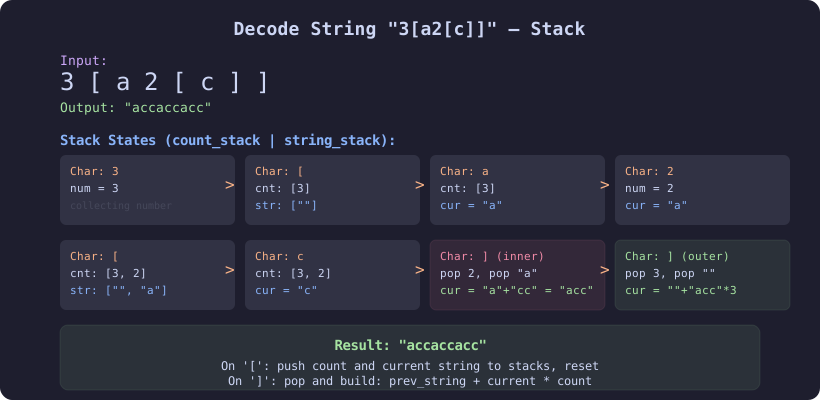
Given an encoded string like 3[a2[c]], decode it to accaccacc. The encoding rule is k[encoded_string], where the encoded_string inside the brackets is repeated k times.
The Stack Approach
Use a stack to handle nesting. When you hit ], pop back to the matching [, build the substring, repeat it, and push the result back.
def decode_string(s):
    """
    Decode encoded string using a stack.
    Time: O(n * max_k), Space: O(n)
    where n is the decoded output length
    """
    stack = []
    current_num = 0
    current_str = ""

    for char in s:
        if char.isdigit():
            current_num = current_num * 10 + int(char)
        elif char == '[':
            stack.append((current_str, current_num))
            current_str = ""
            current_num = 0
        elif char == ']':
            prev_str, num = stack.pop()
            current_str = prev_str + current_str * num
        else:
            current_str += char

    return current_str
Trace
Input: 3[a2[c]]
char | current_num | current_str | stack
-----|-------------|-------------|------
3    | 3           | ""          | []
[    | 0           | ""          | [("", 3)]
a    | 0           | "a"         | [("", 3)]
2    | 2           | "a"         | [("", 3)]
[    | 0           | ""          | [("", 3), ("a", 2)]
c    | 0           | "c"         | [("", 3), ("a", 2)]
]    | 0           | "acc"       | [("", 3)]         ← "a" + "c"*2
]    | 0           | "accaccacc" | []                 ← "" + "acc"*3
Output: accaccacc
Recursive Approach
def decode_string_recursive(s):
    """Recursive decoder using an index pointer."""
    def helper(s, i):
        result = ""
        while i < len(s) and s[i] != ']':
            if s[i].isdigit():
                num = 0
                while i < len(s) and s[i].isdigit():
                    num = num * 10 + int(s[i])
                    i += 1
                i += 1  # skip '['
                decoded, i = helper(s, i)
                i += 1  # skip ']'
                result += decoded * num
            else:
                result += s[i]
                i += 1
        return result, i

    return helper(s, 0)[0]
Edge Cases
- No encoding —
"abc"returns"abc" - Multi-digit numbers —
"10[a]"returns"aaaaaaaaaa" - Deeply nested —
"2[a2[b3[c]]]"works correctly with stack - Adjacent encodings —
"2[a]3[b]"returns"aabbb" - Empty brackets —
"3[]"returns""
Complexity
| Metric | Value |
|---|---|
| Time | O(S) where S is the decoded output length |
| Space | O(S) for the output + O(d) stack depth where d is max nesting |
When to Use This Pattern
Whenever you have nested structures that need inside-out processing:
- Parsing nested expressions
- Expanding templates or macros
- Processing recursive grammars
Related Problems
- Number of Atoms (LeetCode 726) — similar nested parsing with counts
- Brace Expansion (LeetCode 1087)
- Basic Calculator (LeetCode 224) — nested expression evaluation
- Remove Outermost Parentheses (LeetCode 1021)
Related articles
- DSA Implement Stack Using Two Queues — Two Approaches Explained
Implement a stack using two queues with costly push and costly pop approaches. Complete Python solutions with complexity analysis.
- DSA Asteroid Collision Problem Using Stacks
Solve the asteroid collision problem (LeetCode 735) using a stack. Covers collision rules, Python implementation, and all edge cases.
- DSA Car Fleet Problem — Stack-Based Arrival Time Solution
Solve LeetCode 853 Car Fleet using a stack. Sort by position, compare arrival times, and count fleets. Python solution with visual trace.
- DSA The Celebrity Problem Using Stack-Based Elimination
Solve the celebrity problem in O(n) time using a stack elimination technique. Includes proof of correctness, Python code, and matrix examples.