Walls and Gates — Multi-Source BFS
Fill each empty room with the distance to its nearest gate using multi-source BFS. LeetCode 286 solution with Python code and grid BFS template.
What you'll learn
- ✓Multi-source BFS for distance-to-nearest problems
- ✓Why BFS from gates is better than BFS from each room
- ✓In-place grid modification with queue
- ✓Template for nearest-source distance problems
Prerequisites
- •BFS pattern — see BFS with Queues
- •Multi-source BFS — see Rotten Oranges
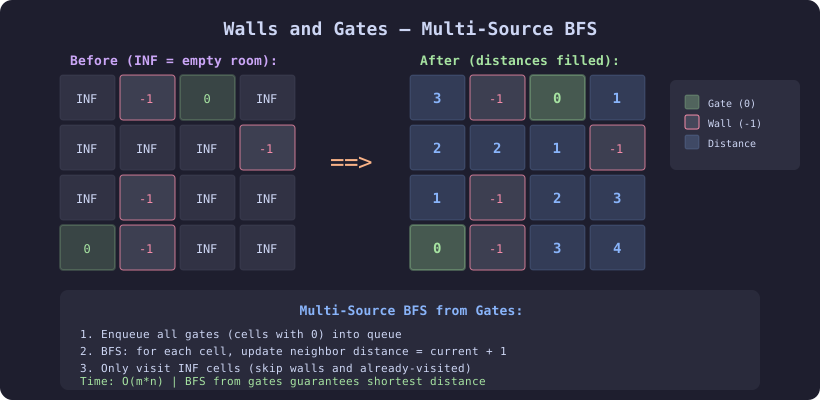
Given a grid where 0 = gate, -1 = wall, and INF = empty room, fill each empty room with the distance to its nearest gate.
Why BFS from Gates?
BFS from each room to find the nearest gate is O(m²n²). Instead, start BFS from all gates simultaneously — each room is visited at most once, giving O(mn).
Solution
from collections import deque

def walls_and_gates(rooms):
    """
    Fill rooms with distance to nearest gate (in-place).
    Time: O(m × n), Space: O(m × n)
    """
    if not rooms:
        return

    INF = 2147483647
    rows, cols = len(rooms), len(rooms[0])
    queue = deque()

    # Enqueue all gates
    for r in range(rows):
        for c in range(cols):
            if rooms[r][c] == 0:
                queue.append((r, c))

    directions = [(0,1), (0,-1), (1,0), (-1,0)]

    while queue:
        r, c = queue.popleft()
        for dr, dc in directions:
            nr, nc = r + dr, c + dc
            if (0 <= nr < rows and 0 <= nc < cols
                and rooms[nr][nc] == INF):
                rooms[nr][nc] = rooms[r][c] + 1
                queue.append((nr, nc))
Trace
Before:                    After:
INF  -1   0  INF          3  -1   0   1
INF INF INF  -1     →     2   2   1  -1
INF  -1 INF  -1           1  -1   2  -1
  0  -1 INF INF           0  -1   3   4
Gates at (0,2) and (3,0) start in the queue. BFS expands level by level:
- Level 0: gates (0,2), (3,0)
- Level 1: (0,3), (1,2), (2,0) get distance 1
- Level 2: (1,1), (1,0) get distance 2
- Level 3: (0,0), (3,2) get distance 3
- Level 4: (3,3) gets distance 4
Why It’s Correct
BFS explores nodes in order of increasing distance from the sources. Since we start from all gates simultaneously, the first time we reach a room, we’ve found the shortest distance to the nearest gate. We only update rooms with value INF, so walls and already-computed rooms are skipped.
Edge Cases
- No gates — all rooms remain INF
- No empty rooms — nothing to fill
- Room surrounded by walls — stays INF (unreachable)
- All gates — all values stay 0
Complexity
| Metric | Value |
|---|---|
| Time | O(m × n) — each cell visited once |
| Space | O(m × n) — queue can hold all cells |
When to Use This Pattern
“Distance to nearest X” problems are always multi-source BFS:
| Problem | Sources |
|---|---|
| Walls and Gates | Gates (value 0) |
| Rotten Oranges | Rotten cells (value 2) |
| As Far from Land | Land cells |
| Map of Highest Peak | Water cells |
Related Problems
- Rotten Oranges (LeetCode 994)
- As Far from Land as Possible (LeetCode 1162)
- Shortest Distance from All Buildings (LeetCode 317)
- 01 Matrix (LeetCode 542)
Related articles
- DSA BFS Pattern with Queues: Level-Order and Shortest Path
Master BFS using queues for tree level-order traversal and shortest path in unweighted graphs. Python implementations with detailed traces.
- DSA Design Circular Deque — Array-Based Implementation (LeetCode 641)
Design a Circular Deque with front/rear pointers on a fixed-size array. Python solution with all O(1) operations, visual trace, and edge case handling.
- DSA Design Hit Counter Using Queue
Design a hit counter that counts hits in the past 5 minutes using a queue. LeetCode 362 solution with O(1) amortized operations.
- DSA First Non-Repeating Character in a Stream
Find the first non-repeating character in a character stream using a queue and hash map. Python solution with O(1) amortized per query.