Remove Nth Node From End of Linked List
Master the two-pointer gap technique to remove the nth node from the end in a single pass. Covers the dummy node trick, edge cases like removing the head and single-node lists, with Python code and Big-O analysis.
What you'll learn
- ✓The two-pointer gap technique for finding the nth node from the end
- ✓Why a dummy node eliminates head-removal edge cases
- ✓Single-pass O(n) time and O(1) space solution
- ✓Edge cases: removing the head, single node, last node
- ✓How to adapt this pattern for related problems
Prerequisites
- •Linked list basics — traversal, insertion, deletion
- •Two-pointer techniques on linked lists
- •Familiarity with Big-O notation — see Big-O Notation
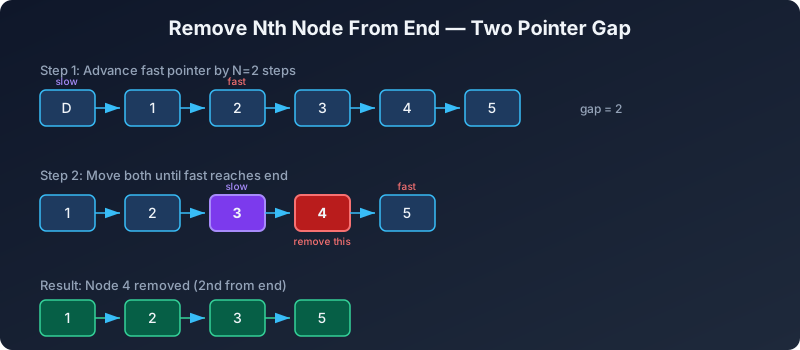
Removing a node from a singly linked list is straightforward when you know its position from the start. But what about from the end? You don’t know the length until you’ve traversed the entire list. The naive approach makes two passes — one to find the length, one to find the target. The elegant approach uses two pointers separated by a gap of n nodes to do it in a single pass.
Problem statement
Given the
headof a linked list, remove the nth node from the end of the list and return its head.LeetCode 19 — Remove Nth Node From End of Linked List
Constraints:
- The number of nodes is
szwhere1 {'<'}= sz {'<'}= 30 1 {'<'}= n {'<'}= sz
Examples:
Input:  1 -> 2 -> 3 -> 4 -> 5,  n = 2
Output: 1 -> 2 -> 3 -> 5
(Removed node 4, which is 2nd from the end)

Input:  1,  n = 1
Output: None
(Removed the only node)

Input:  1 -> 2,  n = 1
Output: 1
(Removed the tail)
Node definition
class ListNode:
    def __init__(self, val=0, next=None):
        self.val = val
        self.next = next
Approach 1: Two-pass (find length first)
Intuition
If the list has L nodes and we want to remove the nth from the end, that’s the (L - n + 1)th from the start (1-indexed). So find L first, then walk to position L - n to find the node before the target.
Implementation
def remove_nth_from_end_two_pass(head: ListNode, n: int) -> ListNode:
    # Pass 1: Find the length
    length = 0
    current = head
    while current:
        length += 1
        current = current.next

    # Edge case: removing the head
    if n == length:
        return head.next

    # Pass 2: Walk to the node before the target
    current = head
    for _ in range(length - n - 1):
        current = current.next

    # Skip over the target node
    current.next = current.next.next

    return head
Walkthrough
List: 1 -> 2 -> 3 -> 4 -> 5,  n = 2

Pass 1: length = 5
Target from start: 5 - 2 + 1 = 4th node (value 4)
Node before target: position 3 (value 3)

Pass 2: Walk to position 3
  current = 1, step 0
  current = 2, step 1
  current = 3, step 2  => stop

current.next = current.next.next
  3.next was 4, now 3.next = 5

Result: 1 -> 2 -> 3 -> 5
Complexity
| Metric | Value |
|---|---|
| Time | O(n) — at most two full passes (still linear) |
| Space | O(1) — only pointer variables |
Approach 2: One-pass with two pointers (the gap technique)
Intuition
Place two pointers n nodes apart. When the fast pointer reaches the end, the slow pointer is exactly at the node before the one we want to remove.
The trick: use a dummy node before head. This handles the edge case where we need to remove the head itself — without it, we’d need special-case logic.
Visual explanation
n = 2
dummy -> 1 -> 2 -> 3 -> 4 -> 5 -> None

Step 1: Advance fast pointer n+1 steps from dummy
  fast moves to: dummy -> 1 -> 2 -> 3
                                      ^fast
  slow stays at: dummy
                  ^slow

Step 2: Move both until fast reaches None
  Iteration 1: slow=1, fast=4
  Iteration 2: slow=2, fast=5
  Iteration 3: slow=3, fast=None  => stop

Step 3: slow.next = slow.next.next
  3.next was 4, now 3.next = 5

Result: 1 -> 2 -> 3 -> 5
Why the gap works
Think of it this way. If fast is n nodes ahead of slow, and fast is at the last node, then slow is n nodes behind the last node. That puts slow right before the nth-from-end node — exactly where we need it for deletion.
Implementation
def remove_nth_from_end(head: ListNode, n: int) -> ListNode:
    # Create a dummy node pointing to head
    dummy = ListNode(0, head)

    # Initialize both pointers at the dummy
    slow = dummy
    fast = dummy

    # Advance fast by n + 1 steps
    for _ in range(n + 1):
        fast = fast.next

    # Move both pointers until fast reaches the end
    while fast:
        slow = slow.next
        fast = fast.next

    # slow is now right before the target — skip it
    slow.next = slow.next.next

    return dummy.next
Step-by-step trace
List: 1 -> 2 -> 3 -> 4 -> 5,  n = 2

dummy -> 1 -> 2 -> 3 -> 4 -> 5 -> None
  ^slow
  ^fast

After advancing fast by 3 (n+1) steps:
dummy -> 1 -> 2 -> 3 -> 4 -> 5 -> None
  ^slow              ^fast

Moving both:
  slow=1, fast=4
  slow=2, fast=5
  slow=3, fast=None  => stop

slow.next = slow.next.next
  Before: 3 -> 4 -> 5
  After:  3 -> 5

return dummy.next => 1 -> 2 -> 3 -> 5
Complexity
| Metric | Value |
|---|---|
| Time | O(n) — single pass through the list |
| Space | O(1) — only pointer variables (dummy node is O(1)) |
The dummy node trick explained
The dummy node is one of the most useful patterns in linked list problems. Here’s why it matters:
Without dummy node — removing the head is a special case
# Without dummy: we need an explicit check
def remove_nth_no_dummy(head: ListNode, n: int) -> ListNode:
    fast = head
    for _ in range(n):
        fast = fast.next

    # If fast is None, we're removing the head
    if fast is None:
        return head.next

    slow = head
    while fast.next:
        slow = slow.next
        fast = fast.next

    slow.next = slow.next.next
    return head
With dummy node — no special cases
The dummy node ensures slow always has a node before the target, even when the target is the head. The code becomes cleaner and less error-prone.
Removing head (n = length):

Without dummy:
  head -> 1 -> 2 -> 3
  fast advances n steps and becomes None
  Need special check: if fast is None, return head.next

With dummy:
  dummy -> 1 -> 2 -> 3
  ^slow
  fast advances n+1 steps
  When fast is None, slow is at dummy
  slow.next = slow.next.next skips head naturally
Rule of thumb: Whenever a linked list problem might require modifying the head, start with a dummy node.
Edge cases deep dive
Case 1: Single node, remove it
List: 1 -> None,  n = 1

dummy -> 1 -> None
  ^slow
  ^fast

Fast advances 2 steps: fast = None

slow = dummy, slow.next = slow.next.next = None

return dummy.next = None  (empty list)
Case 2: Remove the head of a multi-node list
List: 1 -> 2 -> 3,  n = 3

dummy -> 1 -> 2 -> 3 -> None
  ^slow
  ^fast

Fast advances 4 steps: fast = None

slow = dummy
slow.next = slow.next.next = node 2

return dummy.next = 2 -> 3
Case 3: Remove the tail
List: 1 -> 2 -> 3,  n = 1

dummy -> 1 -> 2 -> 3 -> None
  ^slow
  ^fast

Fast advances 2 steps: fast = 1

Move both until fast.next is None... wait, we move until fast is None:
  slow=1, fast=2
  slow=2, fast=3
  slow=2... hmm.

Let me retrace with the correct algorithm:
Fast advances n+1 = 2 steps from dummy:
  fast = node 2

Move both until fast is None:
  slow=1, fast=3
  slow=2, fast=None => stop

slow.next = slow.next.next
  2.next was 3, now 2.next = None

return dummy.next = 1 -> 2
Common mistakes
-
Off-by-one on the gap. The fast pointer needs to advance
n + 1steps from dummy (notn), so thatslowends up before the target, not on it. -
Forgetting to return
dummy.next. If you returnhead, you’ll miss the case where the head was removed. -
Not using a dummy node. This leads to messy special-case code for head removal. Always use a dummy for deletion problems.
-
Assuming
nis valid. The problem guarantees1 {'<'}= n {'<'}= sz, but in production code you’d want to validaten.
Variations and follow-ups
Remove nth node from end — return the removed node
def remove_and_return_nth(head: ListNode, n: int) -> tuple:
    """Returns (new_head, removed_node)."""
    dummy = ListNode(0, head)
    slow, fast = dummy, dummy

    for _ in range(n + 1):
        fast = fast.next

    while fast:
        slow = slow.next
        fast = fast.next

    removed = slow.next
    slow.next = slow.next.next
    removed.next = None  # Clean up the removed node

    return dummy.next, removed
What if you’re given the node to remove (not n)?
That’s a different problem — LeetCode 237: Delete Node in a Linked List. You copy the next node’s value into the current node and skip the next node. But you can’t delete the tail this way.
Practice problems
| Problem | Difficulty | Link |
|---|---|---|
| Remove Nth Node From End of List | Medium | LeetCode 19 |
| Delete Node in a Linked List | Medium | LeetCode 237 |
| Middle of the Linked List | Easy | LeetCode 876 |
| Linked List Cycle | Easy | LeetCode 141 |
| Remove Linked List Elements | Easy | LeetCode 203 |
| Swapping Nodes in a Linked List | Medium | LeetCode 1721 |
Key takeaways
- The two-pointer gap technique is a fundamental pattern. By maintaining a fixed distance between two pointers, you can locate positions relative to the end without knowing the list’s length.
- The dummy node eliminates head-modification edge cases. Use it whenever a problem might require changing the head of the list.
- Even though the two-pass solution is also O(n), the single-pass solution is preferred in interviews because it demonstrates the gap technique — a pattern that applies to many other problems.
- Always test your solution against the three critical edge cases: removing the head, removing the tail, and removing from a single-node list.
Related articles
- DSA Add Two Numbers as Linked Lists
Learn to add two numbers represented as linked lists — both reverse order (LeetCode 2) and forward order (LeetCode 445). Covers carry handling, different-length lists, and Python implementations with Big-O analysis.
- DSA Copy Linked List with Random Pointer
Learn two approaches to deep copy a linked list with random pointers — HashMap O(n) space and the interleaving O(1) space technique. Step-by-step walkthroughs with Python code and Big-O analysis.
- DSA Flatten a Multilevel Linked List
Learn to flatten a multilevel doubly linked list (LeetCode 430) and flatten sorted linked lists. Covers iterative and recursive DFS approaches with Python implementations and Big-O analysis.
- DSA Linked List Palindrome Check: Three Approaches
Learn three ways to check if a linked list is a palindrome — stack-based O(n) space, reverse-second-half O(1) space, and recursive. Step-by-step walkthroughs with Python code and Big-O analysis.