Queues and Deques: FIFO, Double-Ended, and Circular
Master queue variants — simple queue, deque, circular queue, and priority queue. Implementations in Python with BFS, sliding window, and scheduling examples.
What you'll learn
- ✓What a queue is and why FIFO ordering matters
- ✓How to implement queues with collections.deque in Python
- ✓BFS traversal powered by a queue
- ✓What a deque is and when double-ended access is useful
- ✓The sliding window maximum pattern using a monotonic deque
- ✓How a circular queue works and when you need one
- ✓When to reach for a queue vs a stack vs a deque
Prerequisites
- •Read Stacks & Queues Introduction first
- •Familiarity with Big-O — see Big-O Notation
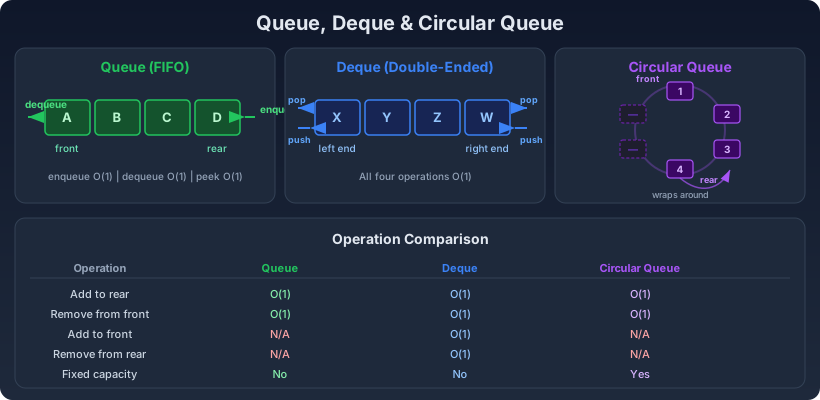
The introduction article gave you the shape of a queue and how it differs from a stack. This post goes deeper. We will build real implementations, use queues to solve graph and array problems, and meet two powerful variants: the deque (double-ended queue) and the circular queue. By the end you will know which queue variant to reach for and why.
1. What is a Queue (FIFO)?
A queue enforces first-in, first-out order. The item that has been waiting the longest is the next one served. Real-world analogies are everywhere:
- A line at a coffee shop — whoever ordered first gets their drink first.
- A printer queue — documents print in the order they were submitted.
- A call center — the caller who dialed in first talks to the next available agent.
The two fundamental operations are:
| Operation | What it does | Time |
|---|---|---|
| enqueue | Add an item to the rear | O(1) |
| dequeue | Remove the item at the front | O(1) |
| peek | Read the front item without removing it | O(1) |
| isEmpty | Check whether the queue is empty | O(1) |
Every operation is O(1). That constant-time guarantee is what makes queues useful in performance-sensitive systems like task schedulers and network buffers.
2. Queue Implementation with collections.deque
Python’s built-in list can act as a queue, but do not use it. Popping from the front of a list is O(n) because every remaining element shifts left. The standard library gives us collections.deque, a doubly-linked list that supports O(1) operations on both ends.
from collections import deque

class Queue:
    """Simple FIFO queue backed by collections.deque."""

    def __init__(self):
        self._data = deque()

    def enqueue(self, val):
        """Add to the rear."""
        self._data.append(val)

    def dequeue(self):
        """Remove and return from the front. Raises IndexError if empty."""
        if self.is_empty():
            raise IndexError("dequeue from an empty queue")
        return self._data.popleft()

    def peek(self):
        """Return the front item without removing it."""
        if self.is_empty():
            raise IndexError("peek from an empty queue")
        return self._data[0]

    def is_empty(self):
        return len(self._data) == 0

    def __len__(self):
        return len(self._data)

    def __repr__(self):
        return f"Queue({list(self._data)})"
Usage:
q = Queue()
q.enqueue("A")
q.enqueue("B")
q.enqueue("C")

print(q.peek())     # "A"
print(q.dequeue())  # "A"
print(q.dequeue())  # "B"
print(q)            # Queue(['C'])
Notice how "A" came out first even though "C" was added last. That is FIFO in action.
Why not list.pop(0)?
# Bad — O(n) per dequeue
queue = [1, 2, 3, 4, 5]
front = queue.pop(0)  # every element shifts left

# Good — O(1) per dequeue
from collections import deque
queue = deque([1, 2, 3, 4, 5])
front = queue.popleft()  # no shifting needed
For a queue of 1 million items, the difference is the difference between 1 microsecond and 1 millisecond per dequeue. Over thousands of operations, it adds up fast.
3. Queue Operations — Big-O Summary
| Operation | collections.deque | list (naive) | Notes |
|---|---|---|---|
| enqueue (append) | O(1) | O(1) amortized | Both append to the end |
| dequeue (popleft) | O(1) | O(n) | List shifts everything |
| peek (index 0) | O(1) | O(1) | Direct access |
| isEmpty | O(1) | O(1) | Length check |
| Search | O(n) | O(n) | Linear scan either way |
The takeaway: always use deque for queues in Python.
4. BFS Using a Queue
Breadth-first search is the textbook use case for a queue. BFS visits all neighbors at distance d before visiting any neighbor at distance d + 1. A queue enforces exactly that order.
from collections import deque

def bfs(graph, start):
    """
    Breadth-first search on an adjacency-list graph.
    Returns the list of nodes in the order they were visited.
    """
    visited = set()
    queue = deque([start])
    visited.add(start)
    order = []

    while queue:
        node = queue.popleft()
        order.append(node)

        for neighbor in graph[node]:
            if neighbor not in visited:
                visited.add(neighbor)
                queue.append(neighbor)

    return order
Let’s run it on a small graph:
graph = {
    "A": ["B", "C"],
    "B": ["A", "D", "E"],
    "C": ["A", "F"],
    "D": ["B"],
    "E": ["B", "F"],
    "F": ["C", "E"],
}

print(bfs(graph, "A"))
# ['A', 'B', 'C', 'D', 'E', 'F']
BFS explores level by level: first A, then its neighbors B and C, then their unvisited neighbors D, E, F. The queue keeps everything in the right order without any extra bookkeeping.
BFS for shortest path (unweighted)
Because BFS visits nodes in order of distance from the source, the first time it reaches a node is the shortest path. This makes BFS the go-to algorithm for shortest paths in unweighted graphs.
from collections import deque

def shortest_path(graph, start, target):
    """Return the shortest path from start to target, or None."""
    visited = {start}
    queue = deque([(start, [start])])

    while queue:
        node, path = queue.popleft()
        if node == target:
            return path
        for neighbor in graph[node]:
            if neighbor not in visited:
                visited.add(neighbor)
                queue.append((neighbor, path + [neighbor]))

    return None

print(shortest_path(graph, "A", "F"))
# ['A', 'C', 'F']
5. What is a Deque (Double-Ended Queue)?
A deque (pronounced “deck”) allows insertion and removal at both ends in O(1) time. A regular queue restricts you to add at the rear and remove from the front. A deque lifts that restriction.
Think of a deque as a deck of cards where you can draw from either the top or the bottom and place new cards on either end.
When do you need a deque?
- Sliding window problems — you need to push on the right and sometimes discard from the left.
- Palindrome checking — compare characters from both ends.
- Work-stealing schedulers — threads push tasks onto one end and steal from the other.
- Undo/redo with bounded history — add new actions to the right, drop oldest from the left when the buffer is full.
6. Deque Operations in Python
collections.deque already is a deque. We have been using it as a queue, but it supports all four directional operations:
from collections import deque

d = deque()

# Add to right end
d.append(1)        # deque([1])
d.append(2)        # deque([1, 2])

# Add to left end
d.appendleft(0)    # deque([0, 1, 2])

# Remove from right end
d.pop()            # returns 2, deque([0, 1])

# Remove from left end
d.popleft()        # returns 0, deque([1])
All four operations — append, appendleft, pop, popleft — are O(1).
Bounded deque
You can limit the size of a deque. When the deque is full and you add to one end, the item on the opposite end is automatically dropped:
history = deque(maxlen=3)
history.append("page1")
history.append("page2")
history.append("page3")
history.append("page4")   # "page1" is silently dropped

print(history)  # deque(['page2', 'page3', 'page4'], maxlen=3)
This is perfect for keeping the last N items — recent logs, rolling averages, or bounded caches.
Full operation reference
| Method | End | Time | Description |
|---|---|---|---|
append(x) | Right | O(1) | Add to rear |
appendleft(x) | Left | O(1) | Add to front |
pop() | Right | O(1) | Remove from rear |
popleft() | Left | O(1) | Remove from front |
rotate(n) | Both | O(n) | Rotate right by n steps |
extend(iterable) | Right | O(k) | Append multiple items |
extendleft(iterable) | Left | O(k) | Prepend multiple items (reverses order) |
7. Sliding Window Maximum — Monotonic Deque
This is one of the most important deque patterns in competitive programming and interviews.
Problem: Given an array nums and a window size k, return the maximum value in each sliding window of size k.
nums = [1, 3, -1, -3, 5, 3, 6, 7], k = 3

Window [1, 3, -1]    -> max = 3
Window [3, -1, -3]   -> max = 3
Window [-1, -3, 5]   -> max = 5
Window [-3, 5, 3]    -> max = 5
Window [5, 3, 6]     -> max = 6
Window [3, 6, 7]     -> max = 7

Output: [3, 3, 5, 5, 6, 7]
The brute force approach scans every window for the max, giving O(n * k). With a monotonic deque, we solve it in O(n).
The idea: maintain a deque of indices where the values are in decreasing order. The front of the deque always holds the index of the current window’s maximum.
from collections import deque

def max_sliding_window(nums, k):
    """
    Return the max of each sliding window of size k.
    Uses a monotonic decreasing deque of indices.
    Time: O(n), Space: O(k)
    """
    result = []
    dq = deque()  # stores indices, values are decreasing

    for i, num in enumerate(nums):
        # 1. Remove indices that have fallen out of the window
        while dq and dq[0] < i - k + 1:
            dq.popleft()

        # 2. Remove indices whose values are smaller than num
        #    (they can never be the max while num is in the window)
        while dq and nums[dq[-1]] <= num:
            dq.pop()

        # 3. Add the current index
        dq.append(i)

        # 4. The window is full — record the max
        if i >= k - 1:
            result.append(nums[dq[0]])

    return result

print(max_sliding_window([1, 3, -1, -3, 5, 3, 6, 7], 3))
# [3, 3, 5, 5, 6, 7]
Why is this O(n)? Each index enters and leaves the deque at most once. The total work across all iterations is linear.
How the deque stays monotonic
At every step, before we push a new index, we pop all indices from the right whose values are smaller. This ensures the deque is always decreasing from left to right. The front is always the largest value in the current window.
8. Circular Queue
A circular queue (or ring buffer) uses a fixed-size array where the rear wraps around to the beginning when it reaches the end. This avoids wasting space that would accumulate in a naive array-based queue after many dequeues.
When to use a circular queue
- Bounded buffers — producer/consumer systems with a fixed buffer size.
- Streaming data — audio samples, network packets, or sensor readings where you only care about the last N values.
- OS scheduling — round-robin CPU schedulers use circular buffers for the ready queue.
Implementation
class CircularQueue:
    """Fixed-capacity circular queue (ring buffer)."""

    def __init__(self, capacity):
        self._data = [None] * capacity
        self._capacity = capacity
        self._front = 0
        self._size = 0

    def enqueue(self, val):
        if self.is_full():
            raise OverflowError("circular queue is full")
        rear = (self._front + self._size) % self._capacity
        self._data[rear] = val
        self._size += 1

    def dequeue(self):
        if self.is_empty():
            raise IndexError("dequeue from an empty circular queue")
        val = self._data[self._front]
        self._data[self._front] = None  # help garbage collection
        self._front = (self._front + 1) % self._capacity
        self._size -= 1
        return val

    def peek(self):
        if self.is_empty():
            raise IndexError("peek from an empty circular queue")
        return self._data[self._front]

    def is_empty(self):
        return self._size == 0

    def is_full(self):
        return self._size == self._capacity

    def __len__(self):
        return self._size

    def __repr__(self):
        if self.is_empty():
            return "CircularQueue([])"
        items = []
        for i in range(self._size):
            idx = (self._front + i) % self._capacity
            items.append(self._data[idx])
        return f"CircularQueue({items})"
Let’s trace through an example:
cq = CircularQueue(4)
cq.enqueue(10)
cq.enqueue(20)
cq.enqueue(30)
print(cq)           # CircularQueue([10, 20, 30])

cq.dequeue()        # removes 10
cq.dequeue()        # removes 20
print(cq)           # CircularQueue([30])

# Now front has moved forward — rear can wrap around
cq.enqueue(40)
cq.enqueue(50)
cq.enqueue(60)      # wraps around to index 0
print(cq)           # CircularQueue([30, 40, 50, 60])
print(cq.is_full()) # True
The internal array after these operations looks like [60, None, 30, 40] — notice how 60 wrapped around to index 0. The front pointer tracks where the logical front is, and the modulo arithmetic handles the wrap.
Complexity
| Operation | Time | Space |
|---|---|---|
| enqueue | O(1) | — |
| dequeue | O(1) | — |
| peek | O(1) | — |
| Space | — | O(capacity) |
The fixed capacity means no dynamic resizing, which is an advantage in systems where predictable memory usage matters.
9. Priority Queue vs Regular Queue
A priority queue does not serve items in FIFO order. Instead, it serves the item with the highest (or lowest) priority first. Under the hood, priority queues are typically implemented with a heap.
import heapq

pq = []
heapq.heappush(pq, (3, "low priority task"))
heapq.heappush(pq, (1, "high priority task"))
heapq.heappush(pq, (2, "medium priority task"))

while pq:
    priority, task = heapq.heappop(pq)
    print(f"  {priority}: {task}")

# Output:
#   1: high priority task
#   2: medium priority task
# 3: low priority task| Feature | Queue | Priority Queue |
|---|---|---|
| Order | FIFO | By priority |
| enqueue | O(1) | O(log n) |
| dequeue | O(1) | O(log n) |
| Best for | Fairness, BFS | Dijkstra, scheduling |
Priority queues deserve their own deep dive. See the Heap & Priority Queue article for full coverage.
10. Queue vs Stack vs Deque — When to Use What
Choosing the right structure comes down to where you need to add and remove items:
| Structure | Add | Remove | Order | Use when… |
|---|---|---|---|---|
| Stack | Top only | Top only | LIFO | Undo, DFS, expression parsing, backtracking |
| Queue | Rear | Front | FIFO | BFS, task scheduling, buffering, fairness |
| Deque | Both ends | Both ends | Both | Sliding window, palindrome check, work-stealing |
| Priority Queue | Any | Min/Max | By priority | Dijkstra, event simulation, top-K |
Quick decision rules
- Need FIFO? Use a queue (
collections.deque). - Need LIFO? Use a stack (Python
list). - Need to add/remove from both ends? Use a deque (
collections.deque). - Need items in priority order? Use
heapq. - Fixed buffer size? Use a circular queue or
deque(maxlen=N).
In Python, collections.deque is versatile enough to serve as both a queue and a deque. You will use it far more than any other queue implementation.
Common Patterns and Tips
Pattern 1: BFS with level tracking
Sometimes you need to know which “level” each node is on. Use a loop that processes an entire level at once:
from collections import deque

def bfs_levels(graph, start):
    """BFS that tracks the level (distance) of each node."""
    visited = {start}
    queue = deque([start])
    level = 0

    while queue:
        level_size = len(queue)
        print(f"Level {level}:", end=" ")

        for _ in range(level_size):
            node = queue.popleft()
            print(node, end=" ")
            for neighbor in graph[node]:
                if neighbor not in visited:
                    visited.add(neighbor)
                    queue.append(neighbor)

        print()
        level += 1

# Using the graph from earlier:
# Level 0: A
# Level 1: B C
# Level 2: D E F
Pattern 2: Multi-source BFS
Start BFS from multiple sources at once. Useful for problems like “distance from nearest 0 in a grid”:
from collections import deque

def multi_source_bfs(grid):
    """Find distance from each cell to the nearest 0."""
    rows, cols = len(grid), len(grid[0])
    dist = [[float('inf')] * cols for _ in range(rows)]
    queue = deque()

    # Initialize: all 0-cells are sources at distance 0
    for r in range(rows):
        for c in range(cols):
            if grid[r][c] == 0:
                dist[r][c] = 0
                queue.append((r, c))

    # BFS outward from all sources simultaneously
    directions = [(0, 1), (0, -1), (1, 0), (-1, 0)]
    while queue:
        r, c = queue.popleft()
        for dr, dc in directions:
            nr, nc = r + dr, c + dc
            if 0 <= nr < rows and 0 <= nc < cols:
                if dist[nr][nc] > dist[r][c] + 1:
                    dist[nr][nc] = dist[r][c] + 1
                    queue.append((nr, nc))

    return dist
Pattern 3: Deque as a max-length history
from collections import deque

recent_searches = deque(maxlen=5)
for term in ["python", "queue", "deque", "bfs", "graph", "tree"]:
    recent_searches.append(term)

print(list(recent_searches))
# ['queue', 'deque', 'bfs', 'graph', 'tree']
# "python" was automatically dropped
Common Mistakes to Avoid
-
Using
list.pop(0)as a queue — O(n) per dequeue. Always usedeque.popleft(). -
Forgetting to mark visited before enqueueing in BFS — If you mark nodes as visited when you dequeue them instead of when you enqueue them, you will add duplicates to the queue and potentially get wrong shortest-path distances.
-
Using a regular queue when you need priority — If items have different urgencies, a FIFO queue will serve them in the wrong order. Use
heapqorqueue.PriorityQueue. -
Not handling the empty-queue case — Always check
is_empty()before callingdequeue()orpeek().
Practice Problems
Here are five problems to solidify your understanding, ordered from easy to medium:
-
Implement Queue using Stacks (LeetCode 232) — Build a FIFO queue using two LIFO stacks. This forces you to deeply understand how FIFO differs from LIFO. Hint: use one stack for enqueue and one for dequeue.
-
Number of Islands (LeetCode 200) — Given a 2D grid of
'1's (land) and'0's (water), count the number of islands. Solve it with BFS using a queue. Hint: start BFS from every unvisited land cell. -
Sliding Window Maximum (LeetCode 239) — The monotonic deque problem we covered above. Implement it yourself without looking at the solution. Target: O(n) time.
-
Design Circular Queue (LeetCode 622) — Implement the
MyCircularQueueclass withenQueue,deQueue,Front,Rear,isEmpty, andisFullmethods. Hint: use the modulo-based approach from Section 8. -
Rotting Oranges (LeetCode 994) — A grid contains fresh and rotten oranges. Each minute, rotten oranges infect adjacent fresh ones. Return the minimum minutes until no fresh orange remains. This is a classic multi-source BFS problem.
Wrapping Up
Queues are everywhere in computing — from the operating system’s process scheduler to the browser’s event loop to your favorite streaming service’s buffering system. The key ideas to take away:
- A queue is FIFO: first in, first out. Use
collections.dequein Python. - A deque generalizes the queue to allow O(1) operations on both ends. It powers sliding window algorithms and many other patterns.
- A circular queue uses fixed memory and wraps around, making it ideal for bounded buffers.
- A priority queue orders by priority, not arrival time, and is built on a heap.
The next step is to practice. Start with the BFS problems — they build strong intuition for how queues drive exploration one level at a time. Then tackle the sliding window maximum to see the deque’s power. Once those feel natural, you will reach for the right queue variant without thinking twice.
Related articles
- DSA Moving Average from Data Stream Using Queue
Calculate the moving average from a data stream using a queue with fixed window size. LeetCode 346 solution with O(1) per operation.
- DSA Deque Design Patterns — Sliding Window, Palindrome, Work Stealing
Master deque design patterns including sliding window maximum, palindrome checking, work stealing, and BFS/DFS hybrid. Python implementations.
- DSA BFS Pattern with Queues: Level-Order and Shortest Path
Master BFS using queues for tree level-order traversal and shortest path in unweighted graphs. Python implementations with detailed traces.
- DSA Design Circular Deque — Array-Based Implementation (LeetCode 641)
Design a Circular Deque with front/rear pointers on a fixed-size array. Python solution with all O(1) operations, visual trace, and edge case handling.