Knapsack DP Variants: 0/1, Unbounded, Fractional, Subset Sum & Target Sum
Master every knapsack variant — 0/1 knapsack, unbounded knapsack, fractional knapsack, subset sum, partition equal subset, and target sum with Python solutions and Big-O analysis.
What you'll learn
- ✓How the 0/1 knapsack recurrence works and how to optimise it to 1D
- ✓How unbounded knapsack differs and where it appears
- ✓Why fractional knapsack is greedy, not DP
- ✓How subset sum, partition equal subset, and target sum reduce to knapsack
- ✓Space-optimised Python implementations for every variant
Prerequisites
- •Comfortable with DP fundamentals
- •Basic Python fluency
The knapsack family is the single most important DP family for interviews. Nearly every DP problem you encounter can be mapped back to one of these variants. This post covers all six, with full code and complexity analysis.
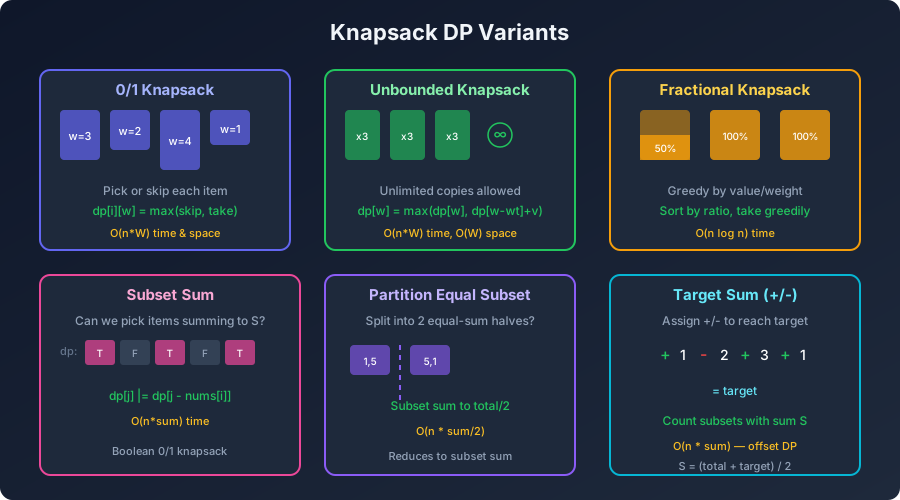
1. The 0/1 Knapsack
Problem: Given n items, each with a weight w[i] and value v[i], and a knapsack of capacity W, find the maximum total value you can carry. Each item can be used at most once.
The Recurrence
For each item i, you have two choices:
- Skip it:
dp[i][w] = dp[i-1][w] - Take it (if it fits):
dp[i][w] = dp[i-1][w - w[i]] + v[i]
Take the max of both.
Full 2D Solution
def knapsack_01(weights, values, W):
    n = len(weights)
    dp = [[0] * (W + 1) for _ in range(n + 1)]

    for i in range(1, n + 1):
        for w in range(W + 1):
            dp[i][w] = dp[i - 1][w]  # skip item i
            if weights[i - 1] <= w:
                dp[i][w] = max(
                    dp[i][w],
                    dp[i - 1][w - weights[i - 1]] + values[i - 1]
                )

    return dp[n][W]
Time: O(n * W) | Space: O(n * W)
Space-Optimised 1D Solution
Since each row only depends on the previous row, we can use a single array. The trick is to iterate weights right to left so we do not overwrite values we still need.
def knapsack_01_optimised(weights, values, W):
    n = len(weights)
    dp = [0] * (W + 1)

    for i in range(n):
        for w in range(W, weights[i] - 1, -1):  # right to left
            dp[w] = max(dp[w], dp[w - weights[i]] + values[i])

    return dp[W]
Time: O(n * W) | Space: O(W)
Why Right to Left?
If we go left to right, dp[w - weights[i]] might already include item i from this same iteration, effectively allowing unlimited copies. That is the unbounded variant (next section). Right-to-left ensures each item is used at most once.
Reconstructing the Solution
def knapsack_01_with_items(weights, values, W):
    n = len(weights)
    dp = [[0] * (W + 1) for _ in range(n + 1)]

    for i in range(1, n + 1):
        for w in range(W + 1):
            dp[i][w] = dp[i - 1][w]
            if weights[i - 1] <= w:
                dp[i][w] = max(dp[i][w], dp[i - 1][w - weights[i - 1]] + values[i - 1])

    # Backtrack to find which items were picked
    items = []
    w = W
    for i in range(n, 0, -1):
        if dp[i][w] != dp[i - 1][w]:
            items.append(i - 1)
            w -= weights[i - 1]

    return dp[n][W], items[::-1]
2. Unbounded Knapsack
Problem: Same as 0/1 knapsack, but each item can be used unlimited times.
The Key Difference
In 0/1 knapsack we look at dp[i-1][w - w[i]] (previous row). In unbounded, we look at dp[i][w - w[i]] (same row), because we can take item i again.
def knapsack_unbounded(weights, values, W):
    dp = [0] * (W + 1)

    for i in range(len(weights)):
        for w in range(weights[i], W + 1):  # LEFT to RIGHT
            dp[w] = max(dp[w], dp[w - weights[i]] + values[i])

    return dp[W]
Time: O(n * W) | Space: O(W)
Notice: the only code difference from the 1D 0/1 knapsack is the loop direction. Left-to-right allows reusing the same item.
Classic Applications
| Problem | Mapping |
|---|---|
| Coin Change (min coins) | Unbounded knapsack, minimise count |
| Coin Change 2 (count ways) | Unbounded knapsack, count combinations |
| Rod Cutting | Unbounded knapsack on rod lengths |
| Integer Break | Unbounded knapsack on factors |
Coin Change Example
def coin_change(coins, amount):
    """Minimum coins to make amount."""
    dp = [float('inf')] * (amount + 1)
    dp[0] = 0

    for coin in coins:
        for a in range(coin, amount + 1):
            dp[a] = min(dp[a], dp[a - coin] + 1)

    return dp[amount] if dp[amount] != float('inf') else -1
3. Fractional Knapsack
Problem: You can take fractions of items. This is the only variant that is greedy, not DP.
Why Greedy Works
When you can break items, the optimal strategy is always to take the item with the highest value-to-weight ratio first. There is no overlapping subproblem structure.
def fractional_knapsack(weights, values, W):
    items = sorted(
        zip(values, weights),
        key=lambda x: x[0] / x[1],
        reverse=True
    )

    total_value = 0
    remaining = W

    for v, w in items:
        if remaining >= w:
            total_value += v
            remaining -= w
        else:
            total_value += v * (remaining / w)
            break

    return total_value
Time: O(n log n) for sorting | Space: O(n)
Comparison Table
| Variant | Items | Approach | Time |
|---|---|---|---|
| 0/1 Knapsack | Use once | DP | O(nW) |
| Unbounded | Unlimited | DP | O(nW) |
| Fractional | Breakable | Greedy | O(n log n) |
4. Subset Sum
Problem: Given an array of positive integers and a target S, determine if any subset sums to S.
This is a boolean 0/1 knapsack where the “value” is irrelevant and the “weight” equals the number itself.
def subset_sum(nums, target):
    dp = [False] * (target + 1)
    dp[0] = True

    for num in nums:
        for s in range(target, num - 1, -1):  # right to left (0/1)
            dp[s] = dp[s] or dp[s - num]

    return dp[target]
Time: O(n * target) | Space: O(target)
Counting Subsets
To count the number of subsets that sum to S:
def count_subsets(nums, target):
    dp = [0] * (target + 1)
    dp[0] = 1

    for num in nums:
        for s in range(target, num - 1, -1):
            dp[s] += dp[s - num]

    return dp[target]
5. Partition Equal Subset Sum
Problem: Can the array be partitioned into two subsets with equal sum? (LeetCode 416)
Reduction to Subset Sum
If the total sum is odd, the answer is immediately False. Otherwise, find if a subset sums to total // 2.
def can_partition(nums):
    total = sum(nums)
    if total % 2 != 0:
        return False

    target = total // 2
    dp = [False] * (target + 1)
    dp[0] = True

    for num in nums:
        for s in range(target, num - 1, -1):
            dp[s] = dp[s] or dp[s - num]

    return dp[target]
Time: O(n * sum/2) | Space: O(sum/2)
Optimisation with Bitset
Python integers have arbitrary precision, so we can use bit shifts for a constant-factor speedup:
def can_partition_bitset(nums):
    total = sum(nums)
    if total % 2 != 0:
        return False

    target = total // 2
    bits = 1  # bit 0 is set (sum 0 is reachable)

    for num in nums:
        bits |= bits << num

    return bool(bits & (1 << target))
This runs the same O(n * sum) work but with hardware-level bit parallelism.
6. Target Sum
Problem: Given an array nums and a target, assign + or - to each element to reach the target. Count the number of ways. (LeetCode 494)
The Math Reduction
Let P = sum of elements assigned +, N = sum of elements assigned -.
P + N = totalP - N = target
Adding: 2P = total + target, so P = (total + target) / 2.
The problem reduces to: count subsets summing to P.
def find_target_sum_ways(nums, target):
    total = sum(nums)

    # P must be a non-negative integer
    if (total + target) % 2 != 0 or total + target < 0:
        return 0

    subset_target = (total + target) // 2
    dp = [0] * (subset_target + 1)
    dp[0] = 1

    for num in nums:
        for s in range(subset_target, num - 1, -1):
            dp[s] += dp[s - num]

    return dp[subset_target]
Time: O(n * P) where P = (total + target) / 2 | Space: O(P)
Edge Case: Zeros in the Array
Each zero can be assigned either + or - without affecting the sum, so each zero doubles the number of valid assignments. The DP handles this naturally since dp[s] += dp[s - 0] doubles every entry.
Variant Comparison
| Problem | Core Idea | Loop Direction | What dp[j] Stores |
|---|---|---|---|
| 0/1 Knapsack | Pick or skip | Right to left | Max value |
| Unbounded | Reuse allowed | Left to right | Max value |
| Subset Sum | Exists a subset? | Right to left | Boolean |
| Count Subsets | How many subsets? | Right to left | Count |
| Partition | Sum to total/2? | Right to left | Boolean |
| Target Sum | Count +/- combos | Right to left | Count |
Common Mistakes
- Wrong loop direction: Left-to-right in 0/1 knapsack allows reuse, giving wrong answers.
- Off-by-one in range: The inner loop should go down to
num(inclusive), notnum + 1. - Forgetting the odd-sum check in partition equal subset.
- Not handling negative numbers in target sum. The math reduction avoids negative indices.
- Initialising dp[0] wrong: For counting,
dp[0] = 1. For min-cost,dp[0] = 0and rest = infinity.
Big-O Summary
| Variant | Time | Space (optimised) |
|---|---|---|
| 0/1 Knapsack | O(n * W) | O(W) |
| Unbounded Knapsack | O(n * W) | O(W) |
| Fractional Knapsack | O(n log n) | O(n) |
| Subset Sum | O(n * S) | O(S) |
| Partition Equal | O(n * S/2) | O(S/2) |
| Target Sum | O(n * P) | O(P) |
Practice Problems
| Problem | Platform | Difficulty | Variant |
|---|---|---|---|
| 0/1 Knapsack | GFG | Medium | Classic |
| Partition Equal Subset Sum | LeetCode 416 | Medium | Subset Sum |
| Target Sum | LeetCode 494 | Medium | Count Subsets |
| Coin Change | LeetCode 322 | Medium | Unbounded |
| Coin Change 2 | LeetCode 518 | Medium | Unbounded Count |
| Last Stone Weight II | LeetCode 1049 | Medium | Partition |
| Ones and Zeroes | LeetCode 474 | Medium | 2D Knapsack |
| Profitable Schemes | LeetCode 879 | Hard | 2D Knapsack |
Key Takeaway
Every knapsack variant shares the same skeleton: iterate over items, iterate over capacities, and decide to include or exclude. The differences are:
- Loop direction (right-to-left for 0/1, left-to-right for unbounded)
- What you track (max value, boolean, count)
- What you optimise (value, existence, count of ways)
Master the 0/1 template and you can derive every other variant on the spot.
Related articles
- DSA Longest Subsequence Variants: LIS, Bitonic, Chain, Zigzag & Envelopes
Master longest subsequence problems — LIS with patience sorting, longest bitonic, chain of pairs, zigzag subsequence, Russian doll envelopes (2D LIS).
- DSA DP Grid Traversal: Unique Paths, Min Path Sum, Dungeon Game & Cherry Pickup
Master DP on grids — unique paths, minimum path sum, dungeon game, cherry pickup, and maximum path in grid with step-by-step Python solutions.
- DSA DP Palindrome Problems: LPS, Partition, Count Substrings & Shortest Palindrome
Master palindrome DP problems — longest palindromic subsequence, minimum cuts for palindrome partitioning, counting palindromic substrings, and shortest palindrome with KMP.
- DSA Stock Trading DP: All 6 Problems Solved with One Framework
Complete guide to all stock trading problems — I through IV, with cooldown, and with transaction fee. One unified state machine DP framework covers them all.