Data Quality and Governance Fundamentals
Learn the six dimensions of data quality, how to implement quality checks with Great Expectations and dbt, and the pillars of data governance.
What you'll learn
- ✓The six dimensions of data quality
- ✓How to implement quality checks with dbt tests and Great Expectations
- ✓The circuit breaker pattern for stopping bad data
- ✓Core pillars of data governance: catalog, lineage, access, ownership
- ✓Practical governance for small and large teams
Prerequisites
- •Basic SQL and Python knowledge
- •Understanding of data pipelines and warehouses
Bad data is worse than no data. A dashboard showing wrong revenue numbers leads to wrong business decisions. A model trained on dirty data makes bad predictions. Data quality and governance are not optional — they are what separates a production data platform from a spreadsheet someone emailed around.
The six dimensions of data quality
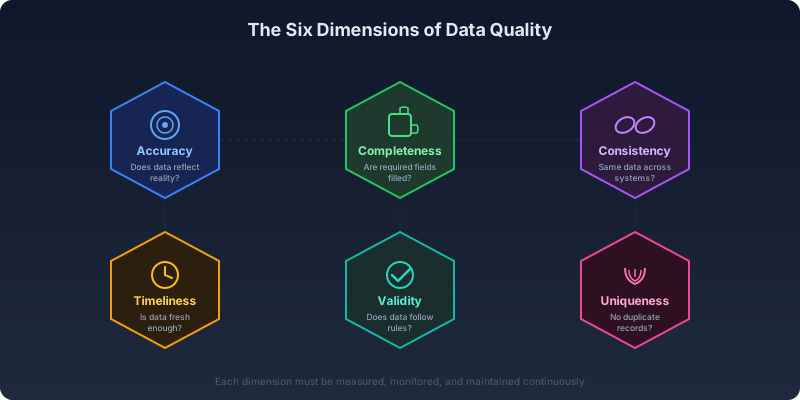
1. Accuracy
Does the data reflect reality? If a customer’s address changed last week, does the warehouse show the new address?
2. Completeness
Are required fields populated? If 30% of your orders have null customer_id, your revenue-by-segment report is unreliable.
3. Consistency
Does the same data agree across systems? If the payments service says $1M in revenue and the orders table says $950K, something is wrong.
4. Timeliness
Is the data fresh enough? A fraud detection system needs sub-second data. A monthly board report can tolerate a day of delay.
5. Validity
Does the data conform to business rules? An order quantity of -5 or an email address without an @ is invalid.
6. Uniqueness
No duplicate records. If the same order appears twice, revenue is double-counted.
Implementing quality checks
dbt tests — the simplest starting point
dbt has built-in tests for the most common quality checks:
# models/staging/_staging.yml
version: 2
models:
  - name: stg_orders
    columns:
      - name: order_id
        tests:
          - unique
          - not_null
      - name: status
        tests:
          - accepted_values:
              values: ['pending', 'shipped', 'delivered', 'cancelled']
      - name: customer_id
        tests:
          - not_null
          - relationships:
              to: ref('stg_customers')
              field: customer_id
      - name: total_amount
        tests:
          - not_null
Custom SQL tests for business rules:
-- tests/assert_no_negative_revenue.sql
SELECT order_id, total_amount
FROM {{ ref('fact_orders') }}
WHERE total_amount < 0
This test fails if any rows are returned — any order with negative revenue triggers an alert.
Great Expectations — Python-based quality framework
For more complex validations:
import great_expectations as gx

context = gx.get_context()

validator = context.sources.pandas_default.read_csv("orders.csv")

validator.expect_column_values_to_not_be_null("order_id")
validator.expect_column_values_to_be_unique("order_id")
validator.expect_column_values_to_be_between(
    "quantity", min_value=1, max_value=10000
)
validator.expect_column_values_to_be_in_set(
    "status", ["pending", "shipped", "delivered", "cancelled"]
)
validator.expect_column_pair_values_a_to_be_greater_than_b(
    "ship_date", "order_date", or_equal=True
)

results = validator.validate()
if not results.success:
    raise Exception("Data quality check failed")
The circuit breaker pattern
Stop bad data from flowing downstream. If quality thresholds are breached, halt the pipeline.
def quality_gate(df, table_name):
    """Halt pipeline if data quality thresholds are breached."""
    null_rate = df.isnull().sum().max() / len(df)
    duplicate_rate = 1 - df['id'].nunique() / len(df)
    row_count = len(df)

    if null_rate > 0.05:
        raise DataQualityError(
            f"{table_name}: null rate {null_rate:.2%} exceeds 5% threshold"
        )
    if duplicate_rate > 0.01:
        raise DataQualityError(
            f"{table_name}: duplicate rate {duplicate_rate:.2%} exceeds 1%"
        )
    if row_count == 0:
        raise DataQualityError(
            f"{table_name}: zero rows — source may be down"
        )

    return df
Integrate this into your Airflow DAG:
extract >> quality_gate_task >> transform >> loadIf quality_gate_task fails, the pipeline stops. No bad data reaches the warehouse.
Data governance
Quality checks catch problems row by row. Governance is the organizational system that prevents problems at scale.
The four pillars
1. Data catalog — an inventory of all data assets. What tables exist, what they contain, who owns them, when they were last updated.
Tools: DataHub, OpenMetadata, Atlan, Alation.
2. Data lineage — track data from source to consumption. When a metric looks wrong, lineage tells you which upstream table, transformation, or source system to investigate.
Source: PostgreSQL.orders → Airflow DAG: daily_orders
  → Staging: stg_orders → dbt model: fact_orders
    → Dashboard: Revenue by Region
3. Access control — who can see what. PII (names, emails, SSNs) should be restricted. Column-level security lets analysts query the table without seeing sensitive columns.
-- Snowflake row access policy example
CREATE ROW ACCESS POLICY region_policy AS (region VARCHAR)
RETURNS BOOLEAN ->
  CASE
    WHEN CURRENT_ROLE() = 'ADMIN' THEN TRUE
    WHEN CURRENT_ROLE() = 'US_ANALYST' AND region = 'US' THEN TRUE
    ELSE FALSE
  END;
4. Data ownership — every dataset has an accountable owner. When the fact_orders table breaks, there is a specific person or team responsible for fixing it.
Classification
Tag data by sensitivity level:
- Public — aggregate metrics, published reports.
- Internal — business data accessible to employees.
- Confidential — customer PII, financial records, credentials.
- Restricted — regulated data (HIPAA, GDPR, SOC2).
Classification drives access control. Restricted data gets encryption at rest, audit logging, and limited access.
Governance for small teams
You do not need a data catalog tool on day one. Start with:
- dbt docs —
dbt docs generatecreates a searchable documentation site with lineage graphs for free. - YAML schema files — document every model and column in dbt YAML files.
- Naming conventions —
stg_for staging,int_for intermediate,fct_for facts,dim_for dimensions. Consistent naming is the cheapest governance tool. - CODEOWNERS — use Git’s CODEOWNERS file to assign ownership to dbt model directories.
- Tests — dbt tests are your first quality layer. Start with
uniqueandnot_nullon every primary key.
Scale up to dedicated tools when your data platform has more than 50 models or more than 10 consumers.
Quality monitoring tools
| Tool | Type | Best for |
|---|---|---|
| dbt tests | SQL assertions | Teams already using dbt |
| Great Expectations | Python expectations | Complex Python pipelines |
| Elementary | dbt-native observability | dbt-centric teams wanting automated monitoring |
| Monte Carlo | Data observability platform | Enterprise-scale anomaly detection |
| Soda | YAML-based checks | Multi-platform, simple configuration |
Next steps
- Data Warehouse Concepts — understand the schemas your quality checks protect.
- Data Modeling for Analytics — build models worth governing.
- What Is Apache Airflow? — orchestrate quality checks in your pipelines.
Related articles
- Data Engineering Data Observability — Monitoring Your Data, Not Just Pipes
Learn the five pillars of data observability, anomaly detection, lineage tracking, incident response, and tools like Elementary, Monte Carlo, and Soda.
- Data Engineering Data Pipeline Testing — Catching Bugs Before They Hit Production
Learn the data testing pyramid, unit testing transformations, contract testing between stages, and how to build reliable CI/CD test suites for pipelines.
- Data Engineering Apache Spark Fundamentals — Big Data Processing at Scale
Learn Apache Spark: RDDs, DataFrames, SparkSQL, the execution model, PySpark basics, platform comparisons, and essential performance optimization tips.
- Data Engineering CI/CD for Data Pipelines — Ship Data with Confidence
Build CI/CD workflows for data pipelines: lint SQL, validate DAGs, run tests, deploy dbt models, and manage dev/staging/prod environments.