Asteroid Collision Problem Using Stacks
Solve the asteroid collision problem (LeetCode 735) using a stack. Covers collision rules, Python implementation, and all edge cases.
What you'll learn
- ✓How to simulate asteroid collisions with a stack
- ✓Handling all collision outcomes: destroy left, destroy right, mutual destruction
- ✓Why this is a natural stack problem
- ✓Edge cases and testing strategies
Prerequisites
- •Stack basics — see Stacks & Queues Intro
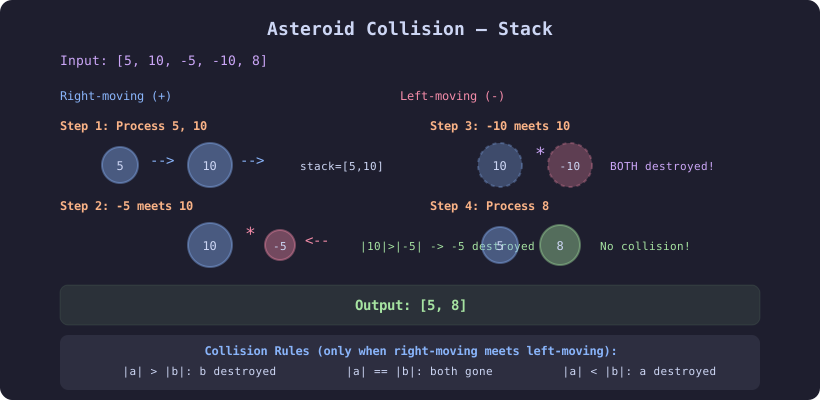
Asteroids move in a row. Each asteroid has a size and direction: positive means moving right, negative means moving left. When two asteroids meet, the smaller one explodes. If they’re the same size, both explode. Asteroids moving in the same direction never meet.
When Do Collisions Happen?
A collision only occurs when a right-moving asteroid (positive) is followed by a left-moving asteroid (negative). Two left-moving or two right-moving asteroids never collide.
[5, 10, -5]  → [5, 10]     (10 destroys -5)
[8, -8]      → []           (mutual destruction)
[-2, -1, 1, 2] → [-2,-1,1,2] (no collision, moving apart)
Solution
def asteroid_collision(asteroids):
    """
    Simulate asteroid collisions.
    Time: O(n), Space: O(n)
    """
    stack = []

    for asteroid in asteroids:
        alive = True

        while alive and stack and asteroid < 0 < stack[-1]:
            # Collision: right-moving (stack top) vs left-moving (current)
            if stack[-1] < -asteroid:
                stack.pop()  # Stack top is smaller, it explodes
            elif stack[-1] == -asteroid:
                stack.pop()  # Same size, both explode
                alive = False
            else:
                alive = False  # Current asteroid is smaller, it explodes

        if alive:
            stack.append(asteroid)

    return stack
Trace
Input: [5, 10, -5]
asteroid | stack      | action
---------|------------|-------
5        | [5]        | push (moving right)
10       | [5, 10]    | push (moving right)
-5       | [5, 10]    | collision: |10| > |-5| → -5 explodes
Output: [5, 10]
Input: [10, 2, -5]
asteroid | stack      | action
---------|------------|-------
10       | [10]       | push
2        | [10, 2]    | push
-5       | [10, 2]    | collision: |2| < |-5| → 2 explodes
         | [10]       | collision: |10| > |-5| → -5 explodes
Output: [10]
Input: [-2, -1, 1, 2]
asteroid | stack          | action
---------|----------------|-------
-2       | [-2]           | push (moving left, no collision)
-1       | [-2, -1]       | push (both moving left)
1        | [-2, -1, 1]    | push (top is negative, no collision)
2        | [-2, -1, 1, 2] | push (both moving right)
Output: [-2, -1, 1, 2]
Why a Stack?
The stack naturally models “what’s still alive.” Each new asteroid only interacts with the most recent right-moving asteroid (the stack top). If the new asteroid destroys it, it then faces the next one — exactly how pop works.
Edge Cases
- All moving same direction — no collisions, return as-is
- All moving left then all right —
[-3,-2,1,2]→ no collisions - Chain destruction —
[1,2,3,-10]→[-10](the -10 destroys everything) - Mutual destruction chain —
[1,-1,2,-2]→[] - Empty array — return
[]
Complexity
Each asteroid is pushed at most once and popped at most once: O(n) time, O(n) space.
When to Use This Pattern
Anytime you have elements that interact with their neighbors in a “last one wins” pattern:
- Bracket matching
- Stock prices with thresholds
- Particle collision simulations
Related Problems
- Daily Temperatures (LeetCode 739) — stack for nearest greater
- Remove K Digits (LeetCode 402) — stack with removal logic
- Online Stock Span (LeetCode 901) — stack for spanning
Related articles
- DSA Implement Stack Using Two Queues — Two Approaches Explained
Implement a stack using two queues with costly push and costly pop approaches. Complete Python solutions with complexity analysis.
- DSA Car Fleet Problem — Stack-Based Arrival Time Solution
Solve LeetCode 853 Car Fleet using a stack. Sort by position, compare arrival times, and count fleets. Python solution with visual trace.
- DSA The Celebrity Problem Using Stack-Based Elimination
Solve the celebrity problem in O(n) time using a stack elimination technique. Includes proof of correctness, Python code, and matrix examples.
- DSA Decode String (LeetCode 394) — Nested Bracket Decoding
Decode nested encoded strings like '3[a2[c]]' using a stack. Complete walkthrough with Python solution, traces, and edge cases.