AVL Tree Rotations: Self-Balancing BST Explained
Understand AVL trees — balance factors, all four rotation types (LL, RR, LR, RL), insertion with rebalancing, and complete Python implementation with height tracking.
What you'll learn
- ✓Why regular BSTs degrade to O(n)
- ✓Balance factor and height tracking
- ✓Left rotation and right rotation mechanics
- ✓Left-Right and Right-Left double rotations
- ✓Insertion with automatic rebalancing
- ✓Complete Python AVL tree implementation
- ✓When to use AVL vs Red-Black trees
Prerequisites
- •Solid understanding of BST operations
- •Comfortable with recursion and tree traversals
A regular BST has a fatal flaw: if you insert sorted data, it degrades into a linked list with O(n) operations. AVL trees solve this by maintaining balance after every insertion and deletion. Named after Adelson-Velsky and Landis (1962), they were the first self-balancing BST.
Why BSTs degrade
Insert the values 1, 2, 3, 4, 5 into a regular BST:
1
 \
  2
   \
    3
     \
      4
       \
        5

Height = 4 (should be ~2 for 5 nodes)
Search for 5: 5 comparisons instead of ~3
Every operation becomes O(n). An AVL tree prevents this by enforcing that the heights of the left and right subtrees differ by at most 1.
Balance factor
The balance factor of a node is:
balance_factor(node) = height(left subtree) - height(right subtree)An AVL tree requires that every node has a balance factor of -1, 0, or 1. If any node’s balance factor becomes -2 or 2, we must rebalance with rotations.
class AVLNode:
    def __init__(self, val):
        self.val = val
        self.left = None
        self.right = None
        self.height = 1  # new nodes are leaves with height 1

def get_height(node):
    if node is None:
        return 0
    return node.height

def get_balance(node):
    if node is None:
        return 0
    return get_height(node.left) - get_height(node.right)

def update_height(node):
    node.height = 1 + max(get_height(node.left), get_height(node.right))
The four rotation types
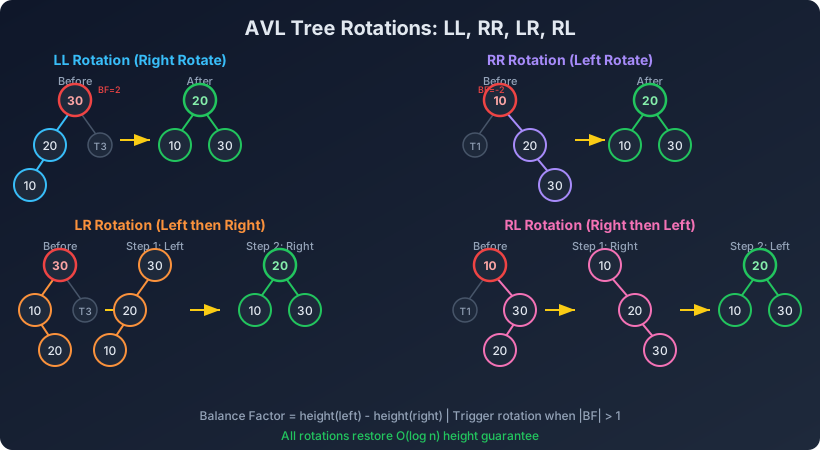
When balance is violated, exactly one of four rotation patterns fixes it. Each rotation is O(1) — it only rearranges a constant number of pointers.
Right Rotation (for LL imbalance)
When a node becomes left-heavy (balance factor = 2) and its left child is left-heavy or balanced (balance factor >= 0):
Before:           After:
    z                 y
   / \              /   \
  y   T4    →      x     z
 / \              / \   / \
x   T3           T1 T2 T3 T4
/ \
T1 T2
def right_rotate(z):
"""Perform right rotation on node z."""
y = z.left
T3 = y.right
# Rotate
y.right = z
z.left = T3
# Update heights (z first, then y — order matters)
update_height(z)
update_height(y)
return y # y is the new root of this subtreeLeft Rotation (for RR imbalance)
Mirror of right rotation. When a node becomes right-heavy (balance factor = -2) and its right child is right-heavy or balanced (balance factor <= 0):
Before:         After:
  z                y
 / \             /   \
T1  y    →      z     x
   / \         / \   / \
  T2  x       T1 T2 T3 T4
     / \
    T3 T4
def left_rotate(z):
"""Perform left rotation on node z."""
y = z.right
T2 = y.left
# Rotate
y.left = z
z.right = T2
# Update heights
update_height(z)
update_height(y)
return yLeft-Right Rotation (for LR imbalance)
When a node is left-heavy (balance factor = 2) but its left child is right-heavy (balance factor < 0). A single right rotation will not fix this — we need a double rotation.
Before:          Step 1 (Left):    Step 2 (Right):
    z                z                  x
   / \              / \               /   \
  y   T4    →      x   T4    →      y     z
 / \              / \               / \   / \
T1  x            y   T3           T1  T2 T3 T4
   / \          / \
  T2  T3       T1  T2
First, left-rotate y, then right-rotate z.
Right-Left Rotation (for RL imbalance)
When a node is right-heavy (balance factor = -2) but its right child is left-heavy (balance factor > 0).
Before:          Step 1 (Right):    Step 2 (Left):
  z                  z                   x
 / \                / \                /   \
T1  y       →      T1  x      →      z     y
   / \                 / \           / \   / \
  x   T4             T2   y        T1 T2 T3 T4
 / \                      / \
T2  T3                   T3  T4
First, right-rotate y, then left-rotate z.
Choosing the right rotation
The decision depends on two balance factors:
| Node BF | Child BF | Rotation | Case |
|---|---|---|---|
| +2 | +1 or 0 | Right | LL |
| -2 | -1 or 0 | Left | RR |
| +2 | -1 | Left-Right | LR |
| -2 | +1 | Right-Left | RL |
Think of it this way: the letters tell you the path of imbalance.
- LL: went left, then left (fix with right rotation)
- RR: went right, then right (fix with left rotation)
- LR: went left, then right (fix with left-right double rotation)
- RL: went right, then left (fix with right-left double rotation)
AVL insertion
Insert like a regular BST, then walk back up updating heights and rebalancing:
def insert(node, val):
    """Insert val into AVL tree rooted at node. Return new root."""
    # Step 1: Standard BST insert
    if node is None:
        return AVLNode(val)

    if val < node.val:
        node.left = insert(node.left, val)
    elif val > node.val:
        node.right = insert(node.right, val)
    else:
        return node  # no duplicates

    # Step 2: Update height of this node
    update_height(node)

    # Step 3: Get balance factor
    balance = get_balance(node)

    # Step 4: Rebalance if needed (4 cases)

    # LL Case
    if balance > 1 and val < node.left.val:
        return right_rotate(node)

    # RR Case
    if balance < -1 and val > node.right.val:
        return left_rotate(node)

    # LR Case
    if balance > 1 and val > node.left.val:
        node.left = left_rotate(node.left)
        return right_rotate(node)

    # RL Case
    if balance < -1 and val < node.right.val:
        node.right = right_rotate(node.right)
        return left_rotate(node)

    return node
Insertion walkthrough
Insert 1, 2, 3 into an AVL tree:
# Insert 1:  Just a single node
#   1

# Insert 2:  No rebalance needed (BF of 1 is -1)
#   1
#    \
#     2

# Insert 3:  Node 1 has BF = -2 (RR case → left rotate)
#   1              2
#    \     →      / \
#     2          1   3
#      \
#       3

# Without AVL, we'd have a skewed line.
# With AVL, we get a balanced tree of height 1.
AVL deletion
Deletion is similar to BST deletion, but we must rebalance on the way back up:
def delete(node, val):
    """Delete val from AVL tree rooted at node. Return new root."""
    # Step 1: Standard BST delete
    if node is None:
        return None

    if val < node.val:
        node.left = delete(node.left, val)
    elif val > node.val:
        node.right = delete(node.right, val)
    else:
        # Node to delete found
        if node.left is None:
            return node.right
        elif node.right is None:
            return node.left
        else:
            # Two children: get in-order successor
            successor = find_min(node.right)
            node.val = successor.val
            node.right = delete(node.right, successor.val)

    # Step 2: Update height
    update_height(node)

    # Step 3: Rebalance
    balance = get_balance(node)

    # LL Case
    if balance > 1 and get_balance(node.left) >= 0:
        return right_rotate(node)

    # LR Case
    if balance > 1 and get_balance(node.left) < 0:
        node.left = left_rotate(node.left)
        return right_rotate(node)

    # RR Case
    if balance < -1 and get_balance(node.right) <= 0:
        return left_rotate(node)

    # RL Case
    if balance < -1 and get_balance(node.right) > 0:
        node.right = right_rotate(node.right)
        return left_rotate(node)

    return node

def find_min(node):
    while node.left:
        node = node.left
    return node
Note: For deletion, we check the child’s balance factor directly (not by comparing the value), because the imbalance may come from the opposite subtree losing a node.
Complete AVL tree class
class AVLTree:
    def __init__(self):
        self.root = None

    def insert(self, val):
        self.root = self._insert(self.root, val)

    def _insert(self, node, val):
        if not node:
            return AVLNode(val)
        if val < node.val:
            node.left = self._insert(node.left, val)
        elif val > node.val:
            node.right = self._insert(node.right, val)
        else:
            return node

        update_height(node)
        return self._rebalance(node)

    def delete(self, val):
        self.root = self._delete(self.root, val)

    def _delete(self, node, val):
        if not node:
            return None
        if val < node.val:
            node.left = self._delete(node.left, val)
        elif val > node.val:
            node.right = self._delete(node.right, val)
        else:
            if not node.left:
                return node.right
            if not node.right:
                return node.left
            successor = find_min(node.right)
            node.val = successor.val
            node.right = self._delete(node.right, successor.val)

        update_height(node)
        return self._rebalance(node)

    def _rebalance(self, node):
        balance = get_balance(node)

        if balance > 1:
            if get_balance(node.left) < 0:
                node.left = left_rotate(node.left)
            return right_rotate(node)

        if balance < -1:
            if get_balance(node.right) > 0:
                node.right = right_rotate(node.right)
            return left_rotate(node)

        return node

    def search(self, val):
        node = self.root
        while node:
            if val == node.val:
                return True
            elif val < node.val:
                node = node.left
            else:
                node = node.right
        return False

    def inorder(self):
        result = []
        self._inorder(self.root, result)
        return result

    def _inorder(self, node, result):
        if node:
            self._inorder(node.left, result)
            result.append(node.val)
            self._inorder(node.right, result)

    def get_height(self):
        return get_height(self.root)
Usage example
avl = AVLTree()

# Insert sorted data — would kill a regular BST
for i in range(1, 16):
    avl.insert(i)

print(avl.inorder())       # [1, 2, 3, ..., 15]
print(avl.get_height())    # 4 (log2(15) ≈ 4, not 14!)
print(avl.search(10))      # True
print(avl.search(20))      # False

avl.delete(8)
print(avl.inorder())       # [1, 2, 3, 4, 5, 6, 7, 9, 10, 11, 12, 13, 14, 15]
print(avl.get_height())    # Still 4 — stays balanced
Time complexity
| Operation | AVL Tree | Regular BST (worst) |
|---|---|---|
| Search | O(log n) | O(n) |
| Insert | O(log n) | O(n) |
| Delete | O(log n) | O(n) |
| Space | O(n) | O(n) |
AVL trees guarantee O(log n) for all operations because the height is always bounded by approximately 1.44 * log2(n).
Rotation cost
Each insertion triggers at most 2 rotations (one double rotation). Each deletion can trigger at most O(log n) rotations (one per ancestor). But each individual rotation is O(1), so the overall operation stays O(log n).
AVL vs Red-Black trees
| Feature | AVL | Red-Black |
|---|---|---|
| Balance strictness | height diff <= 1 | roughly balanced |
| Max height | 1.44 log n | 2 log n |
| Search speed | Slightly faster | Slightly slower |
| Insert rotations | Up to 2 | Up to 2 |
| Delete rotations | Up to O(log n) | Up to 3 |
| Use case | Read-heavy | Write-heavy |
Use AVL when: Lookups vastly outnumber insertions/deletions (databases indexes, dictionaries).
Use Red-Black when: Insertions and deletions are frequent (language standard libraries — Java TreeMap, C++ std::map, Linux kernel).
Verifying AVL property
A helper to verify that a tree maintains the AVL invariant:
def is_avl(node):
    """Check if tree rooted at node is a valid AVL tree."""
    if node is None:
        return True, 0

    left_avl, left_h = is_avl(node.left)
    right_avl, right_h = is_avl(node.right)

    balanced = abs(left_h - right_h) <= 1
    height = 1 + max(left_h, right_h)

    return left_avl and right_avl and balanced, height

# Usage:
valid, _ = is_avl(avl.root)
print(valid)  # True
Practice problems
- Insert into AVL — Build the full insert with rotations
- Delete from AVL — Handle rebalancing after delete
- Convert Sorted Array to Balanced BST (LeetCode 108) — Already balanced, no rotations needed
- Balance a BST (LeetCode 1382) — In-order then rebuild
- Count nodes with balance factor 0 — Practice height calculations
- Print AVL tree level by level showing balance factors — Debugging tool
Key takeaways
- AVL trees maintain balance factor in {-1, 0, 1} for every node
- Four rotation types handle all imbalance cases: LL, RR, LR, RL
- Height is always O(log n), guaranteeing O(log n) operations
- Slightly more overhead than Red-Black trees on writes, but faster reads
- The recursion naturally handles rebalancing as it unwinds up the tree
Related articles
- DSA Flatten Binary Tree to Linked List
Learn how to flatten a binary tree to a linked list using preorder threading, Morris traversal, and how to convert a BST to a sorted doubly linked list — with full Python implementations and Big-O analysis.
- DSA BST Iterator, Range Queries, and Closest Value
Master BST iterator using stack-based controlled in-order traversal, range sum queries, counting nodes in range, closest value, and closest K values — with full Python implementations.
- DSA Boundary Traversal of Binary Tree
Complete guide to boundary traversal — left boundary, leaf nodes, and right boundary in reverse. Multiple Python approaches with edge case handling.
- DSA Distance Problems in Binary Trees
Solve distance problems in binary trees — distance between two nodes, all nodes at distance K, burning a tree from a node, and sum of distances using rerooting. Full Python implementations.