Backtracking Comprehensive: From Template to Hard Problems
Master backtracking with the choose-explore-unchoose template. Solve N-Queens, Sudoku, word search, generate parentheses, palindrome partitioning, and subset sum.
What you'll learn
- ✓The choose/explore/unchoose backtracking template
- ✓N-Queens: row-by-row placement with column and diagonal tracking
- ✓Sudoku solver with constraint propagation
- ✓Word search, generate parentheses, palindrome partitioning
- ✓How pruning transforms exponential search into feasible algorithms
Prerequisites
- •Recursion: [Recursion Fundamentals](/blog/recursion-fundamentals)
- •Arrays: [Arrays Introduction](/blog/arrays-introduction)
- •Big-O: [Big-O Notation Explained](/blog/big-o-notation-explained)
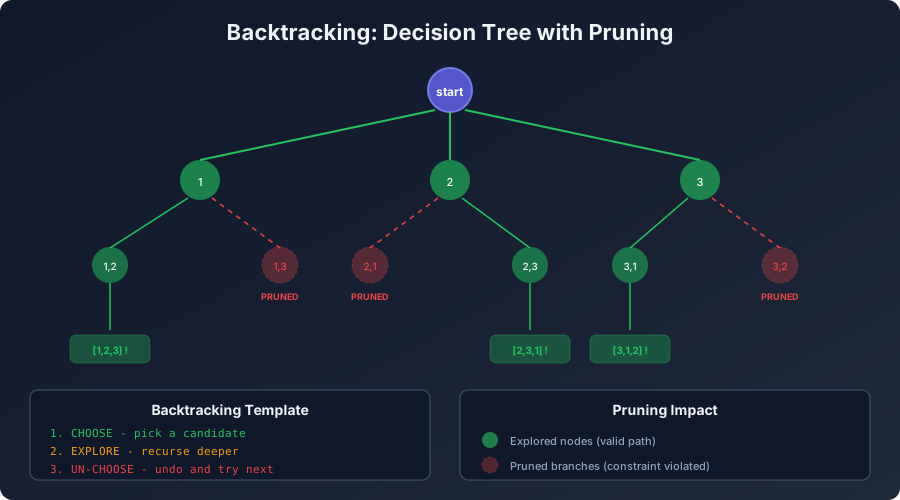
Backtracking is depth-first search over a decision tree with pruning. At each node you make a choice, explore its consequences recursively, and undo the choice before trying the next option. The pruning step is what makes backtracking practical: you abandon branches that cannot possibly lead to valid solutions.
Once you master the template, an entire family of problems collapses into the same pattern: subsets, permutations, combinations, N-Queens, Sudoku, word search, and more.
The universal template
Every backtracking algorithm follows this skeleton:
def backtrack(state, choices):
    if is_complete(state):
        record(state)
        return

    for choice in choices:
        if not is_valid(choice, state):
            continue                    # PRUNE

        apply(choice, state)            # CHOOSE
        backtrack(state, next_choices)   # EXPLORE
        undo(choice, state)             # UN-CHOOSE
The three steps are:
- Choose: pick a candidate and apply it to the current partial state.
- Explore: recurse with the updated state.
- Un-choose: undo the change so the next iteration starts clean.
The pruning step (skipping invalid choices) is what distinguishes backtracking from brute force.
Backtracking vs brute force
| Brute Force | Backtracking | |
|---|---|---|
| Approach | Generate all possibilities, filter | Build solutions incrementally, prune early |
| Pruning | None | Prune invalid branches |
| Space | Generate full candidates | Only partial candidates on stack |
| Performance | Always exponential | Often dramatically faster |
Problem 1: N-Queens
Place N queens on an N x N chessboard so that no two queens attack each other (no shared row, column, or diagonal).
def solve_n_queens(n):
    """
    Find all valid N-Queens configurations.
    Time: O(N!) approximately (with pruning)
    Space: O(N) for the recursion stack and sets
    """
    results = []
    cols = set()
    pos_diag = set()   # row + col (positive diagonal)
    neg_diag = set()   # row - col (negative diagonal)

    board = [["." for _ in range(n)] for _ in range(n)]

    def backtrack(row):
        if row == n:
            # All queens placed successfully
            results.append(["".join(r) for r in board])
            return

        for col in range(n):
            # Pruning: check if this position is under attack
            if col in cols or (row + col) in pos_diag or (row - col) in neg_diag:
                continue

            # Choose
            board[row][col] = "Q"
            cols.add(col)
            pos_diag.add(row + col)
            neg_diag.add(row - col)

            # Explore
            backtrack(row + 1)

            # Un-choose
            board[row][col] = "."
            cols.remove(col)
            pos_diag.remove(row + col)
            neg_diag.remove(row - col)

    backtrack(0)
    return results


# Print solutions for 4-Queens
solutions = solve_n_queens(4)
print(f"4-Queens has {len(solutions)} solutions:")
for i, sol in enumerate(solutions):
    print(f"\nSolution {i + 1}:")
    for row in sol:
        print(f"  {row}")
# 4-Queens has 2 solutions
N-Queens: just count solutions
def total_n_queens(n):
    """
    Count total N-Queens solutions (faster, no board construction).
    """
    count = 0
    cols = set()
    pos_diag = set()
    neg_diag = set()

    def backtrack(row):
        nonlocal count
        if row == n:
            count += 1
            return

        for col in range(n):
            if col in cols or (row + col) in pos_diag or (row - col) in neg_diag:
                continue

            cols.add(col)
            pos_diag.add(row + col)
            neg_diag.add(row - col)

            backtrack(row + 1)

            cols.remove(col)
            pos_diag.remove(row + col)
            neg_diag.remove(row - col)

    backtrack(0)
    return count


for n in range(1, 11):
    print(f"  {n}-Queens: {total_n_queens(n)} solutions")
Problem 2: Sudoku solver
Fill a 9x9 grid so each row, column, and 3x3 box contains digits 1-9 exactly once.
def solve_sudoku(board):
    """
    Solve a Sudoku puzzle in-place.
    Time: O(9^(empty cells)) worst case, much less with pruning
    Space: O(81) for the board
    """
    rows = [set() for _ in range(9)]
    cols = [set() for _ in range(9)]
    boxes = [set() for _ in range(9)]

    # Initialize constraint sets from existing numbers
    empty_cells = []
    for r in range(9):
        for c in range(9):
            if board[r][c] != '.':
                num = int(board[r][c])
                rows[r].add(num)
                cols[c].add(num)
                boxes[(r // 3) * 3 + c // 3].add(num)
            else:
                empty_cells.append((r, c))

    def backtrack(idx):
        if idx == len(empty_cells):
            return True  # All cells filled

        r, c = empty_cells[idx]
        box_idx = (r // 3) * 3 + c // 3

        for num in range(1, 10):
            # Pruning: check all three constraints
            if num in rows[r] or num in cols[c] or num in boxes[box_idx]:
                continue

            # Choose
            board[r][c] = str(num)
            rows[r].add(num)
            cols[c].add(num)
            boxes[box_idx].add(num)

            # Explore
            if backtrack(idx + 1):
                return True

            # Un-choose
            board[r][c] = '.'
            rows[r].remove(num)
            cols[c].remove(num)
            boxes[box_idx].remove(num)

        return False  # No valid number for this cell

    backtrack(0)
    return board


# Example
board = [
    ["5","3",".",".","7",".",".",".","."],
    ["6",".",".","1","9","5",".",".","."],
    [".","9","8",".",".",".",".","6","."],
    ["8",".",".",".","6",".",".",".","3"],
    ["4",".",".","8",".","3",".",".","1"],
    ["7",".",".",".","2",".",".",".","6"],
    [".","6",".",".",".",".","2","8","."],
    [".",".",".","4","1","9",".",".","5"],
    [".",".",".",".","8",".",".","7","9"]
]

solve_sudoku(board)
for row in board:
    print(" ".join(row))
Problem 3: word search
Given a 2D board and a word, find if the word exists by connecting adjacent cells (horizontally or vertically).
def word_search(board, word):
    """
    Search for word in 2D grid using backtracking.
    Time: O(M * N * 4^L) where L = len(word)
    Space: O(L) recursion stack
    """
    if not board or not word:
        return False

    rows, cols = len(board), len(board[0])

    def backtrack(r, c, idx):
        if idx == len(word):
            return True

        if (r < 0 or r >= rows or c < 0 or c >= cols or
                board[r][c] != word[idx]):
            return False

        # Choose: mark as visited
        temp = board[r][c]
        board[r][c] = '#'

        # Explore all 4 directions
        found = (backtrack(r + 1, c, idx + 1) or
                 backtrack(r - 1, c, idx + 1) or
                 backtrack(r, c + 1, idx + 1) or
                 backtrack(r, c - 1, idx + 1))

        # Un-choose: restore
        board[r][c] = temp

        return found

    for r in range(rows):
        for c in range(cols):
            if board[r][c] == word[0] and backtrack(r, c, 0):
                return True

    return False


board = [
    ['A', 'B', 'C', 'E'],
    ['S', 'F', 'C', 'S'],
    ['A', 'D', 'E', 'E']
]
print(word_search(board, "ABCCED"))  # True
print(word_search(board, "SEE"))     # True
print(word_search(board, "ABCB"))    # False
Problem 4: generate parentheses
Generate all valid combinations of n pairs of parentheses.
def generate_parentheses(n):
    """
    Generate all valid parentheses combinations.
    Time: O(4^n / sqrt(n)) - nth Catalan number
    Space: O(n) recursion stack
    """
    result = []

    def backtrack(current, open_count, close_count):
        if len(current) == 2 * n:
            result.append(current)
            return

        # Can add open paren if we haven't used all n
        if open_count < n:
            backtrack(current + "(", open_count + 1, close_count)

        # Can add close paren if it won't make string invalid
        if close_count < open_count:
            backtrack(current + ")", open_count, close_count + 1)

    backtrack("", 0, 0)
    return result


for combo in generate_parentheses(3):
    print(f"  {combo}")
# ((()))
# (()())
# (())()
# ()(())
# ()()()
Pruning rules:
- Only add
(if open count < n. - Only add
)if close count < open count (ensures validity).
These two rules guarantee every generated string is valid. No invalid strings are ever constructed.
Problem 5: palindrome partitioning
Partition a string so every substring is a palindrome.
def palindrome_partition(s):
    """
    Find all palindrome partitionings of string s.
    Time: O(n * 2^n)
    Space: O(n) recursion + O(n^2) cache
    """
    n = len(s)
    result = []

    # Precompute palindrome checks
    is_palindrome = [[False] * n for _ in range(n)]
    for i in range(n):
        is_palindrome[i][i] = True
    for length in range(2, n + 1):
        for i in range(n - length + 1):
            j = i + length - 1
            if s[i] == s[j]:
                is_palindrome[i][j] = (length == 2 or is_palindrome[i + 1][j - 1])

    def backtrack(start, path):
        if start == n:
            result.append(path[:])
            return

        for end in range(start, n):
            if is_palindrome[start][end]:
                path.append(s[start:end + 1])
                backtrack(end + 1, path)
                path.pop()

    backtrack(0, [])
    return result


for partition in palindrome_partition("aab"):
    print(f"  {partition}")
# ['a', 'a', 'b']
# ['aa', 'b']
Problem 6: subset sum
Find all subsets that sum to a target value.
def subset_sum(nums, target):
    """
    Find all subsets that sum to target.
    Time: O(2^n) worst case
    Space: O(n) recursion stack
    """
    result = []
    nums.sort()  # Sort for pruning

    def backtrack(start, remaining, path):
        if remaining == 0:
            result.append(path[:])
            return

        for i in range(start, len(nums)):
            # Skip duplicates
            if i > start and nums[i] == nums[i - 1]:
                continue

            # Pruning: if current number is too large, all future will be too
            if nums[i] > remaining:
                break

            path.append(nums[i])
            backtrack(i + 1, remaining - nums[i], path)
            path.pop()

    backtrack(0, target, [])
    return result


print(subset_sum([10, 1, 2, 7, 6, 1, 5], 8))
# [[1, 1, 6], [1, 2, 5], [1, 7], [2, 6]]
Problem 7: combination sum (elements reusable)
def combination_sum(candidates, target):
    """
    Find combinations that sum to target. Each number can be used
    unlimited times.
    Time: O(N^(T/M)) where T=target, M=min(candidates)
    """
    result = []
    candidates.sort()

    def backtrack(start, remaining, path):
        if remaining == 0:
            result.append(path[:])
            return

        for i in range(start, len(candidates)):
            if candidates[i] > remaining:
                break  # Pruning

            path.append(candidates[i])
            backtrack(i, remaining - candidates[i], path)  # i, not i+1 (reuse allowed)
            path.pop()

    backtrack(0, target, [])
    return result


print(combination_sum([2, 3, 6, 7], 7))
# [[2, 2, 3], [7]]
Problem 8: letter combinations of a phone number
def letter_combinations(digits):
    """
    Generate all letter combinations for phone number digits.
    Time: O(4^n * n) where n = len(digits)
    """
    if not digits:
        return []

    phone = {
        '2': 'abc', '3': 'def', '4': 'ghi', '5': 'jkl',
        '6': 'mno', '7': 'pqrs', '8': 'tuv', '9': 'wxyz'
    }

    result = []

    def backtrack(idx, current):
        if idx == len(digits):
            result.append(current)
            return

        for letter in phone[digits[idx]]:
            backtrack(idx + 1, current + letter)

    backtrack(0, "")
    return result


print(letter_combinations("23"))
# ['ad', 'ae', 'af', 'bd', 'be', 'bf', 'cd', 'ce', 'cf']
Problem 9: permutations with duplicates
def permutations_unique(nums):
    """
    Generate all unique permutations.
    Time: O(n! / (k1! * k2! * ...))
    """
    result = []
    nums.sort()
    used = [False] * len(nums)

    def backtrack(path):
        if len(path) == len(nums):
            result.append(path[:])
            return

        for i in range(len(nums)):
            if used[i]:
                continue

            # Skip duplicates: only use a duplicate if the
            # previous identical element was used
            if i > 0 and nums[i] == nums[i - 1] and not used[i - 1]:
                continue

            used[i] = True
            path.append(nums[i])
            backtrack(path)
            path.pop()
            used[i] = False

    backtrack([])
    return result


print(permutations_unique([1, 1, 2]))
# [[1, 1, 2], [1, 2, 1], [2, 1, 1]]
Time complexity analysis
Backtracking time complexity depends heavily on pruning effectiveness.
| Problem | Without Pruning | With Pruning | Actual |
|---|---|---|---|
| N-Queens | O(N^N) | O(N!) | Much less in practice |
| Sudoku | O(9^81) | O(9^(empty)) | Fast with constraint propagation |
| Subsets | O(2^n) | O(2^n) | Cannot prune subsets |
| Permutations | O(n!) | O(n!) | Cannot prune permutations |
| Combination Sum | O(N^T) | O(N^(T/M)) | Sorting enables early termination |
| Palindrome Part. | O(n * 2^n) | O(n * 2^n) | Precomputed palindrome check helps |
General rule: The branching factor is the number of choices at each step, and the depth is the length of a complete solution. Total nodes in the decision tree = branching_factor^depth.
Optimization tips
1. Sort the input for early termination
# Without sorting: must check all candidates
for num in candidates:
    if num > remaining:
        continue  # Can't skip the rest

# With sorting: break early
candidates.sort()
for num in candidates:
    if num > remaining:
        break  # All remaining are too large
2. Use sets for O(1) constraint checking
# N-Queens: O(1) attack checks using sets
cols = set()
pos_diag = set()  # row + col
neg_diag = set()  # row - col

# O(1) to check if position is safe
if col in cols or (row + col) in pos_diag or (row - col) in neg_diag:
    continue
3. Precompute expensive checks
# Palindrome partitioning: precompute all palindrome substrings
# Instead of checking O(n) per substring during backtracking
is_palindrome = [[False] * n for _ in range(n)]
# Fill in O(n^2) total, then O(1) lookups
4. Use in-place modification instead of creating new objects
# SLOW: create new list each time
backtrack(path + [nums[i]])

# FAST: modify in place, undo after
path.append(nums[i])
backtrack(path)
path.pop()
Practice problems
| Problem | Difficulty | Pattern |
|---|---|---|
| Subsets (LC 78) | Medium | Include/exclude each element |
| Permutations (LC 46) | Medium | Pick from remaining |
| Combination Sum (LC 39) | Medium | Reusable elements |
| N-Queens (LC 51) | Hard | Row-by-row placement |
| Sudoku Solver (LC 37) | Hard | Cell-by-cell filling |
| Word Search (LC 79) | Medium | Grid DFS |
| Generate Parentheses (LC 22) | Medium | Count-based pruning |
| Palindrome Partitioning (LC 131) | Medium | Substring partitioning |
| Subsets II (LC 90) | Medium | Skip duplicates |
| Permutations II (LC 47) | Medium | Skip duplicates |
| Combination Sum II (LC 40) | Medium | No reuse + skip duplicates |
| Letter Combinations (LC 17) | Medium | Fixed branching per digit |
| Restore IP Addresses (LC 93) | Medium | String partitioning |
Key takeaways
- Template is universal: Choose, explore, un-choose. Learn it once, apply it everywhere.
- Pruning is the difference between backtracking and brute force. Good pruning can reduce runtime from hours to milliseconds.
- Sort the input when possible for early termination.
- Use sets for O(1) constraint checking instead of scanning.
- Modify in place and undo, rather than copying data structures.
- The decision tree’s branching factor and depth determine the worst-case time complexity.
Related articles
- DSA Deque Design Patterns — Sliding Window, Palindrome, Work Stealing
Master deque design patterns including sliding window maximum, palindrome checking, work stealing, and BFS/DFS hybrid. Python implementations.
- DSA Priority Queue Patterns — Top-K, Merge K Lists, Median, Dijkstra
Master priority queue patterns for coding interviews. Top-K elements, merge K sorted lists, running median, and Dijkstra's algorithm in Python.
- DSA Design Front Middle Back Queue — Two Deques (LeetCode 1670)
Design Front Middle Back Queue using two balanced deques. Python solution with O(1) operations, step-by-step trace, and complexity analysis for LeetCode 1670.
- DSA Open the Lock — BFS on State Space (LeetCode 752)
Open the Lock problem solved with BFS on 4-digit state space. Python solution with deadend handling, bidirectional BFS optimization, and complexity analysis.