LeetCode Interval Problems: Merge, Insert, and Schedule
Master interval problems on LeetCode: sorting, merging, inserting, and scheduling with templates, visual walkthroughs, and complexity analysis.
What you'll learn
- ✓The universal first step for interval problems: sort by start
- ✓How to merge overlapping intervals (#56)
- ✓How to insert into a sorted interval list (#57)
- ✓Meeting rooms and minimum rooms scheduling
- ✓Overlap detection techniques and sweep-line basics
Prerequisites
- •Basic sorting concepts
- •Familiarity with greedy algorithms
- •Python list operations
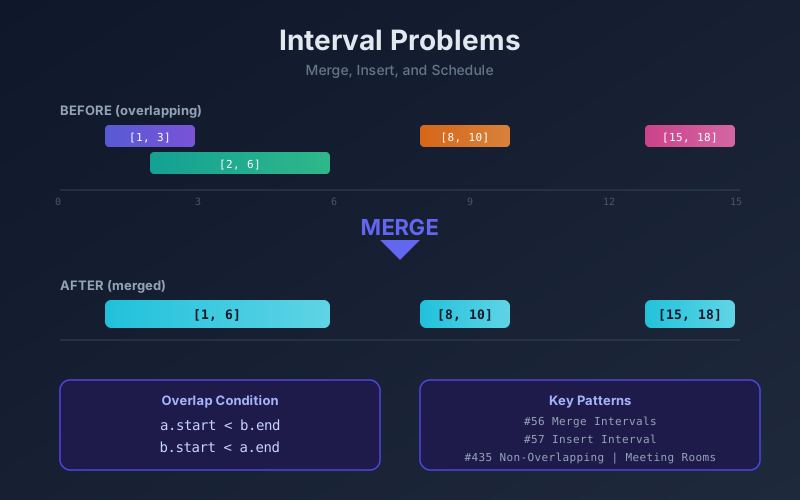
Interval problems appear constantly in coding interviews. They look diverse but almost all share the same first step: sort by start time. Once sorted, a single scan can merge, insert, count overlaps, or schedule rooms. This guide covers the core patterns.
The Golden Rule
Almost every interval problem starts with:
intervals.sort(key=lambda x: x[0])Sorting by start time guarantees that as you scan left to right, you only need to compare each interval against the previous one (or a running state). Without sorting, you would need O(n^2) pairwise comparisons.
Pattern 1: Merge Overlapping Intervals (LeetCode #56)
Given a list of intervals, merge all overlapping ones.
Key insight: After sorting, two consecutive intervals overlap if and only if the second starts before or at the first’s end.
def merge(intervals: list[list[int]]) -> list[list[int]]:
    intervals.sort(key=lambda x: x[0])
    merged = [intervals[0]]

    for start, end in intervals[1:]:
        last_end = merged[-1][1]

        if start <= last_end:
            # overlapping — extend the current interval
            merged[-1][1] = max(last_end, end)
        else:
            # no overlap — start a new interval
            merged.append([start, end])

    return merged

print(merge([[1,3],[2,6],[8,10],[15,18]]))
# [[1, 6], [8, 10], [15, 18]]

print(merge([[1,4],[4,5]]))
# [[1, 5]]
Complexity: O(n log n) time for sorting, O(n) space for the result.
Walkthrough
Input (sorted): [1,3] [2,6] [8,10] [15,18]

Step 1: merged = [[1,3]]
Step 2: [2,6] — 2 <= 3, overlap! Extend to [1,6]
Step 3: [8,10] — 8 > 6, no overlap. Add [8,10]
Step 4: [15,18] — 15 > 10, no overlap. Add [15,18]

Result: [[1,6], [8,10], [15,18]]
Pattern 2: Insert Interval (LeetCode #57)
Given a sorted, non-overlapping list of intervals and a new interval, insert it and merge if necessary.
Key insight: Split the problem into three phases: intervals entirely before, intervals that overlap, and intervals entirely after.
def insert(intervals: list[list[int]],
           new: list[int]) -> list[list[int]]:
    result = []
    i = 0
    n = len(intervals)

    # phase 1: add all intervals that end before new starts
    while i < n and intervals[i][1] < new[0]:
        result.append(intervals[i])
        i += 1

    # phase 2: merge all overlapping intervals with new
    while i < n and intervals[i][0] <= new[1]:
        new[0] = min(new[0], intervals[i][0])
        new[1] = max(new[1], intervals[i][1])
        i += 1
    result.append(new)

    # phase 3: add remaining intervals
    while i < n:
        result.append(intervals[i])
        i += 1

    return result

print(insert([[1,3],[6,9]], [2,5]))
# [[1, 5], [6, 9]]

print(insert([[1,2],[3,5],[6,7],[8,10],[12,16]], [4,8]))
# [[1, 2], [3, 10], [12, 16]]
Complexity: O(n) time (input is already sorted), O(n) space.
Pattern 3: Meeting Rooms (Can Attend All?)
Given a list of meeting intervals, determine if a person can attend all of them. This is simply checking for any overlap.
def can_attend_all(intervals: list[list[int]]) -> bool:
    intervals.sort(key=lambda x: x[0])

    for i in range(1, len(intervals)):
        if intervals[i][0] < intervals[i - 1][1]:
            return False  # overlap found

    return True

print(can_attend_all([[0,30],[5,10],[15,20]]))  # False
print(can_attend_all([[7,10],[2,4]]))            # True
Pattern 4: Minimum Meeting Rooms (Sweep Line)
Find the minimum number of conference rooms required. This is the classic sweep-line problem.
Key insight: Convert each interval into two events: a start (+1 room) and an end (-1 room). Sort events and sweep through them, tracking the running count.
import heapq

def min_meeting_rooms(intervals: list[list[int]]) -> int:
    if not intervals:
        return 0

    # approach 1: min-heap of end times
    intervals.sort(key=lambda x: x[0])
    heap = [intervals[0][1]]  # end time of first meeting

    for start, end in intervals[1:]:
        if start >= heap[0]:
            heapq.heappop(heap)  # reuse the room
        heapq.heappush(heap, end)

    return len(heap)

print(min_meeting_rooms([[0,30],[5,10],[15,20]]))  # 2
print(min_meeting_rooms([[7,10],[2,4]]))            # 1
Alternative: Event-Based Sweep
def min_rooms_sweep(intervals: list[list[int]]) -> int:
    events = []
    for start, end in intervals:
        events.append((start, 1))   # meeting starts
        events.append((end, -1))    # meeting ends

    events.sort()
    max_rooms = current = 0

    for _, delta in events:
        current += delta
        max_rooms = max(max_rooms, current)

    return max_rooms

print(min_rooms_sweep([[0,30],[5,10],[15,20]]))  # 2
Complexity: O(n log n) time, O(n) space.
Pattern 5: Non-Overlapping Intervals (LeetCode #435)
Find the minimum number of intervals to remove so no two intervals overlap. This is the classic interval scheduling maximization problem.
Key insight: Sort by end time. Greedily keep the interval that ends earliest, giving the most room for future intervals.
def erase_overlap_intervals(intervals: list[list[int]]) -> int:
    intervals.sort(key=lambda x: x[1])  # sort by END
    removals = 0
    prev_end = float('-inf')

    for start, end in intervals:
        if start >= prev_end:
            prev_end = end  # keep this interval
        else:
            removals += 1   # remove this interval

    return removals

print(erase_overlap_intervals([[1,2],[2,3],[3,4],[1,3]]))  # 1
print(erase_overlap_intervals([[1,2],[1,2],[1,2]]))         # 2
Decision Guide
| Situation | Pattern | Sort By |
|---|---|---|
| Merge overlapping intervals | Scan and extend | Start time |
| Insert into sorted list | Three-phase scan | Already sorted |
| Check for any overlap | Pairwise neighbor check | Start time |
| Count max simultaneous | Sweep line / heap | Start time or events |
| Maximize non-overlapping | Greedy keep earliest end | End time |
Overlap Detection Cheat Sheet
Two intervals [a1, a2] and [b1, b2] overlap if and only if:
a1 < b2 and b1 < a2They do NOT overlap if one ends before the other starts:
a2 <= b1 or b2 <= a1This simple check is the foundation of every interval problem. Memorize it.
Common Pitfalls
Sorting by the wrong key: Merge problems sort by start. Scheduling maximization sorts by end. Mixing these up gives wrong answers.
Inclusive vs exclusive boundaries: Pay attention to whether endpoints are inclusive. [1,5] and [5,10] may or may not overlap depending on the problem definition. Read the problem statement carefully.
Forgetting edge cases: Empty input, single interval, and fully nested intervals (like [1,10] containing [2,3]) are common edge cases that break naive implementations.
Interval problems are some of the most predictable in coding interviews. Sort, scan, and apply the right overlap logic. Once you internalize these five patterns, most interval questions become straightforward.
Related articles
- LeetCode Greedy Algorithm Patterns: Interval Scheduling, Activity Selection, and More
Master greedy algorithm patterns for LeetCode including interval scheduling, activity selection, jump games, and proving greedy correctness.
- LeetCode LeetCode Two Pointer Patterns: The Complete Guide
Master every two pointer pattern for LeetCode: opposite-end, same-direction, and fast/slow pointers with templates, complexity analysis, and 15+ mapped problems.
- LeetCode Binary Search Patterns: Search Space, Boundaries, and Rotated Arrays
Master binary search patterns for LeetCode including search space reduction, boundary finding, rotated array search, and practical templates.
- LeetCode Dynamic Programming Patterns: 1D, 2D, Memoization, and Tabulation
Master dynamic programming with 1D and 2D patterns, memoization vs tabulation approaches, and solutions to classic LeetCode DP problems.