Alien Dictionary: Topological Sort from Word Ordering
Derive character ordering from sorted alien words using topological sort, with course schedule variants and prerequisite chain problems.
What you'll learn
- ✓How to extract ordering constraints from sorted word pairs
- ✓Building a dependency graph from adjacent word comparisons
- ✓Kahn's BFS topological sort for valid ordering
- ✓DFS-based topological sort with cycle detection
- ✓Course schedule and prerequisite chain variants
Prerequisites
- •Topological sort from /blog/topological-sort-explained
- •BFS and DFS traversal from /blog/graphs-bfs-and-dfs
- •Graph adjacency list representation
- •Big O notation from /blog/big-o-notation-explained
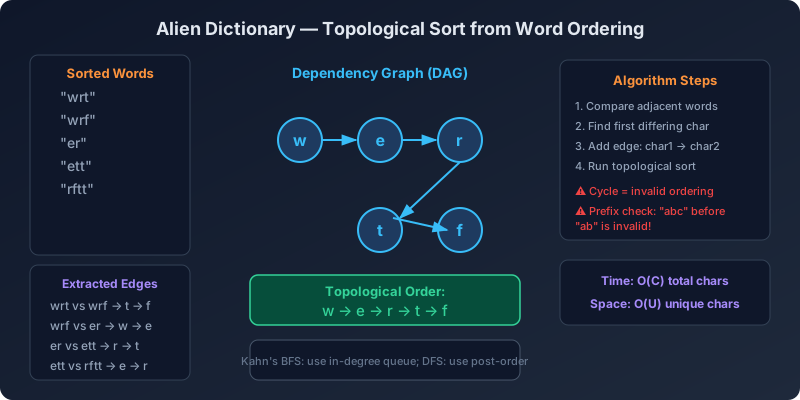
The alien dictionary problem is a beautiful application of topological sorting. Given a list of words sorted in an alien language’s alphabetical order, determine the order of characters in that language. The trick is recognizing that adjacent word pairs give you ordering constraints, which form a directed acyclic graph (DAG). Topological sort on this DAG produces the character ordering.
The Core Insight
When words are sorted, comparing adjacent words reveals which character comes first. Consider “wrt” before “wrf”. The first two characters match (“wr”), but the third differs: ‘t’ vs ‘f’. Since “wrt” comes before “wrf” in the alien order, we know that ‘t’ comes before ‘f’ in the alien alphabet.
This gives us a directed edge: t -> f (t must come before f).
By comparing every adjacent pair of words, we extract all ordering constraints. Then topological sort gives us a valid character ordering.
Step-by-Step Algorithm
- Compare adjacent words to extract edges
- Build a directed graph from these edges
- Run topological sort (Kahn’s BFS or DFS)
- Handle edge cases: cycles (invalid), prefix issues
Full Implementation: Kahn’s BFS
from collections import defaultdict, deque

def alienOrder(words: list[str]) -> str:
    """
    LeetCode 269: Alien Dictionary.
    Returns character ordering, or "" if invalid.
    """
    # Step 1: Initialize graph with all unique characters
    graph = defaultdict(set)  # char -> set of chars that come after
    in_degree = {}

    for word in words:
        for char in word:
            if char not in in_degree:
                in_degree[char] = 0

    # Step 2: Compare adjacent words to extract edges
    for i in range(len(words) - 1):
        word1 = words[i]
        word2 = words[i + 1]

        # Edge case: if word1 is longer and word2 is its prefix
        # e.g., "abc" before "ab" is INVALID
        min_len = min(len(word1), len(word2))
        if len(word1) > len(word2) and word1[:min_len] == word2[:min_len]:
            return ""

        # Find first differing character
        for j in range(min_len):
            if word1[j] != word2[j]:
                # word1[j] comes before word2[j]
                if word2[j] not in graph[word1[j]]:
                    graph[word1[j]].add(word2[j])
                    in_degree[word2[j]] += 1
                break  # only the first difference matters

    # Step 3: Kahn's topological sort (BFS)
    queue = deque()
    for char in in_degree:
        if in_degree[char] == 0:
            queue.append(char)

    result = []
    while queue:
        char = queue.popleft()
        result.append(char)

        for neighbor in graph[char]:
            in_degree[neighbor] -= 1
            if in_degree[neighbor] == 0:
                queue.append(neighbor)

    # If not all characters are in result, there's a cycle
    if len(result) != len(in_degree):
        return ""

    return ''.join(result)
Walkthrough with Example
Words: [“wrt”, “wrf”, “er”, “ett”, “rftt”]
Step 1: Extract edges from adjacent pairs
| Pair | First Diff | Edge |
|---|---|---|
| wrt, wrf | index 2: t vs f | t -> f |
| wrf, er | index 0: w vs e | w -> e |
| er, ett | index 1: r vs t | r -> t |
| ett, rftt | index 0: e vs r | e -> r |
Step 2: Build graph
- t ->
{f} - w ->
{e} - r ->
{t} - e ->
{r} - f ->
{}
In-degrees: w:0, e:1, r:1, t:1, f:1
Step 3: Kahn’s BFS
- Queue: [w] (in-degree 0)
- Process w, add e (in-degree 1->0). Queue: [e]. Result: [w]
- Process e, add r (in-degree 1->0). Queue: [r]. Result: [w,e]
- Process r, add t (in-degree 1->0). Queue: [t]. Result: [w,e,r]
- Process t, add f (in-degree 1->0). Queue: [f]. Result: [w,e,r,t]
- Process f. Queue empty. Result: [w,e,r,t,f]
Answer: “wertf”
DFS-Based Topological Sort
An alternative approach using DFS with 3-color cycle detection.
def alienOrder_dfs(words: list[str]) -> str:
    """DFS-based topological sort for alien dictionary."""
    graph = defaultdict(set)
    all_chars = set()

    for word in words:
        all_chars.update(word)

    # Extract edges
    for i in range(len(words) - 1):
        w1, w2 = words[i], words[i + 1]
        min_len = min(len(w1), len(w2))

        if len(w1) > len(w2) and w1[:min_len] == w2[:min_len]:
            return ""

        for j in range(min_len):
            if w1[j] != w2[j]:
                graph[w1[j]].add(w2[j])
                break

    # DFS with 3 states: 0=unvisited, 1=in_progress, 2=done
    state = {c: 0 for c in all_chars}
    result = []

    def dfs(char: str) -> bool:
        """Returns False if cycle detected."""
        if state[char] == 1:  # cycle!
            return False
        if state[char] == 2:  # already processed
            return True

        state[char] = 1  # mark in-progress

        for neighbor in graph[char]:
            if not dfs(neighbor):
                return False

        state[char] = 2  # mark done
        result.append(char)  # post-order
        return True

    for char in all_chars:
        if state[char] == 0:
            if not dfs(char):
                return ""

    # Post-order gives reverse topological order
    result.reverse()
    return ''.join(result)
Edge Cases to Watch
1. Prefix Problem
If “abc” comes before “ab”, this is invalid. A shorter word that is a prefix of a longer word must come first, not after.
# This check is critical
if len(word1) > len(word2) and word1[:min_len] == word2[:min_len]:
    return ""  # INVALID ordering
2. Duplicate Words
Adjacent identical words give no information. Do not add any edges.
3. Multiple Valid Orderings
If the graph has multiple valid topological orders, any one is acceptable. Kahn’s BFS gives a deterministic order based on the queue (you could use a min-heap for lexicographic smallest).
4. Characters Not in Any Edge
Characters that appear in words but never differ in adjacent comparisons have no ordering constraints. They can go anywhere in the result. Both Kahn’s and DFS handle this correctly.
Course Schedule (LeetCode 207)
The classic topological sort problem. Can you finish all courses given prerequisites?
def canFinish(numCourses: int, prerequisites: list[list[int]]) -> bool:
    """
    LeetCode 207: Course Schedule.
    Can we take all courses? (Is the graph a DAG?)
    """
    graph = defaultdict(list)
    in_degree = [0] * numCourses

    for course, prereq in prerequisites:
        graph[prereq].append(course)
        in_degree[course] += 1

    # Kahn's BFS
    queue = deque()
    for i in range(numCourses):
        if in_degree[i] == 0:
            queue.append(i)

    taken = 0
    while queue:
        course = queue.popleft()
        taken += 1

        for next_course in graph[course]:
            in_degree[next_course] -= 1
            if in_degree[next_course] == 0:
                queue.append(next_course)

    return taken == numCourses
Course Schedule II (LeetCode 210)
Return the ordering of courses (topological order).
def findOrder(numCourses: int, prerequisites: list[list[int]]) -> list[int]:
    """
    LeetCode 210: Return a valid course ordering.
    """
    graph = defaultdict(list)
    in_degree = [0] * numCourses

    for course, prereq in prerequisites:
        graph[prereq].append(course)
        in_degree[course] += 1

    queue = deque()
    for i in range(numCourses):
        if in_degree[i] == 0:
            queue.append(i)

    order = []
    while queue:
        course = queue.popleft()
        order.append(course)

        for next_course in graph[course]:
            in_degree[next_course] -= 1
            if in_degree[next_course] == 0:
                queue.append(next_course)

    return order if len(order) == numCourses else []
Prerequisite Chains: Longest Path in DAG
Find the longest chain of prerequisites. This is the longest path in a DAG, solvable with topological sort + DP.
def longest_prerequisite_chain(numCourses: int,
                                prerequisites: list[list[int]]) -> int:
    """
    Find the longest chain of prerequisites.
    This is the longest path in the prerequisite DAG.
    """
    graph = defaultdict(list)
    in_degree = [0] * numCourses

    for course, prereq in prerequisites:
        graph[prereq].append(course)
        in_degree[course] += 1

    # Topological sort with DP for longest path
    queue = deque()
    longest = [1] * numCourses  # minimum chain length is 1 (the course itself)

    for i in range(numCourses):
        if in_degree[i] == 0:
            queue.append(i)

    while queue:
        course = queue.popleft()
        for next_course in graph[course]:
            longest[next_course] = max(longest[next_course],
                                        longest[course] + 1)
            in_degree[next_course] -= 1
            if in_degree[next_course] == 0:
                queue.append(next_course)

    return max(longest)
Parallel Courses (LeetCode 1136)
Find the minimum number of semesters to complete all courses, where courses with no prerequisite conflicts can be taken in parallel.
def minimumSemesters(n: int, relations: list[list[int]]) -> int:
    """
    LeetCode 1136: Minimum semesters = longest path in DAG + 1.
    This equals the number of levels in topological sort.
    """
    graph = defaultdict(list)
    in_degree = [0] * (n + 1)

    for prereq, course in relations:
        graph[prereq].append(course)
        in_degree[course] += 1

    queue = deque()
    for i in range(1, n + 1):
        if in_degree[i] == 0:
            queue.append(i)

    semesters = 0
    taken = 0

    while queue:
        semesters += 1
        next_queue = deque()

        for _ in range(len(queue)):
            course = queue.popleft()
            taken += 1

            for next_course in graph[course]:
                in_degree[next_course] -= 1
                if in_degree[next_course] == 0:
                    next_queue.append(next_course)

        queue = next_queue

    return semesters if taken == n else -1
Verifying Alien Dictionary (LeetCode 953)
The inverse problem: given the character order, verify that the words are sorted correctly.
def isAlienSorted(words: list[str], order: str) -> bool:
    """
    LeetCode 953: Are words sorted in the given alien order?
    """
    # Map each character to its priority
    priority = {c: i for i, c in enumerate(order)}

    for i in range(len(words) - 1):
        w1, w2 = words[i], words[i + 1]

        # Compare character by character
        for j in range(min(len(w1), len(w2))):
            if w1[j] != w2[j]:
                if priority[w1[j]] > priority[w2[j]]:
                    return False
                break
        else:
            # All compared chars equal; shorter word should come first
            if len(w1) > len(w2):
                return False

    return True
Complexity Analysis
| Problem | Time | Space |
|---|---|---|
| Alien Dictionary | O(C) where C = total chars in all words | O(U) where U = unique chars |
| Course Schedule | O(V + E) | O(V + E) |
| Longest Prereq Chain | O(V + E) | O(V + E) |
| Parallel Courses | O(V + E) | O(V + E) |
| Verify Alien Sorted | O(C) total chars | O(1) for the mapping |
For the alien dictionary, we compare each adjacent pair and scan characters once. Building the graph is O(C). Topological sort is O(V + E) where V = unique characters (at most 26) and E = number of edges (at most 26^2). So the total is dominated by O(C).
Kahn’s BFS vs DFS Topological Sort
| Aspect | Kahn’s BFS | DFS Post-Order |
|---|---|---|
| Cycle detection | len(result) != num_nodes | 3-color state (in-progress = cycle) |
| Order | Natural (front to back) | Reverse post-order |
| Level info | Easy to get (queue levels) | Harder to extract |
| Implementation | In-degree array + queue | Recursion + state array |
| Preference | When you need levels or lexicographic order | When you need any valid order quickly |
Practice Problems
| Problem | Difficulty | Key Concept |
|---|---|---|
| LeetCode 269: Alien Dictionary | Hard | Core alien dictionary |
| LeetCode 953: Verifying Alien Dictionary | Easy | Verification variant |
| LeetCode 207: Course Schedule | Medium | DAG cycle detection |
| LeetCode 210: Course Schedule II | Medium | Topological ordering |
| LeetCode 1136: Parallel Courses | Medium | Level-based topo sort |
| LeetCode 2115: Find All Possible Recipes | Medium | Topo sort with supplies |
| LeetCode 802: Find Eventual Safe States | Medium | Reverse topo sort |
Key Takeaways
- Adjacent word comparison gives ONE edge. Only the first differing character matters; subsequent characters give no information.
- Prefix validation is critical. “abc” before “ab” is always invalid regardless of the alphabet.
- Cycle = invalid ordering. If topological sort cannot process all nodes, the input is contradictory.
- Topological sort is the go-to for dependency problems. Courses, build systems, task scheduling all reduce to this.
- Kahn’s BFS gives level information for free, useful for parallel scheduling problems.
Related articles
- DSA Detecting Negative Cycles in Graphs
Learn how to detect negative cycles using Bellman-Ford's nth relaxation, SPFA algorithm, and apply it to arbitrage detection in currency exchange graphs.
- DSA Word Search, Boggle Solver, and Word Ladder: Grid + String Graph Problems
Solve word search with DFS backtracking, Boggle with Trie pruning, and word ladder with BFS for efficient string transformation problems.
- DSA A* Search Algorithm: Heuristic Pathfinding Explained
Learn the A* search algorithm with f=g+h, admissible heuristics, grid pathfinding, and Python implementation compared to Dijkstra and BFS.
- DSA Articulation Points and Bridges in Graphs
Find critical nodes and edges in graphs using Tarjan's algorithm with discovery and low-link arrays, with Python code and network applications.