BST Iterator, Range Queries, and Closest Value
Master BST iterator using stack-based controlled in-order traversal, range sum queries, counting nodes in range, closest value, and closest K values — with full Python implementations.
What you'll learn
- ✓How to build a BST iterator with O(h) space using a stack
- ✓Range sum of BST — recursive and iterative approaches
- ✓Counting nodes within a given range efficiently
- ✓Finding the closest value in a BST to a target
- ✓Finding K closest values using two stacks or inorder + binary search
Prerequisites
- •BST properties — left child smaller, right child larger
- •Inorder traversal produces sorted output
- •Stack data structure basics
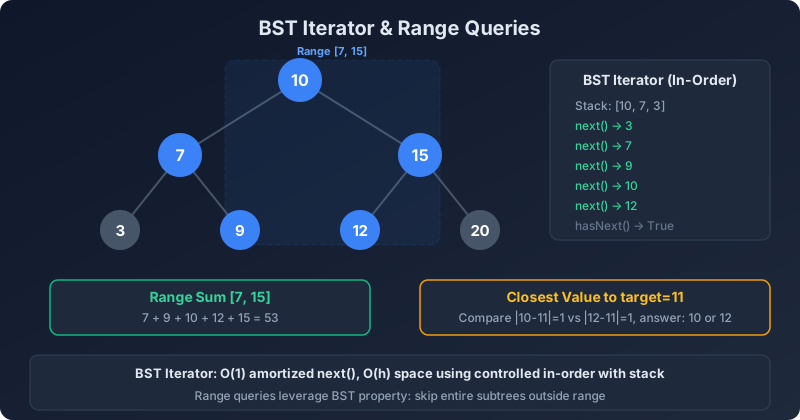
The BST iterator is one of the most elegant tree problems — it asks you to simulate an in-order traversal lazily, one element at a time. Combined with range queries and closest-value problems, these form a family of BST-specific techniques that exploit the sorted structure of a BST.
TreeNode Definition
class TreeNode:
    def __init__(self, val=0, left=None, right=None):
        self.val = val
        self.left = left
        self.right = right
Problem 1: BST Iterator (LeetCode 173)
Implement an iterator over a BST that returns elements in ascending order (in-order). The iterator should support:
next()— return the next smallest elementhasNext()— return whether there are more elements
The naive approach
Flatten the BST into a sorted list, then iterate over the list:
class BSTIteratorNaive:
    def __init__(self, root):
        self.sorted_vals = []
        self.index = 0
        self._inorder(root)

    def _inorder(self, node):
        if not node:
            return
        self._inorder(node.left)
        self.sorted_vals.append(node.val)
        self._inorder(node.right)

    def next(self):
        val = self.sorted_vals[self.index]
        self.index += 1
        return val

    def hasNext(self):
        return self.index < len(self.sorted_vals)
This uses O(n) space. Can we do better?
The optimal approach: Controlled in-order with a stack
The idea is to use a stack that always holds the leftmost path from the current position. Each call to next() pops the top, then pushes the leftmost path from the right child.
class BSTIterator:
    def __init__(self, root):
        self.stack = []
        self._push_left(root)

    def _push_left(self, node):
        """Push all left children onto the stack."""
        while node:
            self.stack.append(node)
            node = node.left

    def next(self):
        """Return the next smallest element."""
        node = self.stack.pop()

        # If this node has a right child, push its leftmost path
        if node.right:
            self._push_left(node.right)

        return node.val

    def hasNext(self):
        """Return True if there are more elements."""
        return len(self.stack) > 0
How the stack evolves
BST:        7
           / \
          3   15
             / \
            9   20

Initial stack (push left from 7): [7, 3]

next() → pop 3, no right child. Stack: [7]
next() → pop 7, right child is 15, push left from 15: [15, 9]
next() → pop 9, no right child. Stack: [15]
next() → pop 15, right child is 20, push left from 20: [20]
next() → pop 20. Stack: []
hasNext() → False

Output: 3, 7, 9, 15, 20  ✓ (sorted!)
Complexity
| Metric | Value |
|---|---|
Time per next() | Amortized O(1) — each node is pushed and popped exactly once across all calls |
| Space | O(h) — stack holds at most h nodes (height of tree) |
The amortized O(1) is the key insight. Although a single next() call might push multiple nodes, across n calls the total pushes are exactly n.
Problem 2: Range Sum of BST (LeetCode 938)
Given a BST and a range [low, high], return the sum of all node values within that range.
        10
       /  \
      5    15
     / \     \
    3   7    18

low = 7, high = 15
Answer: 7 + 10 + 15 = 32
Recursive approach
def range_sum_bst(root, low, high):
    """Sum all values in [low, high] in the BST."""
    if not root:
        return 0

    # If current value is too small, only search right
    if root.val < low:
        return range_sum_bst(root.right, low, high)

    # If current value is too large, only search left
    if root.val > high:
        return range_sum_bst(root.left, low, high)

    # Current value is in range — include it and search both subtrees
    return (root.val
            + range_sum_bst(root.left, low, high)
            + range_sum_bst(root.right, low, high))
Iterative approach
from collections import deque

def range_sum_bst_iterative(root, low, high):
    """Range sum using iterative DFS."""
    if not root:
        return 0

    total = 0
    stack = [root]

    while stack:
        node = stack.pop()
        if not node:
            continue

        if node.val < low:
            stack.append(node.right)
        elif node.val > high:
            stack.append(node.left)
        else:
            total += node.val
            stack.append(node.left)
            stack.append(node.right)

    return total
Complexity
| Metric | Value |
|---|---|
| Time | O(n) worst case, but often much better — we prune branches outside the range |
| Space | O(h) |
Problem 3: Count Nodes in Range
Count how many nodes have values in [low, high].
def count_in_range(root, low, high):
    """Count nodes with values in [low, high]."""
    if not root:
        return 0

    if root.val < low:
        return count_in_range(root.right, low, high)

    if root.val > high:
        return count_in_range(root.left, low, high)

    return (1
            + count_in_range(root.left, low, high)
            + count_in_range(root.right, low, high))
With augmented BST (subtree sizes)
If each node stores its subtree size, we can answer range queries in O(h):
class AugmentedNode:
    def __init__(self, val=0):
        self.val = val
        self.left = None
        self.right = None
        self.size = 1  # Subtree size including self

def count_less_than(node, val):
    """Count nodes with value strictly less than val."""
    if not node:
        return 0

    if val <= node.val:
        return count_less_than(node.left, val)
    else:
        left_size = node.left.size if node.left else 0
        return left_size + 1 + count_less_than(node.right, val)

def count_in_range_augmented(root, low, high):
    """Count nodes in [low, high] using augmented BST."""
    return count_less_than(root, high + 1) - count_less_than(root, low)
Problem 4: Closest Binary Search Tree Value (LeetCode 270)
Given a BST and a target float value, find the node value closest to the target.
        4
       / \
      2   5
     / \
    1   3

Target = 3.7
Closest = 4
Approach: Binary search in BST
def closest_value(root, target):
    """Find the closest value in BST to target."""
    closest = root.val

    while root:
        # Update closest if current is nearer
        if abs(root.val - target) < abs(closest - target):
            closest = root.val

        # Go left or right based on target
        if target < root.val:
            root = root.left
        elif target > root.val:
            root = root.right
        else:
            return root.val  # Exact match

    return closest
Complexity
| Metric | Value |
|---|---|
| Time | O(h) |
| Space | O(1) |
Problem 5: Closest K Values (LeetCode 272)
Given a BST, a target value, and an integer k, find the k values in the BST closest to the target.
Approach 1: Inorder + Two pointers
Get the sorted inorder list, then use two pointers to find the k closest.
def closest_k_values(root, target, k):
    """Find k closest values using inorder + two pointers."""
    # Step 1: Get sorted inorder list
    inorder = []

    def dfs(node):
        if not node:
            return
        dfs(node.left)
        inorder.append(node.val)
        dfs(node.right)

    dfs(root)

    # Step 2: Binary search for closest position
    left = 0
    right = len(inorder) - 1

    # Find insertion point
    import bisect
    pos = bisect.bisect_left(inorder, target)

    # Two pointers expanding outward
    left = pos - 1
    right = pos
    result = []

    while len(result) < k:
        if left < 0:
            result.append(inorder[right])
            right += 1
        elif right >= len(inorder):
            result.append(inorder[left])
            left -= 1
        elif abs(inorder[left] - target) <= abs(inorder[right] - target):
            result.append(inorder[left])
            left -= 1
        else:
            result.append(inorder[right])
            right += 1

    return result
Approach 2: Two stacks (predecessor/successor iterators)
This approach uses O(h) space instead of O(n) by maintaining two stacks — one iterating backward (predecessors) and one forward (successors).
def closest_k_values_stacks(root, target, k):
    """Find k closest values using predecessor/successor stacks."""
    # Predecessor stack: iterate in reverse inorder (descending)
    pred_stack = []
    # Successor stack: iterate in inorder (ascending)
    succ_stack = []

    # Initialize: push path to target
    node = root
    while node:
        if target < node.val:
            succ_stack.append(node)
            node = node.left
        elif target > node.val:
            pred_stack.append(node)
            node = node.right
        else:
            succ_stack.append(node)
            pred_stack.append(node)
            break

    def next_predecessor():
        """Get next smaller value."""
        if not pred_stack:
            return float('-inf')
        node = pred_stack.pop()
        val = node.val
        # Push rightmost path of left subtree
        node = node.left
        while node:
            pred_stack.append(node)
            node = node.right
        return val

    def next_successor():
        """Get next larger value."""
        if not succ_stack:
            return float('inf')
        node = succ_stack.pop()
        val = node.val
        # Push leftmost path of right subtree
        node = node.right
        while node:
            succ_stack.append(node)
            node = node.left
        return val

    result = []
    pred_val = next_predecessor()
    succ_val = next_successor()

    # Skip duplicate if target exists in tree
    if pred_val == succ_val:
        result.append(pred_val)
        pred_val = next_predecessor()
        succ_val = next_successor()

    while len(result) < k:
        if abs(pred_val - target) <= abs(succ_val - target):
            result.append(pred_val)
            pred_val = next_predecessor()
        else:
            result.append(succ_val)
            succ_val = next_successor()

    return result
Complexity comparison
| Approach | Time | Space |
|---|---|---|
| Inorder + two pointers | O(n) | O(n) |
| Two stacks | O(h + k) | O(h) |
The two-stack approach is better when k is much smaller than n.
Problem 6: BST Range Traversal
Print all BST values in a given range in sorted order:
def range_traversal(root, low, high):
    """Print all values in [low, high] in sorted order."""
    result = []

    def inorder(node):
        if not node:
            return

        # Only go left if there might be values >= low
        if node.val > low:
            inorder(node.left)

        # Include current if in range
        if low <= node.val <= high:
            result.append(node.val)

        # Only go right if there might be values <= high
        if node.val < high:
            inorder(node.right)

    inorder(root)
    return result
Using BST Iterator for Merge Operations
The BST iterator is powerful for merging two BSTs:
def merge_two_bsts(root1, root2):
    """Merge two BSTs into a single sorted list."""
    iter1 = BSTIterator(root1)
    iter2 = BSTIterator(root2)

    result = []
    val1 = iter1.next() if iter1.hasNext() else float('inf')
    val2 = iter2.next() if iter2.hasNext() else float('inf')

    while val1 != float('inf') or val2 != float('inf'):
        if val1 <= val2:
            result.append(val1)
            val1 = iter1.next() if iter1.hasNext() else float('inf')
        else:
            result.append(val2)
            val2 = iter2.next() if iter2.hasNext() else float('inf')

    return result
This merges in O(n + m) time with O(h1 + h2) space — much better than flattening both trees first.
Two-Sum in BST Using Two Iterators
Check if any two nodes in a BST sum to a target:
class BSTReverseIterator:
    """Iterates BST in descending order."""
    def __init__(self, root):
        self.stack = []
        self._push_right(root)

    def _push_right(self, node):
        while node:
            self.stack.append(node)
            node = node.right

    def next(self):
        node = self.stack.pop()
        if node.left:
            self._push_right(node.left)
        return node.val

    def hasNext(self):
        return len(self.stack) > 0


def two_sum_bst(root, target):
    """Check if two nodes sum to target using two iterators."""
    forward = BSTIterator(root)
    backward = BSTReverseIterator(root)

    left = forward.next()
    right = backward.next()

    while left < right:
        current_sum = left + right
        if current_sum == target:
            return True
        elif current_sum < target:
            left = forward.next()
        else:
            right = backward.next()

    return False
Complexity
| Metric | Value |
|---|---|
| Time | O(n) |
| Space | O(h) — two stacks of height h |
Common Mistakes
-
Forgetting amortized analysis — the BST iterator’s
next()is O(1) amortized, not O(h) per call. Each node is pushed and popped exactly once across all calls. -
Not pruning in range queries — if
root.val {'<'} low, don’t bother searching the left subtree. The BST property lets you skip entire branches. -
Integer overflow in closest value — when computing
abs(val - target), use floating point or be careful with large integers. -
Returning wrong type for closest K — the problem asks for values, not nodes. Don’t return TreeNode objects.
Practice Problems
| Problem | Platform | Difficulty |
|---|---|---|
| Binary Search Tree Iterator | LeetCode 173 | Medium |
| Range Sum of BST | LeetCode 938 | Easy |
| Closest Binary Search Tree Value | LeetCode 270 | Easy |
| Closest Binary Search Tree Value II | LeetCode 272 | Hard |
| Two Sum IV - Input is a BST | LeetCode 653 | Easy |
| Kth Smallest Element in a BST | LeetCode 230 | Medium |
Key Takeaways
- The BST iterator with a stack is the controlled in-order traversal — O(h) space, O(1) amortized per
next(). - Range queries exploit the BST property to prune entire branches, often visiting far fewer than n nodes.
- Closest value is essentially binary search on a tree — O(h) time, O(1) space.
- Closest K values with two stacks gives O(h + k) time — optimal when k is small.
- The iterator pattern enables merge and two-sum operations with minimal space.
- Always think about whether you can leverage BST ordering to skip subtrees.
Related articles
- DSA Flatten Binary Tree to Linked List
Learn how to flatten a binary tree to a linked list using preorder threading, Morris traversal, and how to convert a BST to a sorted doubly linked list — with full Python implementations and Big-O analysis.
- DSA Boundary Traversal of Binary Tree
Complete guide to boundary traversal — left boundary, leaf nodes, and right boundary in reverse. Multiple Python approaches with edge case handling.
- DSA Distance Problems in Binary Trees
Solve distance problems in binary trees — distance between two nodes, all nodes at distance K, burning a tree from a node, and sum of distances using rerooting. Full Python implementations.
- DSA Tree Pruning and Deletion Patterns
Master tree pruning and deletion — delete nodes in BST, prune binary trees, trim BST to range, and remove leaves with a given value. Full Python implementations with Big-O analysis.