Circular Queue Implementation
Build a circular queue from scratch — understand ring buffers, front/rear pointer math with modulo, full vs empty detection, and real-world uses in OS scheduling.
What you'll learn
- ✓Why circular queues solve the "wasted space" problem of linear queues
- ✓Array-based circular queue with modulo arithmetic
- ✓Full vs empty detection — the count-based and gap-based approaches
- ✓Complete Python implementation with all edge cases
- ✓Use cases: OS scheduling, I/O buffering, BFS, streaming
- ✓Comparison with regular queue and deque
Prerequisites
- •Queue basics — see Queues Intro
- •Array basics — see Arrays Intro
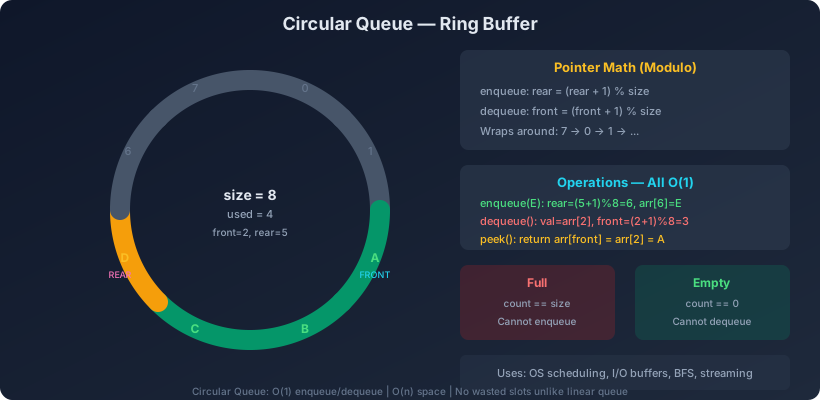
A regular array-based queue has a problem: after many enqueue/dequeue operations, the front pointer moves forward, leaving wasted space at the beginning. A circular queue (ring buffer) solves this by wrapping around to reuse that space.
The Problem with Linear Queues
In a linear array-based queue:
# After enqueue(A), enqueue(B), enqueue(C):
# [A, B, C, _, _]  front=0, rear=2

# After dequeue(), dequeue():
# [_, _, C, _, _]  front=2, rear=2

# Slots 0 and 1 are wasted!
# Even though the queue has room, we can't use those slots
# without shifting everything left — which is O(n)
A circular queue uses modulo arithmetic to wrap the pointers around:
After the rear reaches the end, it wraps: rear = (rear + 1) % size
This reuses the empty slots at the beginning!
Array-Based Circular Queue
The core idea
front: index of the first elementrear: index where the next element will be insertedcount: number of elements currently in the queue- All index math uses
% capacityto wrap around
class CircularQueue:
    """
    Fixed-size circular queue (ring buffer) using an array.
    All operations are O(1).
    """

    def __init__(self, capacity):
        self.capacity = capacity
        self.queue = [None] * capacity
        self.front = 0
        self.rear = 0
        self.count = 0

    def is_empty(self):
        """Check if queue is empty. O(1)."""
        return self.count == 0

    def is_full(self):
        """Check if queue is full. O(1)."""
        return self.count == self.capacity

    def size(self):
        """Return number of elements. O(1)."""
        return self.count

    def enqueue(self, item):
        """
        Add item to the rear of the queue. O(1).
        Raises OverflowError if full.
        """
        if self.is_full():
            raise OverflowError("Queue is full")

        self.queue[self.rear] = item
        self.rear = (self.rear + 1) % self.capacity  # Wrap around!
        self.count += 1

    def dequeue(self):
        """
        Remove and return item from the front. O(1).
        Raises IndexError if empty.
        """
        if self.is_empty():
            raise IndexError("Queue is empty")

        item = self.queue[self.front]
        self.queue[self.front] = None  # Help garbage collection
        self.front = (self.front + 1) % self.capacity  # Wrap around!
        self.count -= 1
        return item

    def peek(self):
        """Return front item without removing. O(1)."""
        if self.is_empty():
            raise IndexError("Queue is empty")
        return self.queue[self.front]

    def __repr__(self):
        if self.is_empty():
            return "CircularQueue([])"
        items = []
        idx = self.front
        for _ in range(self.count):
            items.append(str(self.queue[idx]))
            idx = (idx + 1) % self.capacity
        return f"CircularQueue([{', '.join(items)}])"
Testing the implementation
cq = CircularQueue(5)

# Fill the queue
cq.enqueue('A')
cq.enqueue('B')
cq.enqueue('C')
cq.enqueue('D')
cq.enqueue('E')
print(cq)  # CircularQueue([A, B, C, D, E])
print(f"Full: {cq.is_full()}")  # True

# Dequeue some items
print(cq.dequeue())  # A
print(cq.dequeue())  # B
print(cq)  # CircularQueue([C, D, E])

# Now enqueue wraps around to reuse slots 0 and 1
cq.enqueue('F')
cq.enqueue('G')
print(cq)  # CircularQueue([C, D, E, F, G])

# Internal array looks like: [F, G, C, D, E]
# front=2, rear=2 (wrapped!), count=5
print(f"Internal: {cq.queue}")
print(f"front={cq.front}, rear={cq.rear}, count={cq.count}")
Trace: How wrapping works
Step           | Array          | front | rear | count
---------------|----------------|-------|------|------
Initial        | [_, _, _, _, _] | 0     | 0    | 0
enqueue(A)     | [A, _, _, _, _] | 0     | 1    | 1
enqueue(B)     | [A, B, _, _, _] | 0     | 2    | 2
enqueue(C)     | [A, B, C, _, _] | 0     | 3    | 3
dequeue() → A  | [_, B, C, _, _] | 1     | 3    | 2
dequeue() → B  | [_, _, C, _, _] | 2     | 3    | 1
enqueue(D)     | [_, _, C, D, _] | 2     | 4    | 2
enqueue(E)     | [_, _, C, D, E] | 2     | 0    | 3  ← rear wraps!
enqueue(F)     | [F, _, C, D, E] | 2     | 1    | 4  ← uses slot 0
Full vs Empty Detection
The classic challenge with circular queues: when front == rear, is the queue full or empty? There are two approaches:
Approach 1: Count variable (recommended)
Keep a count of elements. This is what our implementation uses.
def is_empty(self):
    return self.count == 0

def is_full(self):
return self.count == self.capacityPros: Simple, unambiguous. Cons: Extra variable to maintain.
Approach 2: Waste one slot
Use only capacity - 1 slots. The queue is full when (rear + 1) % capacity == front:
class CircularQueueGapBased:
    def __init__(self, capacity):
        # Allocate one extra slot
        self.capacity = capacity + 1
        self.queue = [None] * self.capacity
        self.front = 0
        self.rear = 0

    def is_empty(self):
        return self.front == self.rear

    def is_full(self):
        return (self.rear + 1) % self.capacity == self.front

    def enqueue(self, item):
        if self.is_full():
            raise OverflowError("Queue is full")
        self.queue[self.rear] = item
        self.rear = (self.rear + 1) % self.capacity

    def dequeue(self):
        if self.is_empty():
            raise IndexError("Queue is empty")
        item = self.queue[self.front]
        self.front = (self.front + 1) % self.capacity
return itemPros: No count variable needed. Cons: Wastes one slot, capacity+1 array for capacity items.
Dynamic Circular Queue (Auto-Resize)
A fixed-size queue is limiting. Let’s make one that doubles when full:
class DynamicCircularQueue:
    """Circular queue that doubles in size when full."""

    def __init__(self, initial_capacity=8):
        self.capacity = initial_capacity
        self.queue = [None] * self.capacity
        self.front = 0
        self.rear = 0
        self.count = 0

    def _resize(self, new_capacity):
        """Copy elements to a new array in order. O(n)."""
        new_queue = [None] * new_capacity
        idx = self.front
        for i in range(self.count):
            new_queue[i] = self.queue[idx]
            idx = (idx + 1) % self.capacity

        self.queue = new_queue
        self.front = 0
        self.rear = self.count
        self.capacity = new_capacity

    def enqueue(self, item):
        """Add item, resizing if necessary. Amortized O(1)."""
        if self.count == self.capacity:
            self._resize(self.capacity * 2)

        self.queue[self.rear] = item
        self.rear = (self.rear + 1) % self.capacity
        self.count += 1

    def dequeue(self):
        """Remove front item. Optionally shrink. O(1)."""
        if self.count == 0:
            raise IndexError("Queue is empty")

        item = self.queue[self.front]
        self.queue[self.front] = None
        self.front = (self.front + 1) % self.capacity
        self.count -= 1

        # Shrink when 1/4 full to save memory
        if self.count > 0 and self.count <= self.capacity // 4:
            self._resize(self.capacity // 2)

        return item

    def peek(self):
        if self.count == 0:
            raise IndexError("Queue is empty")
        return self.queue[self.front]

    def __len__(self):
        return self.count

    def __repr__(self):
        items = []
        idx = self.front
        for _ in range(self.count):
            items.append(str(self.queue[idx]))
            idx = (idx + 1) % self.capacity
        return f"DynCQ([{', '.join(items)}], cap={self.capacity})"
dq = DynamicCircularQueue(4)
for i in range(10):
dq.enqueue(i)
print(f" After enqueue({i}): {dq}")
# After enqueue(0): DynCQ([0], cap=4)
# After enqueue(3): DynCQ([0, 1, 2, 3], cap=4)
# After enqueue(4): DynCQ([0, 1, 2, 3, 4], cap=8) ← resized!LeetCode Design Problem
LeetCode 622 — Design Circular Queue:
class MyCircularQueue:
    """LeetCode-ready implementation."""

    def __init__(self, k: int):
        self.queue = [0] * k
        self.capacity = k
        self.count = 0
        self.front = 0

    def enQueue(self, value: int) -> bool:
        if self.isFull():
            return False
        rear = (self.front + self.count) % self.capacity
        self.queue[rear] = value
        self.count += 1
        return True

    def deQueue(self) -> bool:
        if self.isEmpty():
            return False
        self.front = (self.front + 1) % self.capacity
        self.count -= 1
        return True

    def Front(self) -> int:
        if self.isEmpty():
            return -1
        return self.queue[self.front]

    def Rear(self) -> int:
        if self.isEmpty():
            return -1
        rear = (self.front + self.count - 1) % self.capacity
        return self.queue[rear]

    def isEmpty(self) -> bool:
        return self.count == 0

    def isFull(self) -> bool:
        return self.count == self.capacity
Circular Deque
A circular deque supports insertion and removal at both ends:
class CircularDeque:
    """Double-ended circular queue."""

    def __init__(self, capacity):
        self.capacity = capacity
        self.queue = [None] * capacity
        self.front = 0
        self.rear = 0
        self.count = 0

    def insert_front(self, item):
        if self.count == self.capacity:
            raise OverflowError("Deque is full")
        self.front = (self.front - 1) % self.capacity  # Move front backward
        self.queue[self.front] = item
        self.count += 1

    def insert_rear(self, item):
        if self.count == self.capacity:
            raise OverflowError("Deque is full")
        self.queue[self.rear] = item
        self.rear = (self.rear + 1) % self.capacity
        self.count += 1

    def delete_front(self):
        if self.count == 0:
            raise IndexError("Deque is empty")
        item = self.queue[self.front]
        self.front = (self.front + 1) % self.capacity
        self.count -= 1
        return item

    def delete_rear(self):
        if self.count == 0:
            raise IndexError("Deque is empty")
        self.rear = (self.rear - 1) % self.capacity
        item = self.queue[self.rear]
        self.count -= 1
        return item

    def get_front(self):
        if self.count == 0:
            return -1
        return self.queue[self.front]

    def get_rear(self):
        if self.count == 0:
            return -1
        return self.queue[(self.rear - 1) % self.capacity]
Real-World Use Cases
1. OS Process Scheduling (Round Robin)
class RoundRobinScheduler:
    """Simple round-robin CPU scheduler using circular queue."""

    def __init__(self, time_quantum):
        self.queue = CircularQueue(100)
        self.time_quantum = time_quantum

    def add_process(self, process_id, burst_time):
        self.queue.enqueue({'pid': process_id, 'remaining': burst_time})

    def run(self):
        """Simulate round-robin scheduling."""
        time = 0
        while not self.queue.is_empty():
            process = self.queue.dequeue()
            run_time = min(self.time_quantum, process['remaining'])
            time += run_time
            process['remaining'] -= run_time

            if process['remaining'] > 0:
                # Not finished — put back in queue
                self.queue.enqueue(process)
                print(f"t={time}: P{process['pid']} ran {run_time}ms, "
                      f"{process['remaining']}ms remaining")
            else:
                print(f"t={time}: P{process['pid']} completed")


scheduler = RoundRobinScheduler(time_quantum=4)
scheduler.add_process(1, 10)
scheduler.add_process(2, 5)
scheduler.add_process(3, 8)
scheduler.run()
2. Producer-Consumer Buffer
import threading

class BoundedBuffer:
    """Thread-safe bounded buffer using circular queue."""

    def __init__(self, capacity):
        self.buffer = CircularQueue(capacity)
        self.lock = threading.Lock()
        self.not_full = threading.Condition(self.lock)
        self.not_empty = threading.Condition(self.lock)

    def produce(self, item):
        with self.not_full:
            while self.buffer.is_full():
                self.not_full.wait()
            self.buffer.enqueue(item)
            self.not_empty.notify()

    def consume(self):
        with self.not_empty:
            while self.buffer.is_empty():
                self.not_empty.wait()
            item = self.buffer.dequeue()
            self.not_full.notify()
            return item
Circular Queue vs Regular Queue vs Deque
| Feature | Regular Queue | Circular Queue | Python deque |
|---|---|---|---|
| Implementation | Array or LL | Fixed-size array | Doubly linked blocks |
| Space waste | Front slots wasted | None | None |
| Enqueue | O(1) amortized | O(1) | O(1) |
| Dequeue | O(1) or O(n) | O(1) | O(1) |
| Random access | O(1) | O(1) | O(n) |
| Size | Dynamic | Fixed | Dynamic |
| Use case | General | Buffers, embedded | General |
Complexity Summary
| Operation | Time | Space |
|---|---|---|
| enqueue | O(1) | O(1) |
| dequeue | O(1) | O(1) |
| peek | O(1) | O(1) |
| is_empty / is_full | O(1) | O(1) |
| Space (total) | - | O(n) |
| Resize (dynamic) | O(n) | O(n) |
Practice Problems
- LeetCode 622 — Design Circular Queue: Core implementation (Medium)
- LeetCode 641 — Design Circular Deque: Double-ended variant (Medium)
- LeetCode 346 — Moving Average from Data Stream: Sliding window with circular buffer (Easy)
- LeetCode 933 — Number of Recent Calls: Queue-based counting (Easy)
- Implement a circular buffer for a producer-consumer system (System Design)
Key Takeaways
- Circular queues use modulo arithmetic (
(index + 1) % capacity) to wrap pointers around, eliminating wasted space. - The count-based approach for full/empty detection is simpler and more intuitive than wasting a slot.
- Circular queues are ideal for fixed-size buffers in OS scheduling, I/O buffering, and streaming applications.
- For dynamic sizing, use a doubling strategy with O(n) resize — amortized O(1) per operation.
- Python’s
collections.dequeis a better general-purpose choice, but understanding circular queues is essential for interviews and systems programming.
Related articles
- DSA BFS Pattern with Queues: Level-Order and Shortest Path
Master BFS using queues for tree level-order traversal and shortest path in unweighted graphs. Python implementations with detailed traces.
- DSA Design Circular Deque — Array-Based Implementation (LeetCode 641)
Design a Circular Deque with front/rear pointers on a fixed-size array. Python solution with all O(1) operations, visual trace, and edge case handling.
- DSA Design Hit Counter Using Queue
Design a hit counter that counts hits in the past 5 minutes using a queue. LeetCode 362 solution with O(1) amortized operations.
- DSA First Non-Repeating Character in a Stream
Find the first non-repeating character in a character stream using a queue and hash map. Python solution with O(1) amortized per query.