Maximum Frequency Stack — HashMap + Stack Groups (LeetCode 895)
Maximum Frequency Stack solved with HashMap and stack groups by frequency. Python implementation with step-by-step trace, complexity analysis, and design insights.
What you'll learn
- ✓How the Maximum Frequency Stack data structure works
- ✓Why HashMap + stack groups by frequency is the key insight
- ✓Complete O(1) push and pop implementation in Python
- ✓Step-by-step trace through push and pop operations
- ✓How this differs from a standard max-heap approach
Prerequisites
- •Stack basics — see Stacks Intro
- •Hash maps — see Hash Maps Intro
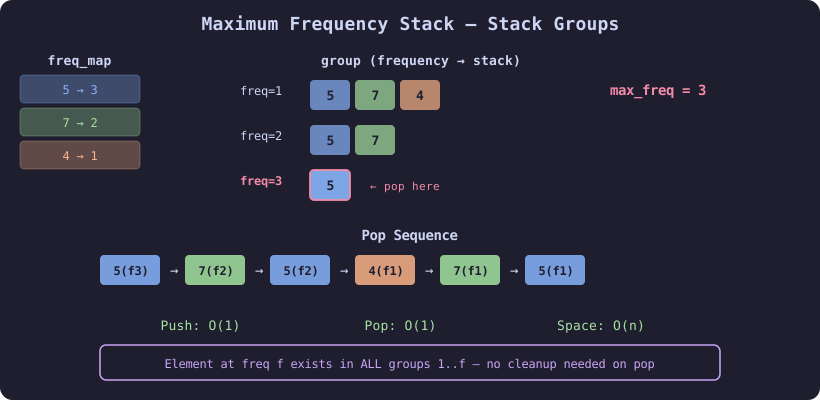
Maximum Frequency Stack (LeetCode 895) asks you to design a stack-like structure where pop removes the most frequent element. If there is a tie, pop the one closest to the top (most recently pushed among the most frequent).
The Problem
push(5), push(7), push(5), push(7), push(4), push(5)

pop() → 5  (freq 3, most frequent)
pop() → 7  (freq 2, tied with 5; 7 was pushed more recently at freq 2)
pop() → 5  (freq 2, most frequent now)
pop() → 4  (freq 1, all tied; 4 was most recently pushed)
The Key Insight: Stack Groups by Frequency
Instead of one big stack, maintain one stack per frequency level:
freq_map: element → current frequencygroup: frequency → stack of elements at that frequencymax_freq: the current maximum frequency
When we push element x:
- Increment its frequency in
freq_map - Push it onto
group[new_freq] - Update
max_freqif needed
When we pop:
- Pop from
group[max_freq] - Decrement its frequency in
freq_map - If
group[max_freq]is now empty, decrementmax_freq
This gives us O(1) for both push and pop.
Implementation
from collections import defaultdict

class FreqStack:
    """
    Maximum Frequency Stack — O(1) push and pop.
    Uses frequency → stack mapping.
    """
    def __init__(self):
        self.freq_map = defaultdict(int)  # element → frequency
        self.group = defaultdict(list)     # frequency → stack
        self.max_freq = 0

    def push(self, val: int) -> None:
        # Increment frequency
        self.freq_map[val] += 1
        freq = self.freq_map[val]

        # Push onto the stack for this frequency
        self.group[freq].append(val)

        # Update max frequency
        self.max_freq = max(self.max_freq, freq)

    def pop(self) -> int:
        # Pop from the most frequent group
        val = self.group[self.max_freq].pop()

        # Decrement frequency
        self.freq_map[val] -= 1

        # If this frequency group is empty, lower max_freq
        if not self.group[self.max_freq]:
            self.max_freq -= 1

        return val
Step-by-Step Trace
Operation         freq_map              group                       max_freq
─────────────────────────────────────────────────────────────────────────────
push(5)          {5:1}                 {1:[5]}                      1
push(7)          {5:1, 7:1}            {1:[5,7]}                    1
push(5)          {5:2, 7:1}            {1:[5,7], 2:[5]}             2
push(7)          {5:2, 7:2}            {1:[5,7], 2:[5,7]}           2
push(4)          {5:2, 7:2, 4:1}       {1:[5,7,4], 2:[5,7]}         2
push(5)          {5:3, 7:2, 4:1}       {1:[5,7,4], 2:[5,7], 3:[5]}  3

pop() → 5        {5:2, 7:2, 4:1}       {1:[5,7,4], 2:[5,7]}         2
  (popped from group[3], group[3] empty → max_freq = 2)

pop() → 7        {5:2, 7:1, 4:1}       {1:[5,7,4], 2:[5]}           2
  (popped from group[2], 7 was on top)

pop() → 5        {5:1, 7:1, 4:1}       {1:[5,7,4]}                  1
  (popped from group[2], group[2] empty → max_freq = 1)

pop() → 4        {5:1, 7:1, 4:0}       {1:[5,7]}                    1
  (popped from group[1], 4 was on top)
Why Not a Max-Heap?
A heap-based approach would store (frequency, push_order, value) tuples:
import heapq

class FreqStackHeap:
    """Heap approach — O(log n) push and pop."""
    def __init__(self):
        self.heap = []  # max-heap: (-freq, -order, val)
        self.freq_map = defaultdict(int)
        self.order = 0

    def push(self, val):
        self.freq_map[val] += 1
        heapq.heappush(self.heap,
            (-self.freq_map[val], -self.order, val))
        self.order += 1

    def pop(self):
        _, _, val = heapq.heappop(self.heap)
        self.freq_map[val] -= 1
        return val
This works but is O(log n) per operation. The stack-group approach is O(1).
| Approach | Push | Pop | Space |
|---|---|---|---|
| Stack groups | O(1) | O(1) | O(n) |
| Max-heap | O(log n) | O(log n) | O(n) |
Why the Stack-Group Trick Works
The critical insight is that an element with frequency f also existed at frequencies 1, 2, ..., f-1. So it appears in all groups from 1 to f. When we pop it from group f, it still exists in groups 1 through f-1. We do not need to remove it from lower groups — it will naturally be popped from there when max_freq drops.
This is why we only decrement freq_map[val] on pop, not remove from all groups.
Complexity Analysis
| Operation | Time | Space |
|---|---|---|
| push | O(1) | O(n) total across all operations |
| pop | O(1) | — |
The total space is O(n) where n is the total number of push operations, because each push adds exactly one entry to group.
Edge Cases
fs = FreqStack()

# Single element pushed multiple times
fs.push(1); fs.push(1); fs.push(1)
assert fs.pop() == 1  # freq 3 → 2
assert fs.pop() == 1  # freq 2 → 1
assert fs.pop() == 1  # freq 1 → 0

# All elements have the same frequency → LIFO order
fs2 = FreqStack()
fs2.push(1); fs2.push(2); fs2.push(3)
assert fs2.pop() == 3  # all freq 1, most recent
assert fs2.pop() == 2
assert fs2.pop() == 1
When to Use This Pattern
Use frequency-based stack grouping when:
- You need to track frequency alongside recency (stack order)
- The problem requires O(1) operations on a frequency-priority structure
- You see “most frequent” + “most recent tiebreaker” in the problem
Common Mistakes
- Trying to remove from all groups on pop — only pop from
max_freqgroup - Forgetting to decrement
max_freqwhen the top group becomes empty - Using a heap instead — works but loses the O(1) guarantee
Related Problems
| Problem | Key Difference |
|---|---|
| LFU Cache (LC 460) | Similar frequency tracking but with eviction |
| Min Stack (LC 155) | Track min instead of frequency |
| Stack with Increment (LC 1381) | Stack with lazy increment |
| Top K Frequent Elements (LC 347) | Frequency counting, different output |
Key Takeaways
- The Maximum Frequency Stack uses one stack per frequency level — a powerful design trick
- Both push and pop are O(1) because we only touch the
max_freqgroup - Elements naturally exist in multiple frequency groups; no cleanup needed on pop
- This pattern (grouping by frequency + stack) appears in LFU cache designs too
Related articles
- DSA Design Front Middle Back Queue — Two Deques (LeetCode 1670)
Design Front Middle Back Queue using two balanced deques. Python solution with O(1) operations, step-by-step trace, and complexity analysis for LeetCode 1670.
- DSA 132 Pattern — Monotonic Stack with Reverse Traversal (LeetCode 456)
Solve the 132 Pattern problem using a monotonic stack scanning right to left. Python solution tracking s3 candidates and s2 maximum, with detailed trace.
- DSA Basic Calculator I, II, III — Complete Expression Evaluation Guide
Solve Basic Calculator problems LeetCode 224, 227, and 772. Master stack-based expression evaluation with +, -, *, /, and parentheses in Python.
- DSA Flatten Nested List Iterator — Lazy Stack Design (LeetCode 341)
Design a Flatten Nested List Iterator using a stack for lazy flattening. Python solution with iterator protocol, step-by-step trace, and design analysis.