Recursion to Iteration: Converting Recursive Code
Learn to convert recursive algorithms to iterative ones. Covers tail recursion, explicit stacks, iterative tree traversals, Morris traversal, and memoization as a bridge to DP.
What you'll learn
- ✓Why and when to convert recursion to iteration
- ✓Tail recursion and simple loop conversion
- ✓Using an explicit stack to simulate the call stack
- ✓Iterative tree traversals: inorder, preorder, postorder
- ✓Memoization as a bridge from recursion to dynamic programming
Prerequisites
- •Recursion: [Recursion Fundamentals](/blog/recursion-fundamentals)
- •Stacks: [Stack Data Structure](/blog/stack-data-structure)
- •Big-O: [Big-O Notation Explained](/blog/big-o-notation-explained)
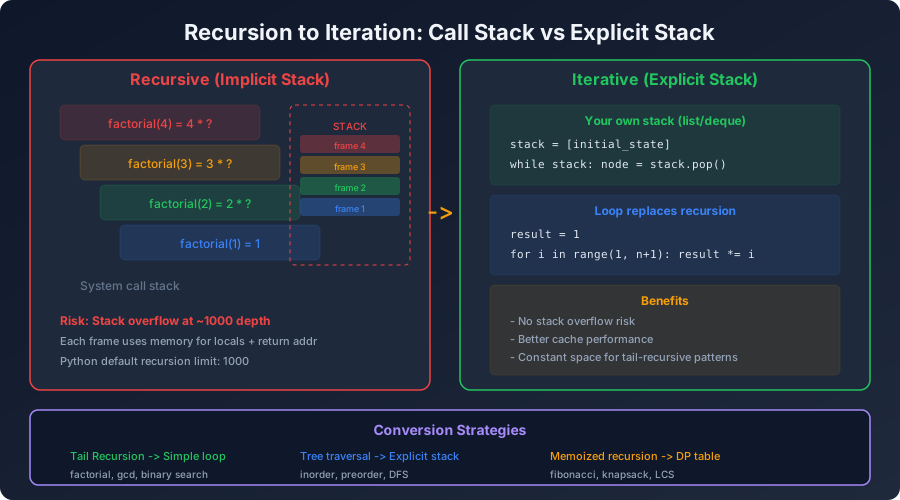
Recursion is elegant and intuitive for many problems, but it has practical limitations: stack overflow for deep recursion, function call overhead, and difficulty with certain optimizations. Knowing how to convert recursive code to iterative code is a fundamental skill that unlocks better performance and handles edge cases that recursion cannot.
Why convert recursion to iteration?
Stack overflow risk
Python has a default recursion limit of 1000. Processing a linked list of 10,000 nodes recursively will crash:
import sys
print(sys.getrecursionlimit())  # 1000

# This WILL crash for large inputs:
def sum_list_recursive(node):
    if node is None:
        return 0
    return node.val + sum_list_recursive(node.next)

# This NEVER crashes:
def sum_list_iterative(node):
    total = 0
    while node:
        total += node.val
        node = node.next
    return total
Performance overhead
Each function call creates a stack frame with local variables, return address, and parameters. Iterative solutions avoid this overhead:
import time

def fib_recursive(n):
    if n <= 1:
        return n
    return fib_recursive(n - 1) + fib_recursive(n - 2)

def fib_iterative(n):
    if n <= 1:
        return n
    a, b = 0, 1
    for _ in range(2, n + 1):
        a, b = b, a + b
    return b

# fib_recursive(35) takes seconds
# fib_iterative(35) takes microseconds
Memory efficiency
Recursive DFS on a graph with 1 million nodes uses 1 million stack frames. Iterative DFS with an explicit stack uses the same memory but does not risk hitting the system stack limit.
Strategy 1: tail recursion to simple loop
Tail recursion is when the recursive call is the very last operation in the function. There is nothing to do after the recursive call returns.
# TAIL RECURSIVE
def factorial_tail(n, accumulator=1):
    if n <= 1:
        return accumulator
    return factorial_tail(n - 1, n * accumulator)  # Last operation

# NOT tail recursive
def factorial_normal(n):
    if n <= 1:
        return 1
    return n * factorial_normal(n - 1)  # Must multiply AFTER return
Tail recursive functions convert directly to loops because there is no work left after the recursive call:
# Tail recursive -> Loop
def factorial_iterative(n):
    accumulator = 1
    while n > 1:
        accumulator *= n
        n -= 1
    return accumulator

print(factorial_iterative(10))  # 3628800
More tail recursion conversions
GCD (Euclidean algorithm):
# Recursive (already tail recursive)
def gcd_recursive(a, b):
    if b == 0:
        return a
    return gcd_recursive(b, a % b)

# Iterative
def gcd_iterative(a, b):
    while b != 0:
        a, b = b, a % b
    return a

print(gcd_iterative(48, 18))  # 6
Binary search:
# Recursive
def binary_search_recursive(arr, target, left, right):
    if left > right:
        return -1
    mid = (left + right) // 2
    if arr[mid] == target:
        return mid
    elif arr[mid] < target:
        return binary_search_recursive(arr, target, mid + 1, right)
    else:
        return binary_search_recursive(arr, target, left, mid - 1)

# Iterative
def binary_search_iterative(arr, target):
    left, right = 0, len(arr) - 1
    while left <= right:
        mid = (left + right) // 2
        if arr[mid] == target:
            return mid
        elif arr[mid] < target:
            left = mid + 1
        else:
            right = mid - 1
    return -1

arr = [1, 3, 5, 7, 9, 11]
print(binary_search_iterative(arr, 7))  # 3
Power function:
# Recursive (tail with accumulator)
def power_recursive(base, exp, acc=1):
    if exp == 0:
        return acc
    if exp % 2 == 0:
        return power_recursive(base * base, exp // 2, acc)
    return power_recursive(base, exp - 1, acc * base)

# Iterative
def power_iterative(base, exp):
    result = 1
    while exp > 0:
        if exp % 2 == 1:
            result *= base
        base *= base
        exp //= 2
    return result

print(power_iterative(2, 10))  # 1024
Strategy 2: explicit stack
When recursion is not tail recursive, you need an explicit stack to simulate the call stack. The key insight: the system call stack stores the same information you can store in your own stack.
General conversion pattern
# Recursive version
def process_recursive(data):
    if base_case(data):
        return base_result

    # pre-processing
    result = process_recursive(smaller_data)
    # post-processing using result

    return final_result

# Iterative version with explicit stack
def process_iterative(data):
    stack = [initial_state]
    result = None

    while stack:
        state = stack.pop()

        if base_case(state):
            # Handle base case
            continue

        # Push states that need processing
        # Push in REVERSE order (stack is LIFO)
        stack.append(next_state)
Example: reverse a linked list
class ListNode:
    def __init__(self, val=0, next=None):
        self.val = val
        self.next = next


# Recursive
def reverse_recursive(head):
    if head is None or head.next is None:
        return head

    new_head = reverse_recursive(head.next)
    head.next.next = head
    head.next = None
    return new_head


# Iterative
def reverse_iterative(head):
    prev = None
    curr = head

    while curr:
        next_node = curr.next
        curr.next = prev
        prev = curr
        curr = next_node

    return prev
Example: flatten nested list
# Recursive
def flatten_recursive(nested):
    result = []
    for item in nested:
        if isinstance(item, list):
            result.extend(flatten_recursive(item))
        else:
            result.append(item)
    return result


# Iterative with explicit stack
def flatten_iterative(nested):
    stack = [nested]
    result = []

    while stack:
        current = stack.pop()

        if isinstance(current, list):
            # Push elements in reverse so first element is processed first
            for item in reversed(current):
                stack.append(item)
        else:
            result.append(current)

    return result


nested = [1, [2, [3, 4], 5], [6, 7]]
print(flatten_recursive(nested))   # [1, 2, 3, 4, 5, 6, 7]
print(flatten_iterative(nested))   # [1, 2, 3, 4, 5, 6, 7]
Strategy 3: iterative tree traversals
Tree traversals are the most common recursion-to-iteration conversion asked in interviews.
Preorder traversal (root, left, right)
class TreeNode:
    def __init__(self, val=0, left=None, right=None):
        self.val = val
        self.left = left
        self.right = right


# Recursive
def preorder_recursive(root):
    if not root:
        return []
    return ([root.val] +
            preorder_recursive(root.left) +
            preorder_recursive(root.right))


# Iterative
def preorder_iterative(root):
    """
    Iterative preorder using explicit stack.
    Push right first, then left (stack is LIFO).
    """
    if not root:
        return []

    result = []
    stack = [root]

    while stack:
        node = stack.pop()
        result.append(node.val)

        # Push right first so left is processed first
        if node.right:
            stack.append(node.right)
        if node.left:
            stack.append(node.left)

    return result
Inorder traversal (left, root, right)
This is trickier because we must process the left subtree before the current node.
# Iterative inorder
def inorder_iterative(root):
    """
    Go left as far as possible, process node, then go right.
    Time: O(n), Space: O(h) where h = height
    """
    result = []
    stack = []
    current = root

    while current or stack:
        # Go to the leftmost node
        while current:
            stack.append(current)
            current = current.left

        # Process the node
        current = stack.pop()
        result.append(current.val)

        # Move to right subtree
        current = current.right

    return result
Postorder traversal (left, right, root)
The trickiest of the three. Two approaches:
# Method 1: Modified preorder + reverse
def postorder_two_stacks(root):
    """
    Do a modified preorder (root, right, left) and reverse.
    """
    if not root:
        return []

    result = []
    stack = [root]

    while stack:
        node = stack.pop()
        result.append(node.val)

        # Push left first, then right (opposite of preorder)
        if node.left:
            stack.append(node.left)
        if node.right:
            stack.append(node.right)

    return result[::-1]


# Method 2: Single stack with visited tracking
def postorder_single_stack(root):
    """
    Track the previously processed node to determine
    if we should process current or go deeper.
    """
    if not root:
        return []

    result = []
    stack = [root]
    prev = None

    while stack:
        current = stack[-1]

        # Going down: push children
        if prev is None or prev.left == current or prev.right == current:
            if current.left:
                stack.append(current.left)
            elif current.right:
                stack.append(current.right)
            else:
                result.append(stack.pop().val)
        # Coming up from left: go right or process
        elif current.left == prev:
            if current.right:
                stack.append(current.right)
            else:
                result.append(stack.pop().val)
        # Coming up from right: process
        else:
            result.append(stack.pop().val)

        prev = current

    return result
Morris traversal (O(1) space inorder)
Morris traversal achieves O(1) space by temporarily modifying tree pointers. No stack or recursion needed.
def morris_inorder(root):
    """
    Inorder traversal with O(1) extra space.
    Temporarily creates threads (links) back to the inorder successor.
    Time: O(n), Space: O(1)
    """
    result = []
    current = root

    while current:
        if current.left is None:
            # No left subtree: process and go right
            result.append(current.val)
            current = current.right
        else:
            # Find the inorder predecessor (rightmost in left subtree)
            predecessor = current.left
            while predecessor.right and predecessor.right != current:
                predecessor = predecessor.right

            if predecessor.right is None:
                # Create thread: link predecessor back to current
                predecessor.right = current
                current = current.left
            else:
                # Thread exists: we've returned via the thread
                # Remove thread and process current
                predecessor.right = None
                result.append(current.val)
                current = current.right

    return result
Strategy 4: DFS iterative
Graph DFS converts naturally to an iterative approach with an explicit stack.
# Recursive DFS
def dfs_recursive(graph, start, visited=None):
    if visited is None:
        visited = set()
    visited.add(start)
    result = [start]

    for neighbor in graph[start]:
        if neighbor not in visited:
            result.extend(dfs_recursive(graph, neighbor, visited))

    return result


# Iterative DFS
def dfs_iterative(graph, start):
    visited = set()
    stack = [start]
    result = []

    while stack:
        node = stack.pop()
        if node in visited:
            continue

        visited.add(node)
        result.append(node)

        # Push neighbors (reverse for consistent order with recursive)
        for neighbor in reversed(graph[node]):
            if neighbor not in visited:
                stack.append(neighbor)

    return result


graph = {
    'A': ['B', 'C'],
    'B': ['D', 'E'],
    'C': ['F'],
    'D': [], 'E': [], 'F': []
}
print(dfs_recursive(graph, 'A'))  # ['A', 'B', 'D', 'E', 'C', 'F']
print(dfs_iterative(graph, 'A'))  # ['A', 'B', 'D', 'E', 'C', 'F']
Strategy 5: memoization as a bridge to DP
Memoized recursion (top-down DP) can be converted to iterative bottom-up DP. This eliminates recursion entirely and often improves cache performance.
Fibonacci: recursion to memoization to tabulation
# Step 1: Naive recursion - O(2^n) time
def fib_naive(n):
    if n <= 1:
        return n
    return fib_naive(n - 1) + fib_naive(n - 2)


# Step 2: Memoized recursion (top-down DP) - O(n) time, O(n) space
def fib_memo(n, memo={}):
    if n in memo:
        return memo[n]
    if n <= 1:
        return n
    memo[n] = fib_memo(n - 1, memo) + fib_memo(n - 2, memo)
    return memo[n]


# Step 3: Iterative tabulation (bottom-up DP) - O(n) time, O(n) space
def fib_table(n):
    if n <= 1:
        return n
    dp = [0] * (n + 1)
    dp[1] = 1
    for i in range(2, n + 1):
        dp[i] = dp[i - 1] + dp[i - 2]
    return dp[n]


# Step 4: Space-optimized iteration - O(n) time, O(1) space
def fib_optimized(n):
    if n <= 1:
        return n
    a, b = 0, 1
    for _ in range(2, n + 1):
        a, b = b, a + b
    return b


print(fib_optimized(50))  # 12586269025
Climbing stairs
# Recursive (with memoization)
def climb_stairs_memo(n, memo={}):
    if n in memo:
        return memo[n]
    if n <= 2:
        return n
    memo[n] = climb_stairs_memo(n - 1, memo) + climb_stairs_memo(n - 2, memo)
    return memo[n]


# Iterative
def climb_stairs_iterative(n):
    if n <= 2:
        return n
    a, b = 1, 2
    for _ in range(3, n + 1):
        a, b = b, a + b
    return b


print(climb_stairs_iterative(10))  # 89
Coin change
# Recursive with memoization
def coin_change_memo(coins, amount):
    memo = {}

    def dp(remaining):
        if remaining in memo:
            return memo[remaining]
        if remaining == 0:
            return 0
        if remaining < 0:
            return float('inf')

        result = float('inf')
        for coin in coins:
            result = min(result, 1 + dp(remaining - coin))

        memo[remaining] = result
        return result

    ans = dp(amount)
    return ans if ans != float('inf') else -1


# Iterative bottom-up
def coin_change_iterative(coins, amount):
    dp = [float('inf')] * (amount + 1)
    dp[0] = 0

    for a in range(1, amount + 1):
        for coin in coins:
            if coin <= a:
                dp[a] = min(dp[a], dp[a - coin] + 1)

    return dp[amount] if dp[amount] != float('inf') else -1


print(coin_change_iterative([1, 5, 10, 25], 36))  # 3 (25 + 10 + 1)
Conversion decision guide
| Recursion Type | Conversion Strategy | Difficulty |
|---|---|---|
| Tail recursion | Replace with while loop | Easy |
| Linear recursion (one call) | Explicit stack or loop | Easy |
| Binary recursion (two calls) | Explicit stack | Medium |
| Tree/graph DFS | Stack-based iteration | Medium |
| Backtracking | Stack with state objects | Hard |
| Mutual recursion | State machine | Hard |
| Memoized recursion | Bottom-up DP table | Medium |
Common pitfalls
Pitfall 1: Forgetting to reverse push order for stacks.
# Stack is LIFO. To process children left-to-right:
# Push RIGHT first, then LEFT
stack.append(node.right)  # Pushed first, popped last
stack.append(node.left)   # Pushed last, popped first
Pitfall 2: Not handling the “work after recursive call” case.
# When there's work to do AFTER the recursive call,
# you need to push a "continuation" onto the stack
# or use the two-stack approach for postorder.
Pitfall 3: Infinite loops from not marking visited nodes.
# Always check visited BEFORE pushing to stack (graph DFS)
if neighbor not in visited:
    stack.append(neighbor)
Practice problems
| Problem | Conversion Type | Difficulty |
|---|---|---|
| Factorial | Tail recursion -> loop | Easy |
| Fibonacci | Memo -> DP table | Easy |
| Binary Search | Tail recursion -> loop | Easy |
| Reverse Linked List (LC 206) | Linear -> iterative | Easy |
| Inorder Traversal (LC 94) | Binary -> stack | Medium |
| Flatten Nested List (LC 341) | Stack-based | Medium |
| DFS on graph | Stack-based | Medium |
| Postorder Traversal (LC 145) | Two stacks | Medium |
| Coin Change (LC 322) | Memo -> tabulation | Medium |
| Morris Inorder Traversal | Threading (no stack) | Hard |
Key takeaways
- Tail recursion converts directly to a while loop. Look for recursive calls that are the last operation.
- Non-tail recursion needs an explicit stack. Push states in reverse order (LIFO).
- Tree traversals have standard iterative patterns. Inorder uses the “go left, process, go right” pattern. Morris traversal achieves O(1) space.
- Memoized recursion naturally converts to bottom-up DP by filling a table in dependency order.
- Always prefer iterative for production code that might handle large inputs. Python’s 1000-call recursion limit is a real constraint.
Related articles
- DSA Moving Average from Data Stream Using Queue
Calculate the moving average from a data stream using a queue with fixed window size. LeetCode 346 solution with O(1) per operation.
- DSA DSA Interview Checklist: 75 Must-Know Problems
The complete DSA interview checklist — 75 essential problems organized by pattern, study schedules for 4, 8, and 12 weeks, a pattern recognition framework, and what interviewers actually look for.
- DSA Queues and Deques: FIFO, Double-Ended, and Circular
Master queue variants — simple queue, deque, circular queue, and priority queue. Implementations in Python with BFS, sliding window, and scheduling examples.
- DSA Heap and Priority Queue: The Data Structure Behind Top-K
Learn how heaps power priority queues, why heapq runs push and pop in O(log n), and how to solve classic Top-K and merge problems in Python.