DSA Interview Checklist: 75 Must-Know Problems
The complete DSA interview checklist — 75 essential problems organized by pattern, study schedules for 4, 8, and 12 weeks, a pattern recognition framework, and what interviewers actually look for.
What you'll learn
- ✓75 must-know problems organized by pattern and data structure
- ✓How to build a 4-week, 8-week, or 12-week study schedule
- ✓A framework for recognizing which pattern to apply to unknown problems
- ✓Common mistakes that cost offers — and how to avoid them
- ✓What interviewers actually evaluate beyond correctness
Prerequisites
- •Basic programming in any language (examples use Python)
- •Familiarity with what DSA is and why it matters
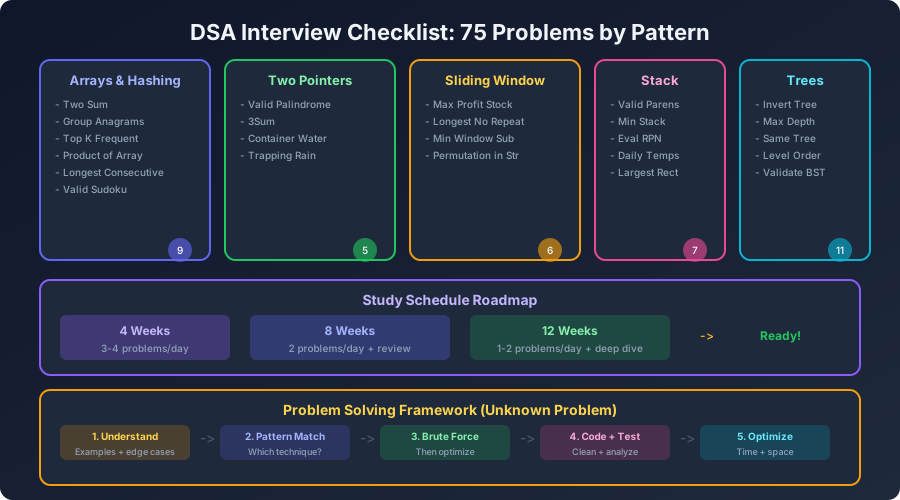
Preparing for coding interviews without a checklist is like studying for an exam without a syllabus. You end up solving random problems, spending weeks on niche topics, and missing the patterns that actually show up. This post gives you the complete checklist: 75 problems, organized by pattern, with study schedules and a framework for tackling problems you have never seen before.
The 75 Must-Know Problems
These problems are curated for maximum coverage. Each one teaches a reusable pattern. Solving all 75 means you have seen every major pattern that appears in FAANG-level interviews.
Arrays and Hashing (10 problems)
| # | Problem | Difficulty | LeetCode | Key Pattern |
|---|---|---|---|---|
| 1 | Two Sum | Easy | #1 | Hash map lookup |
| 2 | Valid Anagram | Easy | #242 | Frequency count |
| 3 | Group Anagrams | Medium | #49 | Sorted key + hash map |
| 4 | Top K Frequent Elements | Medium | #347 | Bucket sort / heap |
| 5 | Product of Array Except Self | Medium | #238 | Prefix/suffix products |
| 6 | Longest Consecutive Sequence | Medium | #128 | Hash set + sequence start |
| 7 | Contains Duplicate | Easy | #217 | Hash set |
| 8 | Encode and Decode Strings | Medium | #271 | Length prefix encoding |
| 9 | Maximum Subarray | Medium | #53 | Kadane’s algorithm |
| 10 | Subarray Sum Equals K | Medium | #560 | Prefix sum + hash map |
Two Pointers (5 problems)
| # | Problem | Difficulty | LeetCode | Key Pattern |
|---|---|---|---|---|
| 11 | Valid Palindrome | Easy | #125 | Two pointers inward |
| 12 | 3Sum | Medium | #15 | Sort + two pointers |
| 13 | Container With Most Water | Medium | #11 | Shrink the shorter side |
| 14 | Trapping Rain Water | Hard | #42 | Left/right max pointers |
| 15 | Two Sum II (Sorted) | Medium | #167 | Two pointers on sorted |
Sliding Window (5 problems)
| # | Problem | Difficulty | LeetCode | Key Pattern |
|---|---|---|---|---|
| 16 | Best Time to Buy/Sell Stock | Easy | #121 | Track min so far |
| 17 | Longest Substring Without Repeating | Medium | #3 | Expand/shrink window |
| 18 | Longest Repeating Character Replacement | Medium | #424 | Window + max freq |
| 19 | Minimum Window Substring | Hard | #76 | Two hash maps + window |
| 20 | Sliding Window Maximum | Hard | #239 | Monotonic deque |
Stack (5 problems)
| # | Problem | Difficulty | LeetCode | Key Pattern |
|---|---|---|---|---|
| 21 | Valid Parentheses | Easy | #20 | Stack matching |
| 22 | Min Stack | Medium | #155 | Auxiliary min stack |
| 23 | Daily Temperatures | Medium | #739 | Monotonic stack |
| 24 | Largest Rectangle in Histogram | Hard | #84 | Monotonic stack |
| 25 | Evaluate Reverse Polish Notation | Medium | #150 | Stack evaluation |
Binary Search (5 problems)
| # | Problem | Difficulty | LeetCode | Key Pattern |
|---|---|---|---|---|
| 26 | Binary Search | Easy | #704 | Classic template |
| 27 | Search in Rotated Sorted Array | Medium | #33 | Find sorted half |
| 28 | Find Minimum in Rotated Sorted Array | Medium | #153 | Pivot detection |
| 29 | Koko Eating Bananas | Medium | #875 | BS on answer |
| 30 | Search a 2D Matrix | Medium | #74 | Flatten to 1D |
Linked Lists (6 problems)
| # | Problem | Difficulty | LeetCode | Key Pattern |
|---|---|---|---|---|
| 31 | Reverse Linked List | Easy | #206 | Three-pointer reversal |
| 32 | Merge Two Sorted Lists | Easy | #21 | Dummy head + merge |
| 33 | Linked List Cycle | Easy | #141 | Fast/slow pointers |
| 34 | Remove Nth Node From End | Medium | #19 | Two-pass or gap pointers |
| 35 | Reorder List | Medium | #143 | Split + reverse + merge |
| 36 | LRU Cache | Medium | #146 | Hash map + doubly linked list |
Trees (10 problems)
| # | Problem | Difficulty | LeetCode | Key Pattern |
|---|---|---|---|---|
| 37 | Invert Binary Tree | Easy | #226 | Recursive swap |
| 38 | Maximum Depth of Binary Tree | Easy | #104 | DFS depth |
| 39 | Same Tree | Easy | #100 | Simultaneous DFS |
| 40 | Subtree of Another Tree | Easy | #572 | DFS + same tree check |
| 41 | Lowest Common Ancestor of BST | Medium | #235 | BST property split |
| 42 | Binary Tree Level Order Traversal | Medium | #102 | BFS with queue |
| 43 | Validate BST | Medium | #98 | In-order or range check |
| 44 | Kth Smallest Element in BST | Medium | #230 | In-order traversal |
| 45 | Binary Tree from Preorder/Inorder | Medium | #105 | Recursive construction |
| 46 | Serialize and Deserialize Binary Tree | Hard | #297 | BFS or preorder + null markers |
Heap / Priority Queue (3 problems)
| # | Problem | Difficulty | LeetCode | Key Pattern |
|---|---|---|---|---|
| 47 | Find Median from Data Stream | Hard | #295 | Two heaps |
| 48 | Merge K Sorted Lists | Hard | #23 | Min-heap of heads |
| 49 | Top K Frequent Words | Medium | #692 | Min-heap of size k |
Backtracking (5 problems)
| # | Problem | Difficulty | LeetCode | Key Pattern |
|---|---|---|---|---|
| 50 | Subsets | Medium | #78 | Include/exclude |
| 51 | Combination Sum | Medium | #39 | Backtrack with reuse |
| 52 | Permutations | Medium | #46 | Swap-based backtrack |
| 53 | Word Search | Medium | #79 | Grid DFS + visited |
| 54 | Letter Combinations of Phone | Medium | #17 | Cartesian product |
Graphs (8 problems)
| # | Problem | Difficulty | LeetCode | Key Pattern |
|---|---|---|---|---|
| 55 | Number of Islands | Medium | #200 | BFS/DFS flood fill |
| 56 | Clone Graph | Medium | #133 | BFS + hash map |
| 57 | Pacific Atlantic Water Flow | Medium | #417 | Reverse BFS from edges |
| 58 | Course Schedule | Medium | #207 | Topological sort (cycle) |
| 59 | Course Schedule II | Medium | #210 | Topological sort (order) |
| 60 | Graph Valid Tree | Medium | #261 | Union-Find or DFS |
| 61 | Number of Connected Components | Medium | #323 | Union-Find |
| 62 | Word Ladder | Hard | #127 | BFS shortest path |
Dynamic Programming (10 problems)
| # | Problem | Difficulty | LeetCode | Key Pattern |
|---|---|---|---|---|
| 63 | Climbing Stairs | Easy | #70 | Fibonacci DP |
| 64 | House Robber | Medium | #198 | Take/skip DP |
| 65 | House Robber II | Medium | #213 | Circular array DP |
| 66 | Longest Increasing Subsequence | Medium | #300 | DP + binary search |
| 67 | Coin Change | Medium | #322 | Unbounded knapsack |
| 68 | Word Break | Medium | #139 | DP + hash set |
| 69 | Unique Paths | Medium | #62 | Grid DP |
| 70 | Decode Ways | Medium | #91 | 1D DP with conditions |
| 71 | Longest Common Subsequence | Medium | #1143 | 2D string DP |
| 72 | Edit Distance | Medium | #72 | 2D string DP |
Intervals and Greedy (3 problems)
| # | Problem | Difficulty | LeetCode | Key Pattern |
|---|---|---|---|---|
| 73 | Merge Intervals | Medium | #56 | Sort + merge overlaps |
| 74 | Non-Overlapping Intervals | Medium | #435 | Greedy earliest end |
| 75 | Meeting Rooms II | Medium | #253 | Min-heap or sweep line |
Study Schedules
4-Week Sprint (Tight Deadline)
For those with < 1 month to prepare. Solve 3-4 problems per day, focusing on the most common patterns.
schedule_4_week = {
    "Week 1: Foundations": [
        "Day 1-2: Arrays + Hashing (#1-10)",
        "Day 3: Two Pointers (#11-15)",
        "Day 4: Sliding Window (#16-20)",
        "Day 5: Stack (#21-25)",
        "Day 6: Binary Search (#26-30)",
        "Day 7: Review + revisit weak spots",
    ],
    "Week 2: Data Structures": [
        "Day 1: Linked Lists (#31-36)",
        "Day 2-3: Trees (#37-46)",
        "Day 4: Heaps (#47-49)",
        "Day 5: Backtracking (#50-54)",
        "Day 6-7: Review + mock interview",
    ],
    "Week 3: Graphs + DP": [
        "Day 1-2: Graphs (#55-62)",
        "Day 3-5: Dynamic Programming (#63-72)",
        "Day 6: Intervals (#73-75)",
        "Day 7: Review all patterns",
    ],
    "Week 4: Polish": [
        "Day 1-3: Redo problems you struggled with",
        "Day 4-5: Timed mock interviews (45 min each)",
        "Day 6: System design review (if applicable)",
        "Day 7: Rest and light review",
    ],
}
8-Week Standard Plan
The sweet spot for most candidates. Solve 2 problems per day with deeper understanding.
schedule_8_week = {
    "Weeks 1-2": "Arrays, Hashing, Two Pointers, Sliding Window (20 problems)",
    "Weeks 3-4": "Stack, Binary Search, Linked Lists, Trees (21 problems)",
    "Weeks 5-6": "Heaps, Backtracking, Graphs (16 problems)",
    "Weeks 7-8": "DP, Intervals, review, and mock interviews (18 problems)",
}
12-Week Deep Dive
For career changers or those starting from scratch. 1-2 problems per day with time for theory.
schedule_12_week = {
    "Weeks 1-3": "Learn data structures + solve Easy problems",
    "Weeks 4-6": "Arrays, Strings, Linked Lists, Trees (patterns + Medium)",
    "Weeks 7-9": "Graphs, DP, Binary Search (core Medium/Hard)",
    "Weeks 10-11": "Mock interviews, company-specific problems",
    "Week 12": "Review, rest, confidence building",
}
Pattern Recognition Framework
When you see an unknown problem, run through this decision tree.
Step 1: What Are You Given?
def identify_input(problem):
    """
    First, classify the input type.
    """
    input_patterns = {
        "Sorted array": "Binary search or two pointers",
        "Unsorted array": "Hash map, sorting, or sliding window",
        "String": "Hash map, two pointers, or DP",
        "Linked list": "Two pointers (fast/slow)",
        "Tree": "DFS or BFS",
        "Graph": "BFS, DFS, or Union-Find",
        "Matrix/Grid": "BFS/DFS or DP",
        "Set of choices": "Backtracking or DP",
    }
    return input_patterns
Step 2: What Are You Asked For?
| Asked For | Likely Pattern |
|---|---|
| ”Find a pair/triplet” | Two pointers or hash map |
| ”Longest/shortest substring” | Sliding window |
| ”All permutations/subsets” | Backtracking |
| ”Minimum/maximum of something” | DP, binary search, or greedy |
| ”Is it possible?” | BFS/DFS or DP |
| ”Count the number of ways” | DP |
| ”Shortest path” | BFS (unweighted) or Dijkstra (weighted) |
| “Connected components” | Union-Find or DFS |
| ”Top K elements” | Heap |
| ”Order of tasks” | Topological sort |
Step 3: Recognize Sub-Patterns
def recognize_pattern(problem_clues):
    """
    Common clue words and their patterns.
    """
    clue_to_pattern = {
        "contiguous subarray": "Sliding window or prefix sum",
        "subsequence": "DP (often 2D)",
        "parentheses/brackets": "Stack",
        "next greater/smaller": "Monotonic stack",
        "k-th largest/smallest": "Heap or quickselect",
        "intervals overlap": "Sort by start, merge or sweep line",
        "minimize the maximum": "Binary search on answer",
        "maximize the minimum": "Binary search on answer",
        "at most k distinct": "Sliding window + hash map",
        "all paths/combinations": "Backtracking (DFS)",
        "optimal substructure": "DP",
    }
    return clue_to_pattern
The 5-Minute Rule
If you cannot identify the pattern in 5 minutes:
- Try brute force first — write the O(n^2) or O(2^n) solution
- Ask: what work is repeated? — that reveals the optimization
- Ask: is there a monotonic property? — that reveals binary search or stack
- Ask: can I break this into subproblems? — that reveals DP
Common Mistakes That Cost Offers
Mistake 1: Jumping to Code Too Fast
Wrong: Read problem, immediately start coding.
Right: Spend 3-5 minutes on examples, edge cases, and approach discussion before writing a single line.
# The interview framework:
# 1. Clarify (1-2 min): constraints, edge cases, input format
# 2. Examples (2-3 min): walk through 2-3 examples by hand
# 3. Approach (2-3 min): explain your algorithm, state complexity
# 4. Code (15-20 min): write clean code
# 5. Test (5 min): trace through your code with examples
# 6. Optimize (if time): discuss improvements
Mistake 2: Not Handling Edge Cases
Always check these before submitting:
- Empty input (
[],"",None) - Single element
- All elements the same
- Already sorted / reverse sorted
- Negative numbers
- Integer overflow (less common in Python)
- Input at constraint boundaries
def safe_solution(nums):
    # ALWAYS handle edge cases first
    if not nums:
        return 0
    if len(nums) == 1:
        return nums[0]
    # ... main logic
Mistake 3: Ignoring Time Complexity
Wrong: “My solution works!” (but it is O(n^3) on n = 10^5)
Right: Check constraints first.
# Rough guide for what passes in ~1 second:
# n <= 10:       O(n!) or O(2^n) is fine
# n <= 20:       O(2^n) is fine
# n <= 500:      O(n^3) is fine
# n <= 5000:     O(n^2) is fine
# n <= 10^5:     O(n log n) needed
# n <= 10^6:     O(n) needed
# n <= 10^8:     O(log n) or O(1) needed
Mistake 4: Poor Variable Names
# BAD — what do i, j, t mean?
def f(a, k):
    t = 0
    for i in range(len(a)):
        t += a[i]
        if t > k:
            return i
    return -1

# GOOD — self-documenting
def find_first_prefix_exceeding(nums, target):
    running_sum = 0
    for idx in range(len(nums)):
        running_sum += nums[idx]
        if running_sum > target:
            return idx
    return -1
Mistake 5: Not Testing Your Code
# After coding, trace through at least:
# 1. The given example
# 2. An edge case (empty/single element)
# 3. A tricky case (duplicates, negatives, boundary)

# Do this OUT LOUD in the interview:
# "Let me trace through [2, 7, 11, 15] with target 9..."
# "i=0, complement = 9-2 = 7, not in map, add 2->0"
# "i=1, complement = 9-7 = 2, found in map at index 0!"
# "Return [0, 1]. Correct."
What Interviewers Actually Look For
1. Problem-Solving Process (40% of evaluation)
- Do you ask clarifying questions?
- Do you consider multiple approaches before committing?
- Can you reason about trade-offs?
2. Code Quality (25% of evaluation)
- Is your code clean, readable, and well-structured?
- Do you use meaningful names?
- Do you handle edge cases?
3. Communication (20% of evaluation)
- Do you think out loud?
- Can you explain your reasoning clearly?
- Do you respond well to hints?
4. Correctness (15% of evaluation)
- Does your code actually work?
- Do you test it yourself before declaring “done”?
Surprising truth: Many candidates who write correct but messy code with no communication get rejected. Candidates who communicate well, write clean code, but need one small hint often get hired.
# What interviewers want to hear:
good_communication = [
    "Let me make sure I understand the problem...",
    "My initial thought is brute force O(n^2), but I think we can do better",
    "I'll use a hash map because we need O(1) lookups",
    "The key insight is that if we sort first...",
    "Let me trace through this example to verify...",
    "The time complexity is O(n log n) because of the sort",
    "An edge case to consider: what if the array is empty?",
]
Quick Reference: Pattern to Complexity
| Pattern | Typical Time | Typical Space |
|---|---|---|
| Hash map lookup | O(n) | O(n) |
| Two pointers (sorted) | O(n) | O(1) |
| Sliding window | O(n) | O(k) |
| Binary search | O(log n) | O(1) |
| BS on answer | O(n log M) | O(1) |
| BFS/DFS | O(V + E) | O(V) |
| Topological sort | O(V + E) | O(V) |
| Backtracking | O(2^n) or O(n!) | O(n) |
| DP (1D) | O(n) or O(n * k) | O(n) |
| DP (2D) | O(n * m) | O(n * m) or O(m) |
| Heap (top K) | O(n log k) | O(k) |
| Union-Find | O(n * alpha(n)) | O(n) |
Your Action Plan
- Bookmark this page. Use the 75-problem table as your checklist.
- Pick a schedule. 4 weeks if you are in a rush, 8 weeks for balanced prep, 12 weeks if starting from zero.
- Track your progress. For each problem, note: solved independently (green), needed hint (yellow), needed solution (red). Revisit yellow/red problems weekly.
- Do mock interviews. Solving problems alone is not enough. Practice explaining your thought process under time pressure.
- Review patterns, not solutions. After solving a problem, ask: “What pattern did this use? Where else can I apply it?”
# Track your progress
progress = {
    "two_sum": "green",           # solved independently
    "trapping_rain_water": "yellow",  # needed hint about two pointers
    "serialize_tree": "red",      # needed to see the solution
}

# Revisit yellows after 3 days, reds after 1 day
# A problem isn't "done" until it's green
Key Takeaways
- 75 problems are enough if you understand the patterns. Random grinding of 500 problems is less effective.
- Pattern recognition > memorization. Learn to map problem clues to techniques.
- Communication matters more than perfection. A clean O(n log n) solution explained well beats an O(n) solution with no explanation.
- Edge cases show maturity. Handling empty input, single elements, and boundary conditions signals an experienced engineer.
- Practice under pressure. Set a 25-minute timer. If you cannot solve it, study the solution and re-solve in 3 days.
Related articles
- DSA Moving Average from Data Stream Using Queue
Calculate the moving average from a data stream using a queue with fixed window size. LeetCode 346 solution with O(1) per operation.
- DSA Graph Interview Patterns: Complete Guide
Master the top 20 graph interview patterns with a BFS vs DFS decision flowchart, Union-Find strategies, grid vs adjacency list trade-offs, and template code.
- DSA Linked List Interview Patterns: Complete Guide
Master the top 15 linked list interview patterns — dummy node, fast-slow pointers, reversal, merge, partition, and more. Includes common mistakes, a time complexity cheatsheet, and a decision flowchart.
- DSA String Interview Patterns: Complete Guide
A complete guide to string interview patterns — top 20 patterns, two-pointer on strings, frequency map technique, sliding window template, when to use Trie vs HashMap, common mistakes, and a complexity cheatsheet.