Score of Parentheses — Stack-Based Scoring (LeetCode 856)
Solve Score of Parentheses using a stack to track nested scores. Python solution with trace, O(n) time, plus the bit-shift trick for O(1) space.
What you'll learn
- ✓The scoring rules: () = 1, (A) = 2*A, AB = A+B
- ✓How a stack tracks scores at each nesting level
- ✓Complete Python solution with step-by-step trace
- ✓The O(1) space depth-counting trick
- ✓Edge cases and complexity analysis
Prerequisites
- •Stack basics — see Stacks Intro
- •Parentheses matching — see Parentheses Problems
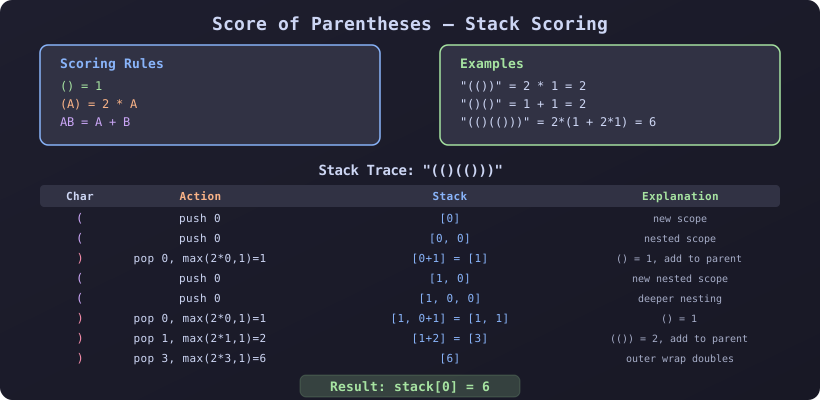
Score of Parentheses (LeetCode 856) combines parentheses matching with arithmetic. The stack doesn’t just track brackets — it tracks scores at each nesting depth.
The Problem
Given a balanced parentheses string s, compute its score based on:
| Rule | Example | Score |
|---|---|---|
() is 1 | () | 1 |
(A) is 2 * A | (()) | 2 |
AB is A + B | ()() | 2 |
More examples:
"(())"       → 2 * 1 = 2
"()()"       → 1 + 1 = 2
"(()(()))"   → 2 * (1 + 2*1) = 2 * 3 = 6
Stack Approach — The Key Idea
Use a stack where each entry represents the running score at that nesting depth. When you see (, push a new scope (0). When you see ), pop the scope, compute its score, and add it to the parent scope.
The formula on closing:
- Pop the top value
v - The scope’s score is
max(2 * v, 1)— this handles both()(empty scope = 1) and(A)(double the inner score) - Add this score to the new top of the stack (the parent scope)
Python Implementation
def score_of_parentheses(s):
    """
    Stack-based scoring of balanced parentheses.
    Time: O(n) — single pass through the string.
    Space: O(n) — stack depth up to n/2.
    """
    stack = [0]  # base scope

    for char in s:
        if char == '(':
            stack.append(0)  # new scope with score 0
        else:
            v = stack.pop()
            # () = 1, (A) = 2*A
            score = max(2 * v, 1)
            stack[-1] += score

    return stack[0]
Step-by-Step Trace
Trace for s = "(()(()))":
Start:         stack = [0]

char '(':      push 0          stack = [0, 0]
char '(':      push 0          stack = [0, 0, 0]
char ')':      pop 0
               score = max(2*0, 1) = 1
               stack[-1] += 1   stack = [0, 1]
char '(':      push 0          stack = [0, 1, 0]
char '(':      push 0          stack = [0, 1, 0, 0]
char ')':      pop 0
               score = max(2*0, 1) = 1
               stack[-1] += 1   stack = [0, 1, 1]
char ')':      pop 1
               score = max(2*1, 1) = 2
               stack[-1] += 2   stack = [0, 3]
char ')':      pop 3
               score = max(2*3, 1) = 6
               stack[-1] += 6   stack = [6]

Answer: 6 ✓
Alternative: Depth-Based O(1) Space
There is a clever O(1) space trick. Every () pair at depth d contributes 2^d to the total score. You only add a score when you see ) immediately after (.
def score_of_parentheses_depth(s):
    """
    Depth-based approach — O(1) space.
    Each () at depth d contributes 2^d.
    """
    depth = 0
    score = 0

    for i, char in enumerate(s):
        if char == '(':
            depth += 1
        else:
            depth -= 1
            if s[i - 1] == '(':
                # This is a () pair at current depth
                score += 1 << depth  # 2^depth

    return score
Why does this work?
Consider (()(())):
- The first
()is at depth 2 → contributes2^2 = 4? No, let’s recount. - Actually at depth 1 after the outer
(opens → wait, let me re-derive.
After the outer (, depth = 1. After the second (, depth = 2. The first ) closes at depth 2, and since s[i-1] = '(', it is a () leaf. At this point depth has already decremented to 1, so contribution = 2^1 = 2.
The second () is at depth 2 inside (()), so after decrementing depth is 2, contribution = 2^2 = 4? Let me trace carefully:
(  (  )  (  (  )  )  )
d: 1  2  1  2  3  2  1  0

At i=2, ')' after '(': depth=1, score += 2^1 = 2
At i=5, ')' after '(': depth=2, score += 2^2 = 4

Total = 2 + 4 = 6 ✓
Comparison of Approaches
| Approach | Time | Space | Complexity |
|---|---|---|---|
| Stack | O(n) | O(n) | Easy to understand |
| Depth counting | O(n) | O(1) | Tricky but elegant |
Edge Cases
- Simplest case —
"()"→ 1 - Deeply nested —
"(((())))"→ 8 (2^3) - Flat concatenation —
"()()()"→ 3 - Mixed —
"(()())"→ 2*(1+1) = 4 - Maximum depth — score grows exponentially with nesting
Common Mistakes
- Forgetting the base scope: initialize stack with
[0], not[] - Using
2 * vwithout themax: an empty pair()would score 0 instead of 1 - Off-by-one in depth counting: remember depth is decremented before you use it
When to Use This Pattern
Use this stack-scoring technique when:
- You need to compute a recursive score based on nesting structure
- The problem has rules like “inner content is multiplied, siblings are added”
- You are parsing nested expressions with aggregation
Related Problems
| Problem | Difficulty | Key Idea |
|---|---|---|
| LeetCode 856 — Score of Parentheses | Medium | This problem |
| LeetCode 20 — Valid Parentheses | Easy | Stack-based matching |
| LeetCode 1190 — Reverse Substrings Between Parentheses | Medium | Stack with string ops |
| LeetCode 394 — Decode String | Medium | Nested multiplier pattern |
Key Takeaway
Score of Parentheses teaches you to use the stack as a scope tracker — each stack entry represents the accumulated score at a nesting level. This pattern extends to any problem where nested structures produce recursive computations.
Related articles
- DSA Implement Stack Using Two Queues — Two Approaches Explained
Implement a stack using two queues with costly push and costly pop approaches. Complete Python solutions with complexity analysis.
- DSA Asteroid Collision Problem Using Stacks
Solve the asteroid collision problem (LeetCode 735) using a stack. Covers collision rules, Python implementation, and all edge cases.
- DSA Car Fleet Problem — Stack-Based Arrival Time Solution
Solve LeetCode 853 Car Fleet using a stack. Sort by position, compare arrival times, and count fleets. Python solution with visual trace.
- DSA The Celebrity Problem Using Stack-Based Elimination
Solve the celebrity problem in O(n) time using a stack elimination technique. Includes proof of correctness, Python code, and matrix examples.