Boundary Traversal of Binary Tree
Complete guide to boundary traversal — left boundary, leaf nodes, and right boundary in reverse. Multiple Python approaches with edge case handling.
What you'll learn
- ✓Boundary traversal concept (anticlockwise)
- ✓Left boundary extraction (excluding leaves)
- ✓Leaf node collection (left to right)
- ✓Right boundary extraction (in reverse, excluding leaves)
- ✓Handling edge cases: single node, skewed trees
- ✓Time and space complexity analysis
Prerequisites
- •Comfortable with DFS and BFS traversals
- •Understanding of binary tree basics
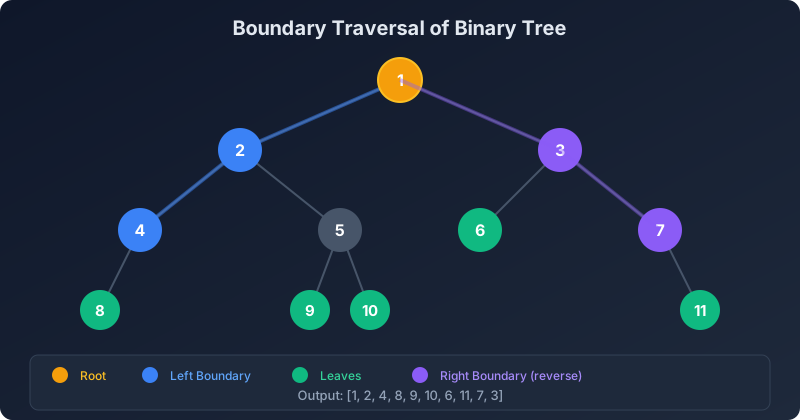
Boundary traversal collects the “outline” of a binary tree in anticlockwise order. Think of tracing a finger around the tree’s perimeter: start at the root, go down the left edge, across the bottom (leaves), and back up the right edge. This problem is a favorite in interviews at companies like Amazon and Microsoft.
Problem statement
Given the root of a binary tree, return the boundary traversal in anticlockwise order. The boundary consists of three parts:
- Left boundary: Nodes on the path from root to the leftmost leaf (excluding the leaf itself)
- Leaf nodes: All leaves from left to right
- Right boundary: Nodes on the path from the rightmost leaf back to root (excluding the leaf, in reverse order)
The root is always part of the boundary (counted once).
TreeNode definition
class TreeNode:
    def __init__(self, val=0, left=None, right=None):
        self.val = val
        self.left = left
        self.right = right
Example walkthrough
           1
          / \
         2   3
        / \   \
       4   5   7
      /   / \   \
     8   9  10  11
Left boundary (root down-left, excluding leaves): [1, 2, 4]
- Start at root (1), go to left child (2), then left child (4)
- Stop at 4 because its child (8) is a leaf
Leaf nodes (left to right): [8, 9, 10, 11]
Right boundary (root down-right, reversed, excluding leaves): [7, 3]
- Start at root, go right (3), then right (7)
- Reverse to get
[7, 3]
Result: [1, 2, 4, 8, 9, 10, 11, 7, 3]
Note: the root (1) is part of the left boundary and is not repeated.
Approach 1: three separate passes
The cleanest approach separates the problem into three independent functions:
def boundaryOfBinaryTree(root):
    """
    Boundary traversal: left boundary + leaves + right boundary (reversed).
    Time: O(n)  Space: O(n)
    """
    if not root:
        return []

    # Single node is its own boundary
    if not root.left and not root.right:
        return [root.val]

    result = [root.val]

    # 1. Left boundary (top to bottom, excluding leaves)
    addLeftBoundary(root.left, result)

    # 2. All leaves (left to right)
    addLeaves(root, result)

    # 3. Right boundary (bottom to top, excluding leaves)
    right_boundary = []
    addRightBoundary(root.right, right_boundary)
    result.extend(reversed(right_boundary))

    return result


def addLeftBoundary(node, result):
    """
    Collect left boundary nodes (excluding leaves).
    Always prefer left child; if no left, take right.
    """
    while node:
        # Skip leaves
        if node.left or node.right:
            result.append(node.val)

        # Prefer left, fallback to right
        if node.left:
            node = node.left
        else:
            node = node.right


def addLeaves(node, result):
    """Collect all leaf nodes using DFS (left to right)."""
    if not node:
        return

    if not node.left and not node.right:
        result.append(node.val)
        return

    addLeaves(node.left, result)
    addLeaves(node.right, result)


def addRightBoundary(node, result):
    """
    Collect right boundary nodes (excluding leaves).
    Always prefer right child; if no right, take left.
    """
    while node:
        if node.left or node.right:
            result.append(node.val)

        if node.right:
            node = node.right
        else:
            node = node.left
Why separate the three parts?
Each part has different traversal logic:
- Left boundary: iterative, prefer-left descent
- Leaves: recursive DFS, in-order leaf collection
- Right boundary: iterative, prefer-right descent, then reverse
Separating them makes each function simple and testable.
Left boundary logic explained
The left boundary walks down from root.left, always preferring the left child. If there is no left child, it takes the right child instead (because the boundary “wraps” to the nearest available path). It stops before leaves because leaves are collected separately.
         1
        / \
       2   3
        \
         5
        / \
       9  10

Left boundary: [2, 5]
- Start at 2 (root.left)
- 2 has no left child, take right → 5
- 5 has children (not a leaf), add 5
- 5's left child 9 is a leaf, stop
Right boundary logic explained
Same idea but mirrored — prefer the right child, fallback to left. Collect in top-to-bottom order, then reverse at the end.
Approach 2: single DFS with flags
An alternative uses a single DFS traversal with flags to mark whether a node is on the left boundary, right boundary, or a leaf:
def boundaryOfBinaryTree_single(root):
    """
    Single-pass DFS with boundary classification.
    Time: O(n)  Space: O(h) + O(n) for result
    """
    if not root:
        return []

    result = [root.val]
    right_boundary = []

    def dfs(node, is_left_boundary, is_right_boundary):
        if not node:
            return

        is_leaf = not node.left and not node.right

        if is_leaf:
            result.append(node.val)
        elif is_left_boundary:
            result.append(node.val)
        elif is_right_boundary:
            right_boundary.append(node.val)

        # Left child inherits left boundary status
        # Right child inherits right boundary status
        # If on left boundary and no left child, right child becomes left boundary
        left_is_lb = is_left_boundary
        left_is_rb = is_right_boundary and not node.right

        right_is_rb = is_right_boundary
        right_is_lb = is_left_boundary and not node.left

        dfs(node.left, left_is_lb, left_is_rb)
        dfs(node.right, right_is_lb, right_is_rb)

    dfs(root.left, True, False)
    dfs(root.right, False, True)

    result.extend(reversed(right_boundary))
    return result
This approach is more complex but does everything in a single traversal.
Approach 3: iterative with explicit stacks
For those who prefer fully iterative solutions:
from collections import deque

def boundaryOfBinaryTree_iterative(root):
    """Fully iterative boundary traversal."""
    if not root:
        return []
    if not root.left and not root.right:
        return [root.val]

    result = [root.val]

    # Left boundary (iterative)
    node = root.left
    while node:
        if node.left or node.right:
            result.append(node.val)
        node = node.left if node.left else node.right

    # Leaves (iterative using stack)
    stack = [root]
    while stack:
        node = stack.pop()
        if not node.left and not node.right:
            result.append(node.val)
        # Push right first so left is processed first
        if node.right:
            stack.append(node.right)
        if node.left:
            stack.append(node.left)

    # Right boundary (iterative, collect then reverse)
    right_boundary = []
    node = root.right
    while node:
        if node.left or node.right:
            right_boundary.append(node.val)
        node = node.right if node.right else node.left

    result.extend(reversed(right_boundary))
    return result
Edge cases
Single node
root = TreeNode(1)
# Output: [1]
# The root is a leaf and the entire boundary
Left-skewed tree
     1
    /
   2
  /
 3
Left boundary: [1, 2] (3 is a leaf)
Leaves: [3]
Right boundary: empty (no right subtree from root)
Result: [1, 2, 3]
Right-skewed tree
1
 \
  2
   \
    3
Left boundary: empty (no left subtree from root)
Leaves: [3]
Right boundary: [2] (reversed from [2])
Result: [1, 3, 2]
Root with only left subtree
      1
     /
    2
   / \
  4   5
Left boundary: [2] (4 is a leaf)
Leaves: [4, 5]
Right boundary: empty
Result: [1, 2, 4, 5]
Test cases
def test_boundary():
    # Single node
    assert boundaryOfBinaryTree(TreeNode(1)) == [1]

    # Two nodes (left child)
    root = TreeNode(1, TreeNode(2))
    assert boundaryOfBinaryTree(root) == [1, 2]

    # Two nodes (right child)
    root = TreeNode(1, None, TreeNode(3))
    assert boundaryOfBinaryTree(root) == [1, 3]

    # Complete tree
    root = TreeNode(1,
        TreeNode(2, TreeNode(4), TreeNode(5)),
        TreeNode(3, TreeNode(6), TreeNode(7))
    )
    # Left boundary: [2], Leaves: [4,5,6,7], Right boundary: [3]
    assert boundaryOfBinaryTree(root) == [1, 2, 4, 5, 6, 7, 3]
Common mistakes
-
Including leaves in left/right boundary: Leaves are collected separately. The left and right boundary functions must skip leaf nodes.
-
Double-counting the root: The root is added once at the start. The left boundary starts from
root.leftand right boundary fromroot.right. -
Forgetting to reverse the right boundary: The right boundary is collected top-to-bottom but should appear bottom-to-top in the final result.
-
Not handling single-child nodes: When a left boundary node has no left child, its right child becomes part of the left boundary. Same for the right boundary with no right child.
-
Empty tree or single node: Return
[]for null root and[root.val]for a single node.
Complexity analysis
Time: O(n)
- Left boundary: O(h) where h is the height
- Leaf collection: O(n) — visits every node once
- Right boundary: O(h)
- Total: O(n) since leaf collection dominates
Space: O(n)
- Result array: O(n) in the worst case (all nodes on boundary)
- Recursion stack for leaf collection: O(h)
- Right boundary temporary list: O(h)
Variation: clockwise boundary
Some problems ask for clockwise boundary instead of anticlockwise. Simply swap the order:
def clockwiseBoundary(root):
    """Clockwise: root + right boundary + reversed leaves + left boundary reversed."""
    if not root:
        return []
    if not root.left and not root.right:
        return [root.val]

    result = [root.val]

    # Right boundary (top to bottom)
    addRightBoundary(root.right, result)

    # Leaves (right to left — reverse of normal)
    leaves = []
    addLeaves(root, leaves)
    result.extend(reversed(leaves))

    # Left boundary (bottom to top)
    left_boundary = []
    addLeftBoundary(root.left, left_boundary)
    result.extend(reversed(left_boundary))

    return result
Practice problems
| Problem | Difficulty | Link |
|---|---|---|
| Boundary of Binary Tree | Medium | LeetCode 545 |
| Binary Tree Right Side View | Medium | LeetCode 199 |
| Leaf-Similar Trees | Easy | LeetCode 872 |
| Sum of Left Leaves | Easy | LeetCode 404 |
| Find Leaves of Binary Tree | Medium | LeetCode 366 |
Key takeaways
- Boundary traversal has three distinct parts: left boundary, leaves, right boundary (reversed)
- Left boundary prefers the left child; right boundary prefers the right child
- Both boundaries exclude leaf nodes to avoid duplication
- The root is added separately and is never duplicated
- Separating into three functions is the clearest and most maintainable approach
Related articles
- DSA Flatten Binary Tree to Linked List
Learn how to flatten a binary tree to a linked list using preorder threading, Morris traversal, and how to convert a BST to a sorted doubly linked list — with full Python implementations and Big-O analysis.
- DSA BST Iterator, Range Queries, and Closest Value
Master BST iterator using stack-based controlled in-order traversal, range sum queries, counting nodes in range, closest value, and closest K values — with full Python implementations.
- DSA Distance Problems in Binary Trees
Solve distance problems in binary trees — distance between two nodes, all nodes at distance K, burning a tree from a node, and sum of distances using rerooting. Full Python implementations.
- DSA Tree Pruning and Deletion Patterns
Master tree pruning and deletion — delete nodes in BST, prune binary trees, trim BST to range, and remove leaves with a given value. Full Python implementations with Big-O analysis.