BFS Pattern with Queues: Level-Order and Shortest Path
Master BFS using queues for tree level-order traversal and shortest path in unweighted graphs. Python implementations with detailed traces.
What you'll learn
- ✓The BFS algorithm and why it uses a queue
- ✓Level-order traversal of binary trees
- ✓Shortest path in unweighted graphs
- ✓BFS template you can reuse across problems
Prerequisites
- •Queue basics — see Stacks & Queues Intro
- •Graph basics — see Graphs Intro
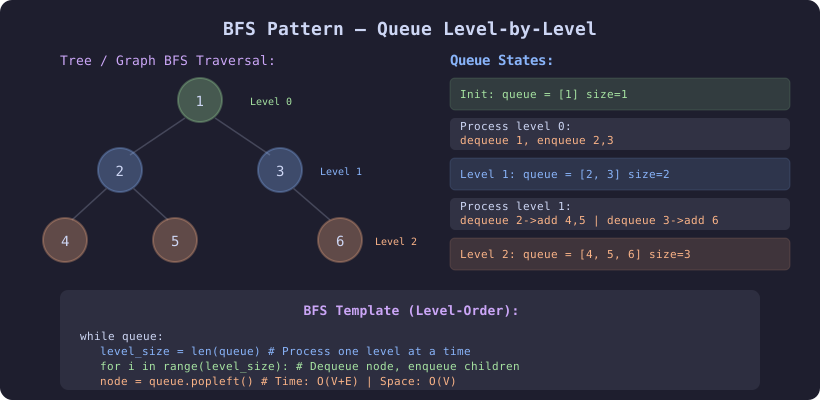
Breadth-First Search (BFS) explores nodes level by level. A queue is the natural data structure because it processes nodes in the order they were discovered — First In, First Out.
The BFS Template
from collections import deque

def bfs(start):
    queue = deque([start])
    visited = {start}

    while queue:
        node = queue.popleft()
        process(node)

        for neighbor in get_neighbors(node):
            if neighbor not in visited:
                visited.add(neighbor)
                queue.append(neighbor)
Level-Order Tree Traversal
Process all nodes at depth d before any node at depth d+1:
def level_order(root):
    """
    Return list of lists, one per level.
    Time: O(n), Space: O(n)
    """
    if not root:
        return []

    result = []
    queue = deque([root])

    while queue:
        level_size = len(queue)
        level = []

        for _ in range(level_size):
            node = queue.popleft()
            level.append(node.val)

            if node.left:
                queue.append(node.left)
            if node.right:
                queue.append(node.right)

        result.append(level)

    return result
Trace
Tree:       1
          /   \
         2     3
        / \     \
       4   5     6

Queue states:
Start:   [1]           → level 0: [1]
After:   [2, 3]        → level 1: [2, 3]
After:   [4, 5, 6]     → level 2: [4, 5, 6]

Result: [[1], [2, 3], [4, 5, 6]]
Shortest Path in Unweighted Graph
BFS guarantees the shortest path (fewest edges) in an unweighted graph:
def shortest_path(graph, start, end):
    """
    Find shortest path in unweighted graph.
    Time: O(V + E), Space: O(V)
    """
    queue = deque([(start, [start])])
    visited = {start}

    while queue:
        node, path = queue.popleft()

        if node == end:
            return path

        for neighbor in graph[node]:
            if neighbor not in visited:
                visited.add(neighbor)
                queue.append((neighbor, path + [neighbor]))

    return None  # No path exists
BFS on a Grid
Many interview problems use BFS on a 2D grid:
def bfs_grid(grid, start_r, start_c):
    """BFS on a 2D grid."""
    rows, cols = len(grid), len(grid[0])
    queue = deque([(start_r, start_c, 0)])  # row, col, distance
    visited = {(start_r, start_c)}
    directions = [(0,1), (0,-1), (1,0), (-1,0)]

    while queue:
        r, c, dist = queue.popleft()

        for dr, dc in directions:
            nr, nc = r + dr, c + dc
            if (0 <= nr < rows and 0 <= nc < cols
                and (nr, nc) not in visited
                and grid[nr][nc] != '#'):
                visited.add((nr, nc))
                queue.append((nr, nc, dist + 1))
Why Queue and Not Stack?
| Data Structure | Traversal | Finds |
|---|---|---|
| Queue (BFS) | Level by level | Shortest path |
| Stack (DFS) | Deep first | Any path |
BFS with a queue guarantees that when you first reach a node, you’ve found the shortest path to it. DFS with a stack might find a longer path first.
Edge Cases
- Empty graph/tree — return empty result
- Single node — return immediately
- Disconnected graph — BFS only visits the connected component
- Cycles — the
visitedset prevents infinite loops
When to Use BFS
- Shortest path in unweighted graph
- Level-order traversal
- Finding all nodes within k distance
- Topological sort (Kahn’s algorithm)
- Multi-source BFS (rotten oranges, walls and gates)
Related Problems
- Binary Tree Level Order (LeetCode 102)
- Shortest Path in Binary Matrix (LeetCode 1091)
- Rotten Oranges (LeetCode 994)
- Word Ladder (LeetCode 127)
Related articles
- DSA Design Circular Deque — Array-Based Implementation (LeetCode 641)
Design a Circular Deque with front/rear pointers on a fixed-size array. Python solution with all O(1) operations, visual trace, and edge case handling.
- DSA Design Hit Counter Using Queue
Design a hit counter that counts hits in the past 5 minutes using a queue. LeetCode 362 solution with O(1) amortized operations.
- DSA First Non-Repeating Character in a Stream
Find the first non-repeating character in a character stream using a queue and hash map. Python solution with O(1) amortized per query.
- DSA Implement Stack Using Two Queues — Two Approaches Explained
Implement a stack using two queues with costly push and costly pop approaches. Complete Python solutions with complexity analysis.