Validate Stack Sequences — Simulate Push/Pop (LeetCode 946)
Validate Stack Sequences solved by simulating push and pop operations. Python solution with step-by-step trace, edge cases, and complexity analysis for LeetCode 946.
What you'll learn
- ✓How to validate whether a push/pop sequence is valid for a stack
- ✓Greedy simulation approach using a single stack
- ✓Step-by-step trace through examples
- ✓Why greedy works and correctness proof intuition
- ✓Time and space complexity analysis
Prerequisites
- •Stack basics — see Stacks Intro
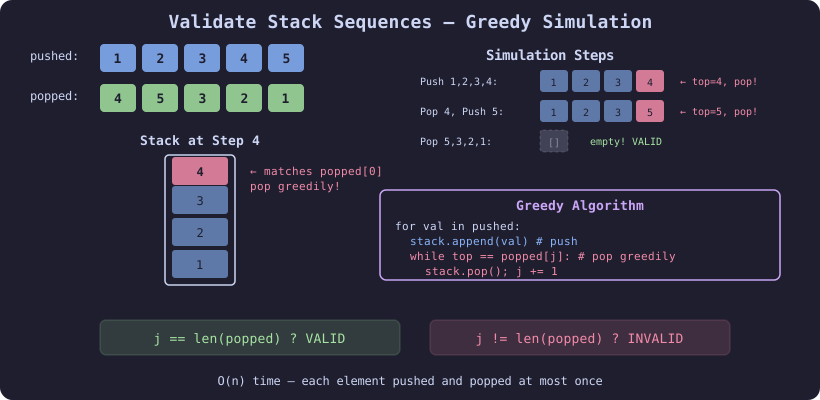
Validate Stack Sequences (LeetCode 946) gives you two sequences — pushed and popped — and asks whether the popped sequence could result from a series of push and pop operations on an initially empty stack, given that elements are pushed in the order of pushed.
The Problem
Input:  pushed = [1, 2, 3, 4, 5], popped = [4, 5, 3, 2, 1]
Output: true

Push 1, Push 2, Push 3, Push 4, Pop 4, Push 5, Pop 5, Pop 3, Pop 2, Pop 1

Input:  pushed = [1, 2, 3, 4, 5], popped = [4, 3, 5, 1, 2]
Output: false

After popping 4, 3 and pushing 5, popping 5 gives [1, 2] on stack.
We need to pop 1 next, but 2 is on top. Invalid!
Approach: Greedy Simulation
The idea is simple: simulate the stack operations.
- Push elements from
pushedone by one - After each push, greedily pop as many elements as possible that match the front of
popped - If we consume all of
popped, the sequence is valid
def validateStackSequences(pushed, popped):
    """
    Simulate push/pop operations greedily.
    Time: O(n), Space: O(n)
    """
    stack = []
    j = 0  # pointer into popped

    for val in pushed:
        stack.append(val)

        # Greedily pop whenever the top matches
        while stack and j < len(popped) and stack[-1] == popped[j]:
            stack.pop()
            j += 1

    return j == len(popped)
That is the entire solution. Let us trace through it carefully.
Step-by-Step Trace: Valid Case
pushed = [1, 2, 3, 4, 5], popped = [4, 5, 3, 2, 1]

Step 1: push 1 → stack = [1], j=0, popped[0]=4, 1≠4 → no pop
Step 2: push 2 → stack = [1,2], j=0, 2≠4 → no pop
Step 3: push 3 → stack = [1,2,3], j=0, 3≠4 → no pop
Step 4: push 4 → stack = [1,2,3,4], j=0, 4==4 → pop!
        stack = [1,2,3], j=1, popped[1]=5, 3≠5 → stop
Step 5: push 5 → stack = [1,2,3,5], j=1, 5==5 → pop!
        stack = [1,2,3], j=2, 3==3 → pop!
        stack = [1,2], j=3, 2==2 → pop!
        stack = [1], j=4, 1==1 → pop!
        stack = [], j=5 → stop

j == 5 == len(popped) → TRUE
Step-by-Step Trace: Invalid Case
pushed = [1, 2, 3, 4, 5], popped = [4, 3, 5, 1, 2]

Step 1: push 1 → stack = [1], j=0, 1≠4 → no pop
Step 2: push 2 → stack = [1,2], j=0, 2≠4 → no pop
Step 3: push 3 → stack = [1,2,3], j=0, 3≠4 → no pop
Step 4: push 4 → stack = [1,2,3,4], j=0, 4==4 → pop!
        stack = [1,2,3], j=1, 3==3 → pop!
        stack = [1,2], j=2, 2≠5 → stop
Step 5: push 5 → stack = [1,2,5], j=2, 5==5 → pop!
        stack = [1,2], j=3, 2≠1 → stop

All pushed, j=3 ≠ 5 → FALSE

Stack has [1, 2] left. We need to pop 1 but 2 is on top.
Why Greedy Works
The key insight: we should always pop as soon as we can. Delaying a pop never helps — if the top of the stack matches the next element in popped, we must pop it now because:
- If we delay and push more elements, those new elements will be on top
- We would still need to pop the matching element eventually
- But it will be buried under the new elements, possibly in the wrong order
So the greedy strategy (pop whenever possible) is both necessary and sufficient.
Space-Optimized Version
We can use the pushed array itself as the stack, avoiding extra space:
def validateStackSequences_inplace(pushed, popped):
    """
    Use pushed array as the stack — O(1) extra space.
    Time: O(n), Space: O(1)
    """
    top = 0  # stack pointer within pushed
    j = 0    # pointer into popped

    for val in pushed:
        pushed[top] = val
        top += 1

        while top > 0 and j < len(popped) and pushed[top-1] == popped[j]:
            top -= 1
            j += 1

    return j == len(popped)
This treats pushed[0:top] as the stack. Each push writes to pushed[top], and pops just decrement top.
Complexity Analysis
| Approach | Time | Space |
|---|---|---|
| Stack simulation | O(n) | O(n) |
| In-place | O(n) | O(1) |
Each element is pushed once and popped at most once, giving a total of 2n operations = O(n).
Edge Cases
# Empty arrays
assert validateStackSequences([], []) == True

# Single element
assert validateStackSequences([1], [1]) == True

# Already sorted (push all, then pop all)
assert validateStackSequences([1,2,3], [3,2,1]) == True

# Pop in push order (pop each immediately after push)
assert validateStackSequences([1,2,3], [1,2,3]) == True

# Impossible: first pop is not in pushed
# (This cannot happen per constraints — both are permutations)

# Large case with alternating push/pop
pushed = list(range(1, 1001))
popped = list(range(1, 1001))  # pop immediately
assert validateStackSequences(pushed, popped) == True
When to Use This Pattern
Use stack simulation when:
- You need to verify if a sequence of operations is valid for a stack or queue
- The problem involves simulating a process with push/pop semantics
- You see “validate” or “check if possible” with ordered operations
- The greedy approach of “process as early as possible” applies
Common Mistakes
- Forgetting the while loop — you might pop multiple elements in a row, not just one
- Not checking bounds on both
stack(non-empty) andj(within popped range) - Checking
stack == []at the end instead ofj == len(popped)— both work, but the j check is cleaner
Related Problems
| Problem | Key Difference |
|---|---|
| Asteroid Collision (LC 735) | Stack simulation with collision rules |
| Baseball Game (LC 682) | Stack simulation with scoring rules |
| Decode String (LC 394) | Stack for nested bracket processing |
| Sort a Stack | Validate vs construct the output |
| Design Stack with Increment (LC 1381) | Design variant with lazy propagation |
Key Takeaways
- Validate Stack Sequences is a greedy simulation problem
- Push elements one by one; pop greedily whenever the stack top matches
- The greedy strategy is optimal — delaying a pop never helps
- The in-place variant uses O(1) extra space by reusing the input array
- This pattern (simulate and greedily process) applies to many validation problems
Related articles
- DSA Implement Stack Using Two Queues — Two Approaches Explained
Implement a stack using two queues with costly push and costly pop approaches. Complete Python solutions with complexity analysis.
- DSA Asteroid Collision Problem Using Stacks
Solve the asteroid collision problem (LeetCode 735) using a stack. Covers collision rules, Python implementation, and all edge cases.
- DSA Car Fleet Problem — Stack-Based Arrival Time Solution
Solve LeetCode 853 Car Fleet using a stack. Sort by position, compare arrival times, and count fleets. Python solution with visual trace.
- DSA The Celebrity Problem Using Stack-Based Elimination
Solve the celebrity problem in O(n) time using a stack elimination technique. Includes proof of correctness, Python code, and matrix examples.