Sum of Subarray Minimums — Contribution Technique with Stack (LeetCode 907)
Solve Sum of Subarray Minimums using the contribution technique with monotonic stacks. Python solution with modular arithmetic, traces, and O(n) analysis.
What you'll learn
- ✓The contribution technique: count how many subarrays each element is the minimum of
- ✓Using previous-smaller and next-smaller-or-equal boundaries
- ✓Why one side uses strict and the other uses non-strict comparison
- ✓Complete Python O(n) solution with modular arithmetic
- ✓Step-by-step trace with a worked example
Prerequisites
- •Monotonic stacks — see Next Greater Element
- •Next Smaller Element — see Next Smaller Element
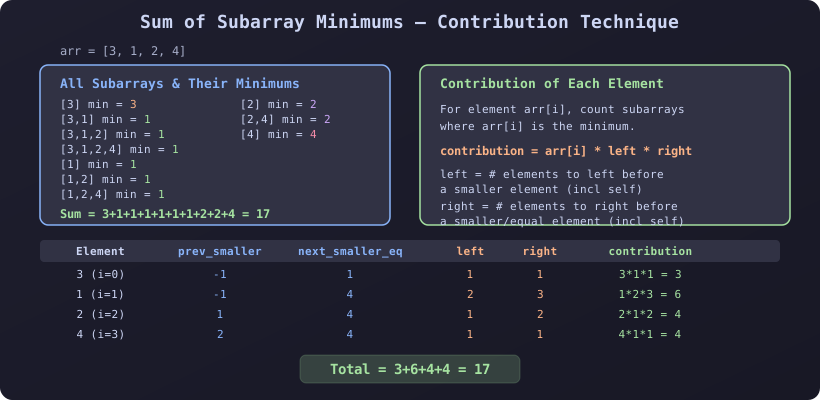
Sum of Subarray Minimums (LeetCode 907) is one of the best problems for mastering monotonic stacks. Instead of finding the minimum of every subarray (O(n^2)), you flip the question: for each element, how many subarrays is it the minimum of?
The Problem
Given an array of integers, find the sum of min(subarray) for all contiguous subarrays. Return the answer modulo 10^9 + 7.
Input:  [3, 1, 2, 4]
Output: 17

Subarrays and their minimums:
[3]=3, [1]=1, [2]=2, [4]=4,
[3,1]=1, [1,2]=1, [2,4]=2,
[3,1,2]=1, [1,2,4]=1,
[3,1,2,4]=1

Sum = 3+1+2+4+1+1+2+1+1+1 = 17
Brute Force — O(n^2)
def sum_subarray_mins_brute(arr):
    """Enumerate all subarrays — O(n^2)."""
    MOD = 10**9 + 7
    n = len(arr)
    total = 0
    for i in range(n):
        curr_min = arr[i]
        for j in range(i, n):
            curr_min = min(curr_min, arr[j])
            total = (total + curr_min) % MOD
    return total
The Contribution Technique
Instead of computing the minimum of each subarray, ask: for element arr[i], how many subarrays have arr[i] as their minimum?
If arr[i] is the minimum of a subarray arr[L..R], then:
Lcan be anything from the previous smaller element’s index + 1 toiRcan be anything fromito the next smaller-or-equal element’s index - 1
The number of such subarrays = left_count * right_count, where:
left_count= distance fromito the previous strictly smaller element (or start of array)right_count= distance fromito the next smaller-or-equal element (or end of array)
The total contribution of arr[i] = arr[i] * left_count * right_count.
Why Strict on One Side, Non-Strict on the Other?
When there are duplicate values, we must avoid double-counting. Consider [1, 2, 1]:
- The subarray
[1, 2, 1]has minimum 1, but which1“owns” it?
We break ties by using:
- Strictly smaller on the left (
<) - Smaller or equal on the right (
<=)
This means the leftmost duplicate owns subarrays containing both. Each subarray is counted exactly once.
Python Implementation
def sum_subarray_mins(arr):
    """
    Contribution technique with monotonic stacks.
    Time: O(n) — two passes for prev/next smaller.
    Space: O(n) — for stacks and boundary arrays.
    """
    MOD = 10**9 + 7
    n = len(arr)

    # Previous smaller element index (strict <)
    prev_smaller = [-1] * n
    stack = []
    for i in range(n):
        while stack and arr[stack[-1]] >= arr[i]:
            stack.pop()
        prev_smaller[i] = stack[-1] if stack else -1
        stack.append(i)

    # Next smaller or equal element index (<= for tie-breaking)
    next_smaller_eq = [n] * n
    stack = []
    for i in range(n - 1, -1, -1):
        while stack and arr[stack[-1]] > arr[i]:
            stack.pop()
        next_smaller_eq[i] = stack[-1] if stack else n
        stack.append(i)

    # Compute contributions
    total = 0
    for i in range(n):
        left = i - prev_smaller[i]      # count of left choices
        right = next_smaller_eq[i] - i   # count of right choices
        total = (total + arr[i] * left * right) % MOD

    return total
Step-by-Step Trace
For arr = [3, 1, 2, 4]:
Step 1: Find previous smaller (strict <)
i=0, val=3: stack=[]     → prev_smaller[0]=-1, push 0
i=1, val=1: pop 0 (3>=1) → prev_smaller[1]=-1, push 1
i=2, val=2: stack=[1]    → prev_smaller[2]=1, push 2
i=3, val=4: stack=[1,2]  → prev_smaller[3]=2, push 3

prev_smaller = [-1, -1, 1, 2]
Step 2: Find next smaller or equal (right to left, > for popping)
i=3, val=4: stack=[]     → next_smaller_eq[3]=4, push 3
i=2, val=2: pop 3 (4>2)  → next_smaller_eq[2]=4, push 2
i=1, val=1: pop 2 (2>1)  → next_smaller_eq[1]=4, push 1
i=0, val=3: stack=[1]    → next_smaller_eq[0]=1, push 0

next_smaller_eq = [1, 4, 4, 4]
Step 3: Compute contributions
i=0: left = 0-(-1) = 1, right = 1-0 = 1
     contribution = 3 * 1 * 1 = 3

i=1: left = 1-(-1) = 2, right = 4-1 = 3
     contribution = 1 * 2 * 3 = 6

i=2: left = 2-1 = 1, right = 4-2 = 2
     contribution = 2 * 1 * 2 = 4

i=3: left = 3-2 = 1, right = 4-3 = 1
     contribution = 4 * 1 * 1 = 4

Total = 3 + 6 + 4 + 4 = 17 ✓
Understanding Left and Right Counts
For element arr[1] = 1 with prev_smaller[1] = -1 and next_smaller_eq[1] = 4:
- Left choices: the subarray can start at index 0 or 1 (2 choices)
- Right choices: the subarray can end at index 1, 2, or 3 (3 choices)
- Total subarrays where
arr[1]=1is the minimum:2 * 3 = 6 - Those subarrays:
[3,1], [1], [3,1,2], [1,2], [3,1,2,4], [1,2,4] - All have minimum 1 ✓
Handling Duplicates: A Detailed Example
For arr = [1, 2, 1]:
prev_smaller (strict <):  [-1, 0, -1]
  For i=2, val=1: pop 1 (2>=1), pop 0 (1>=1) → -1

next_smaller_eq (<=):  [2, 2, 3]
  For i=0, val=1: stack=[2], arr[2]=1, 1 > 1? No → next[0]=2

Contributions:
  i=0: left=1, right=2-0=2 → 1*1*2 = 2
  i=1: left=1-0=1, right=2-1=1 → 2*1*1 = 2
  i=2: left=2-(-1)=3, right=3-2=1 → 1*3*1 = 3

Total = 2 + 2 + 3 = 7

Verification: [1]=1, [2]=2, [1]=1, [1,2]=1, [2,1]=1, [1,2,1]=1
Sum = 1+2+1+1+1+1 = 7 ✓
Notice how [1,2,1] with minimum 1 is “owned” by the rightmost 1 (i=2), not the leftmost, due to our strict/non-strict tie-breaking.
Modular Arithmetic
The problem asks for the answer mod 10^9 + 7. Since we only use addition and multiplication, we can take mod at each step:
total = (total + arr[i] * left * right) % MODThis prevents integer overflow (important in languages like C++ and Java; Python handles big integers natively, but taking mod is still required for the correct answer).
Edge Cases
- Single element —
[5]→ 5 - All same elements —
[3, 3, 3]→ 3+3+3+3+3+3 = 18 - Sorted ascending —
[1, 2, 3]→ each element’s left count is 1 - Sorted descending —
[3, 2, 1]→ each element’s right count is 1 - Large array — up to 30,000 elements, must be O(n)
Complexity Analysis
| Metric | Value |
|---|---|
| Time | O(n) — three linear passes |
| Space | O(n) — boundary arrays and stacks |
When to Use This Pattern
Use the contribution technique when:
- You need the sum (or count) of some property across all subarrays
- The property is defined by a single element per subarray (min, max, etc.)
- You can find boundaries using monotonic stacks
- The problem says “mod 10^9+7” (hinting at large answer, needs efficient approach)
Related Problems
| Problem | Difficulty | Key Idea |
|---|---|---|
| LeetCode 907 — Sum of Subarray Minimums | Medium | This problem |
| LeetCode 2104 — Sum of Subarray Ranges | Medium | Sum of max - sum of min |
| LeetCode 84 — Largest Rectangle in Histogram | Hard | Contribution of each bar |
| LeetCode 85 — Maximal Rectangle | Hard | Build on histogram |
| LeetCode 1856 — Maximum Subarray Min-Product | Medium | Min * sum with boundaries |
Key Takeaway
Sum of Subarray Minimums teaches the contribution technique — instead of iterating over all subarrays, compute each element’s contribution by finding its left and right boundaries using monotonic stacks. The strict-vs-non-strict comparison for tie-breaking is the subtle detail that makes or breaks correctness with duplicates.
Related articles
- DSA 132 Pattern — Monotonic Stack with Reverse Traversal (LeetCode 456)
Solve the 132 Pattern problem using a monotonic stack scanning right to left. Python solution tracking s3 candidates and s2 maximum, with detailed trace.
- DSA Basic Calculator I, II, III — Complete Expression Evaluation Guide
Solve Basic Calculator problems LeetCode 224, 227, and 772. Master stack-based expression evaluation with +, -, *, /, and parentheses in Python.
- DSA Largest Rectangle in Histogram Using Stack
Find the largest rectangle in a histogram using a monotonic stack in O(n). Detailed walkthrough, Python code, visual trace, and common pitfalls.
- DSA Maximal Rectangle in Binary Matrix
Find the maximal rectangle containing only 1s in a binary matrix. Builds on the largest rectangle in histogram technique with detailed explanation.