Design Front Middle Back Queue — Two Deques (LeetCode 1670)
Design Front Middle Back Queue using two balanced deques. Python solution with O(1) operations, step-by-step trace, and complexity analysis for LeetCode 1670.
What you'll learn
- ✓How to split a queue into two balanced deques
- ✓O(1) amortized push/pop at front, middle, and back
- ✓Rebalancing logic to keep deques aligned
- ✓Complete Python implementation with edge cases
- ✓When this two-deque pattern applies to other problems
Prerequisites
- •Deque basics — see Queues Intro
- •Stack basics — see Stacks Intro
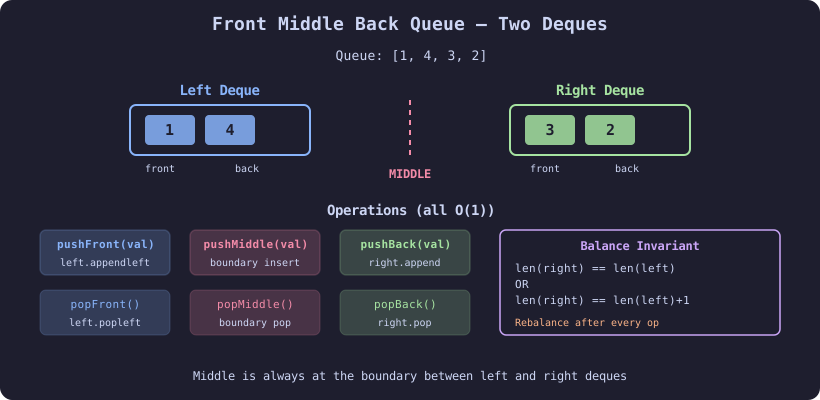
Design Front Middle Back Queue (LeetCode 1670) requires implementing a queue that supports push and pop operations at the front, middle, and back — all efficiently. The key insight is splitting the data across two deques and keeping them balanced.
The Problem
Implement FrontMiddleBackQueue with these operations:
pushFront(val)— add to the frontpushMiddle(val)— add to the middle (left-middle if even length)pushBack(val)— add to the backpopFront()— remove and return the front elementpopMiddle()— remove and return the middle elementpopBack()— remove and return the back element
Return -1 if the queue is empty for any pop operation.
pushFront(1): [1]
pushBack(2):  [1, 2]
pushMiddle(3): [1, 3, 2]
pushMiddle(4): [1, 4, 3, 2]
popFront() → 1: [4, 3, 2]
popMiddle() → 3: [4, 2]
popBack() → 2: [4]
Approach: Two Balanced Deques
Split the elements between a left deque and a right deque:
Full queue: [a, b, c, d, e]

Left deque:  [a, b]      (first half)
Right deque: [c, d, e]   (second half, includes middle if odd)
Balance invariant: len(right) == len(left) or len(right) == len(left) + 1.
This means the middle element is always at the boundary between the two deques.
Implementation
from collections import deque

class FrontMiddleBackQueue:
    """
    Two-deque approach for front/middle/back operations.
    All operations are O(1) amortized.
    """
    def __init__(self):
        self.left = deque()   # first half
        self.right = deque()  # second half (>=left in size)

    def _balance(self):
        """Maintain: len(right) == len(left) or len(left) + 1."""
        if len(self.right) > len(self.left) + 1:
            # right too big → move front of right to back of left
            self.left.append(self.right.popleft())
        elif len(self.left) > len(self.right):
            # left too big → move back of left to front of right
            self.right.appendleft(self.left.pop())

    def pushFront(self, val: int) -> None:
        self.left.appendleft(val)
        self._balance()

    def pushMiddle(self, val: int) -> None:
        # If even total length, insert at left-middle
        if len(self.left) == len(self.right):
            self.right.appendleft(val)
        else:
            self.left.append(val)
        # No rebalance needed — we inserted at the boundary

    def pushBack(self, val: int) -> None:
        self.right.append(val)
        self._balance()

    def popFront(self) -> int:
        if not self.left and not self.right:
            return -1
        if self.left:
            val = self.left.popleft()
        else:
            val = self.right.popleft()
        self._balance()
        return val

    def popMiddle(self) -> int:
        if not self.left and not self.right:
            return -1
        if len(self.left) == len(self.right):
            # Even total: middle is last of left
            val = self.left.pop()
        else:
            # Odd total: middle is first of right
            val = self.right.popleft()
        self._balance()
        return val

    def popBack(self) -> int:
        if not self.right:
            return -1
        val = self.right.pop()
        self._balance()
        return val
Step-by-Step Trace
Operation        left          right         Queue View
──────────────────────────────────────────────────────────
pushFront(1)     []            [1]           [1]
pushBack(2)      [1]           [2]           [1, 2]
pushMiddle(3)    [1]           [3, 2]        [1, 3, 2]
pushMiddle(4)    [1, 4]        [3, 2]        [1, 4, 3, 2]

popFront()→1     [4]           [3, 2]        [4, 3, 2]
  left.popleft()=1, rebalance: len(right)=2 > len(left)+1=2? No

popMiddle()→3    [4]           [2]           [4, 2]
  odd total (3): right.popleft()=3

popMiddle()→4    []            [2]           [2]
  even total (2): left.pop()=4

popBack()→2      []            []            []
  right.pop()=2

popFront()→-1    empty!
The Balance Function in Detail
The rebalancing logic is simple but critical:
def _balance(self):
    # Case 1: right has 2+ more than left
    # Move right's front to left's back
    if len(self.right) > len(self.left) + 1:
        self.left.append(self.right.popleft())

    # Case 2: left has more than right
    # Move left's back to right's front
    elif len(self.left) > len(self.right):
        self.right.appendleft(self.left.pop())
After every push/pop, calling _balance() restores the invariant. Since at most one element moves, it is O(1).
Why Two Deques?
| Approach | pushFront | pushMiddle | pushBack | popMiddle |
|---|---|---|---|---|
| Array | O(n) | O(n) | O(1) | O(n) |
| Linked List | O(1) | O(n) | O(1) | O(n) |
| Two Deques | O(1) | O(1) | O(1) | O(1) |
The two-deque approach gives O(1) for all six operations.
Complexity Analysis
| Operation | Time | Space |
|---|---|---|
| pushFront | O(1) | O(1) |
| pushMiddle | O(1) | O(1) |
| pushBack | O(1) | O(1) |
| popFront | O(1) | O(1) |
| popMiddle | O(1) | O(1) |
| popBack | O(1) | O(1) |
| Total space | — | O(n) |
Edge Cases
q = FrontMiddleBackQueue()

# Pop from empty queue
assert q.popFront() == -1
assert q.popMiddle() == -1
assert q.popBack() == -1

# Single element
q.pushBack(42)
assert q.popMiddle() == 42  # middle of [42] is 42

# Two elements — middle is left-middle
q.pushBack(1); q.pushBack(2)
assert q.popMiddle() == 1  # [1, 2] → middle is index 0

# All operations interleaved
q2 = FrontMiddleBackQueue()
q2.pushFront(1)
q2.pushBack(3)
q2.pushMiddle(2)  # [1, 2, 3]
assert q2.popBack() == 3
assert q2.popFront() == 1
assert q2.popMiddle() == 2
When to Use This Pattern
Use the two-deque split pattern when:
- You need O(1) access to the middle of a sequence
- The problem requires push/pop at both ends and middle
- You need to maintain a balanced split of data
This pattern also works for median-finding with two heaps and for sliding window median problems.
Common Mistakes
- Wrong middle definition — for even length, LeetCode uses the left-middle (floor division)
- Forgetting to rebalance after every operation
- Handling single element — when left is empty, the element is in right
- Off-by-one in pushMiddle — depends on whether total is even or odd
Related Problems
| Problem | Key Difference |
|---|---|
| Design Circular Deque (LC 641) | No middle operations |
| Find Median from Data Stream (LC 295) | Two heaps, similar balancing |
| Sliding Window Median (LC 480) | Two sorted sets |
| Design Circular Queue (LC 622) | Fixed size, no middle |
Key Takeaways
- Splitting a queue into two balanced deques enables O(1) middle access
- The invariant
len(right) = len(left)orlen(right) = len(left) + 1keeps the middle at the boundary - Rebalancing after each operation moves at most one element — O(1)
- This pattern is a building block for many “design a data structure” interview questions
Related articles
- DSA Deque Design Patterns — Sliding Window, Palindrome, Work Stealing
Master deque design patterns including sliding window maximum, palindrome checking, work stealing, and BFS/DFS hybrid. Python implementations.
- DSA Design Circular Deque — Array-Based Implementation (LeetCode 641)
Design a Circular Deque with front/rear pointers on a fixed-size array. Python solution with all O(1) operations, visual trace, and edge case handling.
- DSA Open the Lock — BFS on State Space (LeetCode 752)
Open the Lock problem solved with BFS on 4-digit state space. Python solution with deadend handling, bidirectional BFS optimization, and complexity analysis.
- DSA Sliding Window Maximum Using Deque
Solve the sliding window maximum problem in O(n) using a monotonic deque. Covers the algorithm, Python code, visual traces, and variations.