Counting, Radix, and Bucket Sort: Beyond O(n log n)
Break the comparison sort barrier with counting sort, radix sort (LSD and MSD), and bucket sort — Python implementations, stability analysis, and when to use each non-comparison sort.
What you'll learn
- ✓Why comparison-based sorts cannot beat O(n log n)
- ✓Counting sort — when the range of values is small
- ✓Radix sort — LSD and MSD variants for integers and strings
- ✓Bucket sort — distributing elements into ranges
- ✓Stability analysis for each algorithm
- ✓When to use each non-comparison sort
Prerequisites
- •Understand Big-O notation
- •Familiar with arrays and basic sorting
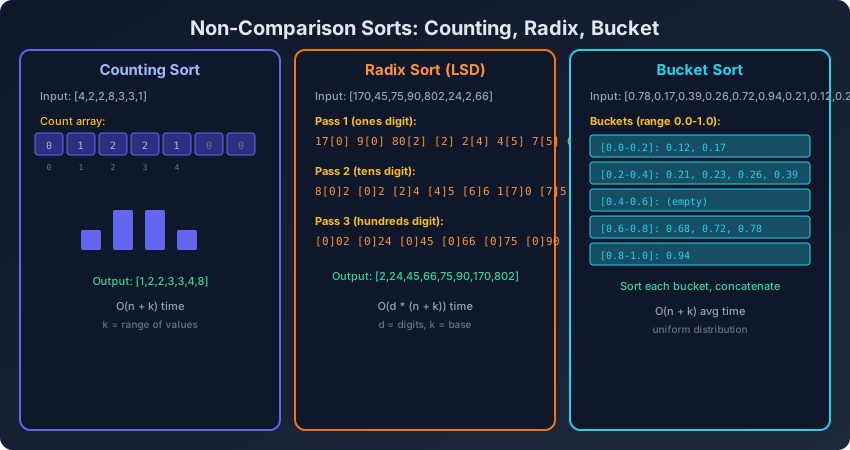
Every comparison-based sorting algorithm — merge sort, quick sort, heap sort — has a lower bound of O(n log n). This is a proven mathematical fact: you cannot determine the order of n elements with fewer than n log n comparisons in the worst case. But what if you do not compare elements at all? Counting sort, radix sort, and bucket sort bypass comparisons entirely, achieving O(n) or near-linear time under the right conditions.
1. The Comparison Sort Lower Bound
Any comparison sort builds a decision tree where each internal node is a comparison and each leaf is a permutation of the input. With n! permutations, the tree needs at least log(n!) = O(n log n) levels. You cannot do better with comparisons.
But non-comparison sorts exploit the structure of the keys (their digits, ranges, or buckets) to sort without pairwise comparisons.
2. Counting Sort
When to use: the values are integers in a known, small range [0, k).
Idea: count how many times each value appears, then place them in order.
def counting_sort(arr, max_val=None):
    """
    Sort an array of non-negative integers using counting sort.

    Time: O(n + k) where k = max value + 1
    Space: O(n + k)
    Stable: Yes

    Args:
        arr: list of non-negative integers
        max_val: maximum value (computed if not given)

    Returns:
        Sorted array.
    """
    if not arr:
        return []

    if max_val is None:
        max_val = max(arr)

    k = max_val + 1

    # Step 1: Count occurrences
    count = [0] * k
    for num in arr:
        count[num] += 1

    # Step 2: Compute cumulative counts (prefix sums)
    for i in range(1, k):
        count[i] += count[i - 1]

    # Step 3: Build output array (iterate right-to-left for stability)
    output = [0] * len(arr)
    for i in range(len(arr) - 1, -1, -1):
        val = arr[i]
        count[val] -= 1
        output[count[val]] = val

    return output


print(counting_sort([4, 2, 2, 8, 3, 3, 1]))
# Output: [1, 2, 2, 3, 3, 4, 8]

print(counting_sort([0, 0, 1, 1, 0, 1]))
# Output: [0, 0, 0, 1, 1, 1]
Simplified Version (When Stability Is Not Needed)
def counting_sort_simple(arr):
    """Simpler counting sort — just count and expand."""
    if not arr:
        return []

    max_val = max(arr)
    count = [0] * (max_val + 1)

    for num in arr:
        count[num] += 1

    result = []
    for val in range(len(count)):
        result.extend([val] * count[val])

    return result


print(counting_sort_simple([4, 2, 2, 8, 3, 3, 1]))
# [1, 2, 2, 3, 3, 4, 8]
Counting Sort with Negative Numbers
def counting_sort_with_negatives(arr):
    """Handle negative integers by shifting."""
    if not arr:
        return []

    min_val = min(arr)
    max_val = max(arr)
    range_size = max_val - min_val + 1

    count = [0] * range_size
    for num in arr:
        count[num - min_val] += 1

    result = []
    for i in range(range_size):
        result.extend([i + min_val] * count[i])

    return result


print(counting_sort_with_negatives([-3, 2, -1, 0, 3, -3, 1]))
# [-3, -3, -1, 0, 1, 2, 3]
When Counting Sort Shines
- Range of values k is O(n) or smaller.
- Used as a subroutine in radix sort.
- Sorting exam scores (0-100), ASCII characters, ages, etc.
When to Avoid
- k is very large (e.g., sorting 64-bit integers by value — would need 2^64 buckets).
- Floating-point numbers (need bucket sort instead).
3. Radix Sort — LSD (Least Significant Digit)
When to use: sorting integers or fixed-length strings by processing one digit/character at a time, from least significant to most significant.
Key requirement: the subroutine sort (for each digit) must be stable — counting sort is the standard choice.
def radix_sort_lsd(arr):
    """
    Sort non-negative integers using LSD radix sort.

    Time: O(d * (n + b)) where d = number of digits, b = base (10)
    Space: O(n + b)
    Stable: Yes

    Uses base-10 digits. Process from least significant to most significant.
    """
    if not arr:
        return []

    max_val = max(arr)

    # Sort by each digit, starting from the least significant
    exp = 1  # current digit place (1s, 10s, 100s, ...)
    result = arr[:]

    while max_val // exp > 0:
        result = _counting_sort_by_digit(result, exp)
        exp *= 10

    return result


def _counting_sort_by_digit(arr, exp):
    """
    Stable sort by the digit at position `exp`.
    E.g., exp=1 sorts by ones digit, exp=10 by tens digit.
    """
    n = len(arr)
    output = [0] * n
    count = [0] * 10  # digits 0-9

    # Count occurrences of each digit
    for num in arr:
        digit = (num // exp) % 10
        count[digit] += 1

    # Cumulative count
    for i in range(1, 10):
        count[i] += count[i - 1]

    # Build output (right-to-left for stability)
    for i in range(n - 1, -1, -1):
        digit = (arr[i] // exp) % 10
        count[digit] -= 1
        output[count[digit]] = arr[i]

    return output


print(radix_sort_lsd([170, 45, 75, 90, 802, 24, 2, 66]))
# [2, 24, 45, 66, 75, 90, 170, 802]

print(radix_sort_lsd([329, 457, 657, 839, 436, 720, 355]))
# [329, 355, 436, 457, 657, 720, 839]
Why LSD Works
Processing digits from right to left seems backwards, but stability is the key. After sorting by the ones digit, all numbers with the same ones digit are in the right relative order. When we then sort by the tens digit (stably), numbers with the same tens digit retain their ones-digit order. By the time we finish the most significant digit, everything is sorted.
4. Radix Sort — MSD (Most Significant Digit)
MSD radix sort processes from the most significant digit first. It works like a recursive bucket sort.
def radix_sort_msd(arr):
    """
    Sort non-negative integers using MSD radix sort.

    Time: O(d * (n + b))
    Space: O(n + b) per recursion level

    Processes from most significant digit to least significant.
    """
    if not arr:
        return []

    max_val = max(arr)
    max_digits = len(str(max_val))

    def _msd_sort(arr, digit_pos):
        """Sort arr by the digit at digit_pos (0 = most significant)."""
        if len(arr) <= 1 or digit_pos >= max_digits:
            return arr

        # Create 10 buckets (one per digit 0-9)
        buckets = [[] for _ in range(10)]

        divisor = 10 ** (max_digits - 1 - digit_pos)
        for num in arr:
            digit = (num // divisor) % 10
            buckets[digit].append(num)

        # Recursively sort each bucket by next digit
        result = []
        for bucket in buckets:
            if len(bucket) > 1:
                result.extend(_msd_sort(bucket, digit_pos + 1))
            else:
                result.extend(bucket)

        return result

    return _msd_sort(arr, 0)


print(radix_sort_msd([170, 45, 75, 90, 802, 24, 2, 66]))
# [2, 24, 45, 66, 75, 90, 170, 802]
LSD vs MSD
| Property | LSD | MSD |
|---|---|---|
| Direction | Right to left | Left to right |
| Stability | Naturally stable | Stable within buckets |
| Best for | Fixed-length keys | Variable-length strings |
| Parallelism | Hard | Natural (independent buckets) |
| Short-circuit | No | Yes (single-element buckets) |
5. Radix Sort for Strings
Radix sort is excellent for sorting strings of equal length (like zip codes, dates, etc.).
def radix_sort_strings(strings, max_len=None):
    """
    Sort fixed-length strings using LSD radix sort.

    Time: O(d * (n + 256)) where d = string length
    Space: O(n)
    """
    if not strings:
        return []

    if max_len is None:
        max_len = max(len(s) for s in strings)

    # Pad shorter strings with null characters
    padded = [s.ljust(max_len, '\0') for s in strings]

    result = padded[:]

    # Process from rightmost character to leftmost
    for pos in range(max_len - 1, -1, -1):
        # Counting sort by character at position `pos`
        count = [0] * 256
        for s in result:
            count[ord(s[pos])] += 1

        for i in range(1, 256):
            count[i] += count[i - 1]

        output = [''] * len(result)
        for i in range(len(result) - 1, -1, -1):
            c = ord(result[i][pos])
            count[c] -= 1
            output[count[c]] = result[i]

        result = output

    # Remove padding
    return [s.rstrip('\0') for s in result]


words = ["cat", "bat", "ant", "car", "bar", "art"]
print(radix_sort_strings(words))
# ['ant', 'art', 'bar', 'bat', 'car', 'cat']
6. Bucket Sort
When to use: values are uniformly distributed over a known range (often floating-point numbers in [0, 1)).
Idea: distribute elements into k buckets, sort each bucket (with insertion sort or any sort), and concatenate.
def bucket_sort(arr, num_buckets=10):
    """
    Sort floating-point numbers in [0, 1) using bucket sort.

    Time: O(n + k) average (when distribution is uniform)
    Space: O(n + k)
    Stable: Depends on subroutine sort

    Worst case: O(n^2) if all elements land in one bucket.
    """
    if not arr:
        return []

    n = len(arr)
    buckets = [[] for _ in range(num_buckets)]

    # Distribute elements into buckets
    for num in arr:
        idx = int(num * num_buckets)
        # Handle edge case: num == 1.0
        if idx == num_buckets:
            idx -= 1
        buckets[idx].append(num)

    # Sort each bucket (insertion sort for small buckets)
    for bucket in buckets:
        bucket.sort()  # or use insertion sort

    # Concatenate
    result = []
    for bucket in buckets:
        result.extend(bucket)

    return result


data = [0.78, 0.17, 0.39, 0.26, 0.72, 0.94, 0.21, 0.12, 0.23, 0.68]
print(bucket_sort(data))
# [0.12, 0.17, 0.21, 0.23, 0.26, 0.39, 0.68, 0.72, 0.78, 0.94]
Bucket Sort for Integers
def bucket_sort_integers(arr, num_buckets=10):
    """
    Bucket sort for integers over an arbitrary range.
    """
    if not arr:
        return []

    min_val = min(arr)
    max_val = max(arr)

    if min_val == max_val:
        return arr[:]

    range_size = max_val - min_val + 1
    bucket_size = max(1, range_size // num_buckets + 1)

    buckets = [[] for _ in range(num_buckets + 1)]

    for num in arr:
        idx = (num - min_val) // bucket_size
        buckets[idx].append(num)

    result = []
    for bucket in buckets:
        bucket.sort()
        result.extend(bucket)

    return result


print(bucket_sort_integers([29, 25, 3, 49, 9, 37, 21, 43]))
# [3, 9, 21, 25, 29, 37, 43, 49]
Maximum Gap Problem (Bucket Sort Application)
def maximum_gap(nums):
    """
    LeetCode 164: Maximum Gap.

    Find the maximum difference between successive elements
    in the sorted form, in O(n) time.

    Key insight: use bucket sort. The maximum gap must be >= ceil((max-min)/(n-1)).
    So if we use buckets of that size, the max gap is between buckets, not within.
    """
    n = len(nums)
    if n < 2:
        return 0

    min_val, max_val = min(nums), max(nums)
    if min_val == max_val:
        return 0

    # Bucket size: gap between buckets >= this value
    bucket_size = max(1, (max_val - min_val) // (n - 1))
    num_buckets = (max_val - min_val) // bucket_size + 1

    # Each bucket stores only min and max
    bucket_min = [float('inf')] * num_buckets
    bucket_max = [float('-inf')] * num_buckets

    for num in nums:
        idx = (num - min_val) // bucket_size
        bucket_min[idx] = min(bucket_min[idx], num)
        bucket_max[idx] = max(bucket_max[idx], num)

    # Maximum gap is the max of (min of current bucket - max of previous bucket)
    max_gap = 0
    prev_max = min_val

    for i in range(num_buckets):
        if bucket_min[i] == float('inf'):
            continue  # empty bucket
        max_gap = max(max_gap, bucket_min[i] - prev_max)
        prev_max = bucket_max[i]

    return max_gap


print(maximum_gap([3, 6, 9, 1]))  # 3
print(maximum_gap([10]))          # 0
7. Stability Analysis
| Algorithm | Stable? | Why |
|---|---|---|
| Counting sort | Yes | Right-to-left output preserves order |
| Radix sort (LSD) | Yes | Uses stable counting sort at each digit |
| Radix sort (MSD) | Yes* | *If stable subroutine is used per bucket |
| Bucket sort | Depends | Stable if subroutine sort is stable |
Stability matters when sorting by multiple keys. Radix sort depends on stability — if the digit-level sort were not stable, LSD radix sort would not work.
8. Comparison of Non-Comparison Sorts
| Algorithm | Time | Space | Stable | Best For |
|---|---|---|---|---|
| Counting Sort | O(n + k) | O(n + k) | Yes | Small range integers |
| Radix Sort (LSD) | O(d(n + b)) | O(n + b) | Yes | Fixed-length integers/strings |
| Radix Sort (MSD) | O(d(n + b)) | O(n + b) | Yes | Variable-length strings |
| Bucket Sort | O(n + k) avg | O(n + k) | Depends | Uniform distribution |
Where:
- k = range of values (counting sort) or number of buckets
- d = number of digits
- b = base (10 for decimal, 256 for characters)
9. Hybrid Sorting Approach
In practice, you combine these techniques:
def smart_sort(arr):
    """
    Choose the best sort based on data characteristics.
    """
    if not arr:
        return []

    n = len(arr)

    if n <= 50:
        # Small array: insertion sort
        result = arr[:]
        for i in range(1, len(result)):
            key = result[i]
            j = i - 1
            while j >= 0 and result[j] > key:
                result[j + 1] = result[j]
                j -= 1
            result[j + 1] = key
        return result

    min_val, max_val = min(arr), max(arr)
    value_range = max_val - min_val

    if value_range <= 2 * n:
        # Small range: counting sort
        return counting_sort_with_negatives(arr)

    max_digits = len(str(max(abs(min_val), abs(max_val))))
    if max_digits <= 10 and min_val >= 0:
        # Moderate number of digits: radix sort
        return radix_sort_lsd(arr)

    # Default: Python's built-in Timsort
    return sorted(arr)


# Test with different data
print(smart_sort([4, 2, 2, 8, 3, 3, 1]))        # counting sort path
print(smart_sort([170, 45, 75, 90, 802, 24, 2]))  # radix sort path
print(smart_sort([3, 1, 4]))                       # insertion sort path
10. Common Interview Applications
Sort by Frequency
def sort_by_frequency(arr):
    """Sort elements by frequency (most frequent first)."""
    from collections import Counter
    freq = Counter(arr)
    max_freq = max(freq.values())

    # Counting sort by frequency
    buckets = [[] for _ in range(max_freq + 1)]
    for num, f in freq.items():
        buckets[f].append(num)

    result = []
    for f in range(max_freq, 0, -1):
        for num in sorted(buckets[f]):
            result.extend([num] * f)

    return result


print(sort_by_frequency([1, 1, 2, 2, 2, 3]))
# [2, 2, 2, 1, 1, 3]
Sort Colors (Dutch National Flag via Counting)
def sort_colors(nums):
    """
    LeetCode 75: Sort Colors.
    Only 3 values (0, 1, 2) — counting sort is perfect.
    """
    count = [0, 0, 0]
    for num in nums:
        count[num] += 1

    idx = 0
    for color in range(3):
        for _ in range(count[color]):
            nums[idx] = color
            idx += 1


colors = [2, 0, 2, 1, 1, 0]
sort_colors(colors)
print(colors)  # [0, 0, 1, 1, 2, 2]
11. Practice Problems
| Problem | Platform | Key Technique |
|---|---|---|
| Sort Colors (LC 75) | LeetCode | Counting sort / DNF |
| Maximum Gap (LC 164) | LeetCode | Bucket sort |
| Sort an Array (LC 912) | LeetCode | Radix sort |
| H-Index (LC 274) | LeetCode | Counting sort |
| Top K Frequent Elements (LC 347) | LeetCode | Bucket sort by frequency |
| Sort Characters By Frequency (LC 451) | LeetCode | Counting + bucket |
| Relative Sort Array (LC 1122) | LeetCode | Counting sort variant |
| Kth Largest Element (LC 215) | LeetCode | Counting sort on range |
Big-O Summary
| Algorithm | Time | Space | Constraint |
|---|---|---|---|
| Counting sort | O(n + k) | O(k) | k = value range |
| Radix sort (LSD) | O(d(n + b)) | O(n + b) | d = digits, b = base |
| Radix sort (MSD) | O(d(n + b)) | O(n + b + d) | recursive stack |
| Bucket sort (avg) | O(n + k) | O(n + k) | uniform distribution |
| Bucket sort (worst) | O(n^2) | O(n + k) | all in one bucket |
Non-comparison sorts are not always faster than O(n log n) sorts — they just shift the complexity from comparisons to the structure of the data. When that structure exists (small range, fixed-width keys, uniform distribution), these algorithms are unbeatable.
Related articles
- DSA Car Fleet Problem — Stack-Based Arrival Time Solution
Solve LeetCode 853 Car Fleet using a stack. Sort by position, compare arrival times, and count fleets. Python solution with visual trace.
- DSA Merge Sort Deep Dive: Divide, Conquer, and Count
Master merge sort — recursive splitting, merging sorted halves, counting inversions, merge sort on linked lists, stability analysis, and O(n log n) guaranteed performance with Python.
- DSA Quick Sort Deep Dive: Partition, Pivot, and QuickSelect
Master quick sort — Lomuto and Hoare partitions, pivot strategies, worst case analysis, Dutch National Flag, QuickSelect for kth element, and comparison with merge sort.
- DSA Sorting Algorithms: Bubble, Insertion, Merge, Quick, Heap
A tour of the five sorting algorithms every programmer should know — their ideas, Big-O time and space, stability, and Python implementations, plus when to just use sort().